Revealing a missing link
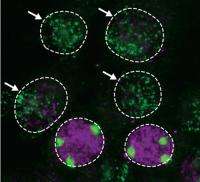
Fluorescence experiments in mouse cells demonstrate that hnRNP U expression is essential to the proper localization of Xist RNA. Arrowheads indicate cells with reduced expression of hnRNP U (purple), resulting in diffuse distribution of Xist (green) rather than the tight X chromosome-associated clusters seen in cells expressing hnRNP U (purple). Credit: 2010 Shinichi Nakagawa
When it comes to genes, its definitely possible to have too much of a good thing. Accordingly, mammalian females have a mechanism that randomly inactivates one of the two X sex chromosomes within each somatic cell nucleus, ensuring that X-linked genes are represented to the same extent as in their single-X-bearing male counterparts.
This process is executed by the product of the Xist gene. Although messenger RNAs typically get exported to the cytoplasm to produce protein, Xist RNA remains in the nucleus and accumulates along the surface of the X chromosome that is to be inactivated, and new findings from a team led by Shinichi Nakagawa at the RIKEN Advanced Science Institute in Wako have provided valuable insights into the mechanism behind this unusual localization.
Their screen of RNA-binding factors revealed a central role for heterogeneous ribonuclear protein U (hnRNP U) in regulating Xist distribution, and this RNA was scattered diffusely throughout the nuclei of cells in which hnRNP U levels were artificially reduced. Closer analysis indicated that hnRNP U acts as an intermediary that binds directly to both RNA and chromosomal DNA and tethers the two together. This physical association appears to be essential to X inactivation; although mouse embryonic stem cells lacking hnRNP U successfully initiated the maturation process, they were significantly more likely to exhibit gene activity from both X chromosomes.
Previous investigations have identified a structural role for hnRNP U within the nucleus, and at least one group has demonstrated that this protein tends to cluster near X chromosomes, although this potential aspect of its function remained unaddressed for the better part of decade. Indeed, Nakagawa was taken aback by its involvement in X inactivation. I was surprised that we came across a factor that has been well-studied in the field of molecular biology rather than a novel gene, he says.
Although Xist is unique in its capacity to engineer the shutdown of an entire chromosome, there are numerous other non-protein-coding RNAs that contribute to the regulation of gene activity at a far smaller scale. Nakagawa hopes that this study will offer a window onto those mechanisms as well. In most cases these non-coding RNAs control neighboring genes on the same chromosome, in a similar manner to Xist, he says, and it is possible that these non-coding RNAs are, in general, also retained around the site of transcription by hnRNP U.
More information: Hasegawa, Y., et al.The matrix protine hnRNP U is required for chromosomal localization of Xist RNA. Developmental Cell 19, 469476 (2010). Article
Provided by RIKEN
-
From lemons to lemonade: Reaction uses carbon dioxide to make carbon-based semiconductor,
28 comments
-
Thioridazine kills cancer stem cells in human while avoiding toxic side-effects of conventional cancer treatments,
3 comments
-
SpaceX private rocket blasts off for space station (Update),
41 comments
-
Climate scientists say they have solved riddle of rising sea,
30 comments
-
Scotland passes turbine test to harness tidal power,
40 comments
-
Why Do Dogs do Strange things...
10 hours ago
-
What does exophillic and endophillic mean in terms of mosquito and their control?
May 24, 2012
-
Semen stains glows under black lights (uv light)?
May 23, 2012
-
Question on Human Chromosome 2
May 23, 2012
-
How important is composition of TBST in diluting antibodies and Western Blotting?
May 22, 2012
-
Does the medulla monitor blood pH
May 20, 2012
- More from Physics Forums - Biology
More news stories
It's in the genes: Research pinpoints how plants know when to flower
Scientists believe they've pinpointed the last crucial piece of the 80-year-old puzzle of how plants "know" when to flower.
8 hours ago |
4 / 5 (5) |
1
|
Researchers solve structure of human protein critical for silencing genes
In a study published in the journal Cell on May 24, Cold Spring Harbor Laboratory (CSHL) scientists describe the three-dimensional atomic structure of a human protein bound to a piece of RNA that "guides" the pr ...
8 hours ago |
5 / 5 (4) |
0
|
Study uncovers secret to speedy burrowing by razor clams
(Phys.org) -- If you look at a razor burrowing clam sitting in a bucket, youd never guess that it could burrow itself down into the soil, much less do it with any speed. Razor clams look like fat straws, ...
Copy of the genetic makeup travels in a protein suitcase
Scientists from the Institute for Physical and Theoretical Chemistry at the University of Bonn have succeeded for the first time in the real time filming of the transport of an important information carrier in biological ...
14 hours ago |
not rated yet |
0
|
'Transformer' protein makes different sized transport pods
These spheres may look almost identical, but subtle differences between them revealed a molecular version of the robots from Transformers. Each sphere is a vesicle, a pod that cells use to transport materials ...
14 hours ago |
not rated yet |
0
Of mice and mental models: Neuroscientific implications of risk-optimized behavior in the mouse
(Medical Xpress) -- Regardless of an organism’s biological complexity, every encephalized animal continuously makes under-informed behavioral choices that can have serious consequences. Despite its ubiquity, ...
Dragon arrives at space station in historic 1st (Update 2)
The privately bankrolled Dragon capsule made a historic arrival at the International Space Station on Friday, triumphantly captured by astronauts wielding a giant robot arm.
Landmark calculation clears the way to answering how matter is formed
(Phys.org) -- An international collaboration of scientists, including Thomas Blum, associate professor of physics, is reporting in landmark detail the decay process of a subatomic particle called a kaon ...
High-speed method to aid search for solar energy storage catalysts
Eons ago, nature solved the problem of converting solar energy to fuels by inventing the process of photosynthesis.
MIT researchers devise new means to synchronize a group of robots (w/ Video)
(Phys.org) -- For several years, roboticists have been working out ways to get a group of robots to perform synchronized activities as demonstrated most often in dance routines. Its not just about trying ...
Researchers demonstrate possible primitive mechanism of chemical info self-replication
(Phys.org) -- When scientists think about the replication of information in chemistry, they usually have in mind something akin to what happens in living organisms when DNA gets copied: a double-stranded molecule ...