The 6-percent solution: How corporations can reduce greenhouse-gas emissions through better planning
Nearly 6 percent of greenhouse gases generated by humans are due to the flow of products to consumers. The good news is that corporations could significantly lower these emissions by systematically analyzing their supply chain logistics, suggests David Simchi-Levi, a professor in MIT's Engineering Systems Division and Department of Civil and Environmental Engineering. The bad news, he adds, is that not enough companies analyze their emissions data in a thorough way.
“This is a big problem,” says Simchi-Levi. “If you just do back-of-the-envelope calculations about logistics, supply chains and emissions, you can arrive at misleading conclusions.”
In his new book, Operations Rules, published this fall by MIT Press, Simchi-Levi outlines a variety of ways companies can improve their logistics — in particular, by using data and analytics to reduce the impact of supply chains on the environment. Consider “food miles,” the distance a food product travels to market, a common statistic aimed at measuring sustainability that is sometimes useful, but sometimes deceptive as well, asserts Simchi-Levi.
“Food miles can be a misleading criteria when you think about the impact on the environment,” says Simchi-Levi. As he recounts in the book, a bottle of domestic wine sent to New York from California has a carbon footprint about 1.8 times that of a bottle of wine imported to New York from France, largely because of the extensive time the California wine will spend being transported by trucks.
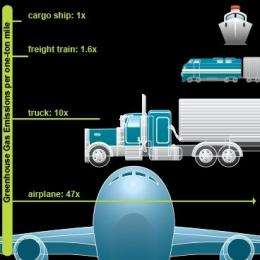
Based on the amount of emissions involved in moving a ton of goods one mile, trucks generate six times as much emissions as rail and 10 times the emissions of container ships. For that matter, long-haul air freight generates 47 times as much emissions per ton-mile as ocean freight.
“Distance does not simply equal a higher carbon footprint,” says Simchi-Levi.
Instead, measuring a product’s carbon footprint involves quantifying several factors, including the emissions produced by particular fuels; the fuel efficiency of each form of transportation; the energy used by distribution centers and the emissions generated by different power-generation technologies (such as coal, natural gas or nuclear power) in those areas; and the emissions resulting from product packaging.
Package deals
Today, firms need to select the appropriate mode of transportation by balancing cost, time and emissions, according to Simchi-Levi. In the past, a retailer that had suppliers in Asia and sold its products on the East Coast of the United States would typically ship products to a port on the West Coast, such as Los Angeles, then truck goods to cities on the East Coast. When oil was cheaper and carbon emissions a lesser concern for logistics managers, this was an appropriate strategy, notes Simchi-Levi. But given higher oil prices and the significant differences in transportation costs and emissions between truck and ocean transportation, he adds, a different strategy should be considered. The same retailer could ship products through the Panama Canal to a port on the East Coast en route to their final destination, which would be ”a cheaper and cleaner distribution strategy” says Simchi-Levi.
A closely related strategy that reduces emissions is to increase the number of distribution centers. In Simchi-Levi’s own modeling, a hypothetical office-furniture company in the United States with national reach would reduce emissions by 33 percent if it had six distribution centers rather than two. And while those additional facilities would use additional energy, this increase would be more than offset by the reduction in the numbers of miles that trucks would have to travel to haul the firm’s goods.
David Simchi-Levi, a professor in MIT's Engineering Systems Division and Department of Civil Engineering, discusses lowering greenhouse emissions generated by humans. Video: Melanie Gonick
Another largely overlooked way to reduce emissions, Simchi-Levi believes, is better packaging. Finding more efficient ways to package goods reduces the space needed to transport them, thus requiring fewer trips — by plane, ship, train or truck — to carry the same quantity of products, while not necessarily costing more.
To be sure, reducing emissions is often at odds with a firm’s bottom-line interests. In many cases, Simchi-Levi writes, “greener performance is achieved at a cost and as a result there are difficult trade-offs to be made.” Many companies find rapid air transport a necessity of competition, which is why they fly goods around the world instead of sending them by sea.
This problem has been accentuated by the trend toward “lean” or just-in-time supply chains, which tend to require more frequent, less energy-efficient deliveries, notes Saif Benjaafar, a professor of mechanical engineering at the University of Minnesota. “A lot of the principles championed by the operations-management community could be questionable when you put an environmental lens on them,” Benjaafar says. Still, he adds, the work of Simchi-Levi and other logistics researchers is showing that even for companies under heavy time pressure, “you can improve sustainability by how you structure your operations.”
For his part, Simchi-Levi believes more firms are now investing in careful analytic studies of their emissions, spurred in part by uncertainty over fuel prices. Those studies may extend to manufacturing operations as well, which account for another 18 percent of human-generated greenhouse gases globally (in addition to those generated by logistics). Partly for this reason, Simchi-Levi is currently starting a new project on the future of manufacturing in the United States; the intention, he says, is to understand how changes in the economy and business environment will affect the United States’ manufacturing footprint.
This story is republished courtesy of MIT News (web.mit.edu/newsoffice/), a popular site that covers news about MIT research, innovation and teaching.
Provided by Massachusetts Institute of Technology


