Milky Way stars move in mysterious ways
November 30, 2010

Milky Way stars move in mysterious ways

Enlarge

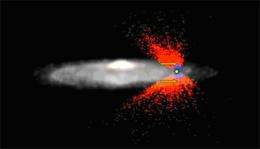
The Sun (in yellow) is located 25,000 light years from the center of the Milky Way. The stars whose velocities were measured by RAVE are shown in red. The arrows show the outward motion observed by the researchers at the Strasbourg Observatory and their colleagues. Credit: Gal Matijevic, Ljubljana University

Rather than moving in circles around the center of the Milky Way, all the stars in our Galaxy are travelling along different paths, moving away from the Galactic center. This has just been evidenced by Arnaud Siebert and Benoit Famaey, astronomers at the Strasbourg Astronomical Observatory, and by their colleagues in other countries. This strange behavior may be due to perturbation caused by the central bar and spiral arms of our Galaxy, forcing stars to leave their normal circular course and take an outward path.

Most galaxies, including our own Milky Way, are spiral-shaped and stars are distributed in a thin disk rotating around the galactic center, with areas divided into or elliptical regions such as the central bar. Due to gravity, the spiral arms move through the disk in the form of density waves. For over twenty years, scientists believed that the potential impact of these density waves on stellar velocities in the was insignificant in comparison with the circular motion of the stars in the galactic disk. This belief has now been blatantly proved wrong by an international team including several researchers from the Strasbourg Astronomical Observatory: near the Earth, stars move towards the exterior of the Galaxy at an average speed of around 10 kilometers per second, which is considerably faster than previously thought.

To reach this conclusion, the team systematically analyzed the velocities of over two hundred thousand stars located within a radius of a little over six thousand light years around the Sun. Using data from the major star survey RAVE (RAdial Velocity Experiment) collected since 2003 by the Australian Astronomical Observatory's Schmidt telescope, they were able to measure for the first time the of hundreds of thousands of stars and determine whether they were moving towards or away from us.

The researchers were thus able to ascertain that the average speed of stars towards the exterior of the Galaxy increases with their distance from the Sun in the direction of the Galactic center, reaching 10 kilometers per second at a distance of 6,000 light years from us (in other words, 19,000 light years from the ). This result was completely unexpected and all the more surprising as it appeared to mainly affect old stars, several billion years old. Until now, it was thought that the spiral arms mostly affected the dynamics of young (only a few tens-of-million-years old). However, theoretical study of the combined effect of the spiral arms and the central bar, both within and outside the plane of the Galaxy, could explain the strange distortions of stellar motion observed by the astronomers in the RAVE team. Watch this space!

More information: “Detection of a radial velocity gradient in the extended local disc with RAVE,” Arnaud Siebert, et al., to be published in Monthly Notices of the Royal Astronomy Society.
The RAVE experiment: http://rave-survey.org/

Provided by CNRS

4.7 /5 (27 votes)  

Filter


Move the slider to adjust rank threshold, so that you can hide some of the comments.


Display comments: newest first

lengould100
Nov 30, 2010

Rank: not rated yet
An incredible result! The relationship between gravity and spiral galaxies just gets stranger and stranger. Density waves. Stars accelerated away form the galaxy with no visible means to re-capture them?

Are the other stars moving away, or is the solar system being "recalled" to the galactic centre?
Tuxford
Nov 30, 2010

Rank: 1.5 / 5 (8)
OR....the stars are moving outward due to their origin. They were formed closer to the galactic center as a result of explosive outbursts from the galactic core. Remember the Fermi bubbles? Remember all the active galactic nuclei we observe? Remember all the new star formation observed near galactic centers? And remember that AGN's are now shown to shut down quickly, in only thousands of years. Hey guys, what about all the dark matter? Isn't that supposed to cause the galaxy to spin???? This is certainly embarrassing.
Tuxford
Nov 30, 2010

Rank: 2.1 / 5 (11)
Paul LaViolette has a cosmological model that predicts this observation. His model includes a finite distance for gravitational influence, maybe 10-20K light years. It includes explosive outbursts like the Fermi bubbles, confirmed in the ice core records. It includes the observed blue-shift of maser signals measured in distant spacecraft (Pioneer Effect). (Watch JPL miss Pluto in a few years.) It explains much more. But then, cling to your notions. I am sure one day, you guys will make it all fit.... I prefer not be so confused.
dtxx
Nov 30, 2010

Rank: 4.3 / 5 (11)
But then, cling to your notions. I am sure one day, you guys will make it all fit.... I prefer not be so confused.


How the hell is anyone clinging to anything here? If that were the case, these results would have been swept under the rug. You are not succesfully making any sort of argument against science when you say that it changes its beliefs to match observations. That's the point, really.
Tuxford
Nov 30, 2010

Rank: 1.7 / 5 (11)
One problem is that current models are bound by accepted physical laws, and 'proven' theories, which, apparently are only approximations and 'proven' for only certain cases. Science is constrained to work within these 'accepted' norms, and those who challenge these viewpoints, are often ignored or ridiculed. This leads to bad cosmology models. First and second thermodynamic laws may be only good approximations, not equivalence, for example. And lack of time dilation in distant quasar data casts serious doubt on relativity and the big bang fantasy.

http://www.physor...752.html

LaViolette predicted this outcome in 2003.
ACTS1038
Nov 30, 2010

Rank: 4.2 / 5 (5)
The most likely explanation is the perturbation caused by the spiral arms.
dtxx
Nov 30, 2010

Rank: 4.5 / 5 (6)
Good luck developing any meaningful or useful theories without some sort of postulate set.

I would say that you criticism is correct to some degree. The copernican principle is a really, really big assumption. But, science adequately addresses this by specifically looking for disproof of the accepted norms. Any scientist would be thrilled to show, for example, laws of thermodynamics do not apply on certain scales. We're talking nobel prize minimum there.
KwasniczJ
Nov 30, 2010

Rank: 1.5 / 5 (16)
It includes the observed blue-shift of maser signals measured in distant spacecraft
It's important information for me - I'll add it to my list of references, because it supports the model, I'm just disputing somewhere else. Blue shift is generally difficult to observe, because of lack or remote reference sources of known frequency (hydrogen signals or remote sources are absorbed with interstellar gas). It's symptomatic, the best informed people are getting downvoted here regularly - it seems, PO attracts trolls reliably.
The Copernican principle is a really, really big assumption.
Actually it's just a subversion of Occam's razor principle. To consider anything else is even bigger assumption.
Tuxford
Nov 30, 2010

Rank: 1 / 5 (7)
LaViolette actually predicted the Pioneer Effect in published paper in mid-eighties. Anyone else predict the effect? JPL announcement in 1998, only after observing the effect since late 80's. He claims his model is within a factor of two of best available data. If so, is this a compelling reason to take a second look??? JPL Juno Mission must correct for the effect, and they still don't have a conclusion? Going to calibrate it out (like the cosmological constant)? Using Earth flyby's to get better data.

ACTS1038
Nov 30, 2010

Rank: 5 / 5 (1)
If not perturbation, take into consideration that theories fall short and become compartmentalized because they don't take into account that space and mass are equally interacting by one fundamental principle C the speed of light which is the constant rate that space and mass interact. Picture the other side to Einstein's E=MCC or E=MVC. Instead of mass, think space E=SVC. Imagine that each quantum of mass interacts with a gradient of space that is equal in energy and is an integral to the constant C (the speed of light). Perhaps, these gradients of space are known as fields and are what makes up space like the colors of a rainbow make up the white light, metaphorically speaking.
Tuxford
Nov 30, 2010

Rank: 1.9 / 5 (9)
LaViolette maintains that red-shift data was confirmed by local inter-stellar measurements, and 'assumed' to be valid over inter-galactic distances. We now know that the standard-candle supernova distance references are a bit suspect. Anyway, in interstellar voids, photons are proposed to loose energy over the vast distance, a violation of the first law. Within the galaxy, with locally higher mass density, photons gain a bit of energy, so slight that it is difficult to observe. In the highest regions of mass density, such as stellar cores, the blue-shifting is greatly augmented, generating energies on par with fusion, resulting in stellar pulsation and cyclic explosions, like we observe. First law is maintained if one considers our universe and open-system, rather than a closed-system. His model includes this point.
omatumr
Nov 30, 2010

Rank: 1.1 / 5 (12)
"Rather than moving in circles around the center of the Milky Way, all the stars in our Galaxy are . . . moving away from the Galactic center."

Neutron repulsion. The energy source that powers the Sun and cosmos. The energy source that causes heavy nuclei to fission, stars to explode, and galactic centers to fragment.

www.youtube.com/w...yLYSiPO0

With kind regards,
Oliver K. Manuel
Former NASA Principal
Investigator for Apollo
MrPressure
Dec 01, 2010

Rank: 1 / 5 (8)
Space dont expanding.

There is no gravity at all.

I mean drawing force.

nucleus of atoms expanding all a time. Nucleus of atoms absorbs more and more en energy all a time and same time expanding nucleus of atoms emit energywaves who have a nature of electrons and particle like photons, if outside coming some energy who interactive with that energy what nucleus of atoms emit.

galaxys born to inside to outside. All stars energy are from galaxy centre huge energyconcentrations who expanding and emit energywaves who have nature of atoms and nature of stars.

Onesimpleprinciple

.
DamienS
Dec 01, 2010

Rank: 4.6 / 5 (9)
Boy, the nuts are certainly out today.

One problem is that current models are bound by accepted physical laws, and 'proven' theories

As opposed to models that are unconstrained by physical laws and observational knowledge?
KwasniczJ
Dec 01, 2010

Rank: 1.2 / 5 (11)
"Rather than moving in circles around the center of the Milky Way, all the stars in our Galaxy are . . . moving away from the Galactic center."
The question is, what such stars are supposed to do, if they're losing their mass due the radiation of matter and emanation of gas in average. Only cold gas can fall to the centre of galaxy, but such gas cannot radiate.
genastropsychicallst
Dec 01, 2010

Rank: 1 / 5 (6)
Eclip S, but Neptune is stronger of all. To be read on my website biopsychica, Albert.
Nik_2213
Dec 04, 2010

Rank: 3 / 5 (2)
Uh, in galactic terms, this could be a local effect caused by density waves of spiral arms...

Whatever, the data looks good enough to renew their grant and look a little further...
Witch9
Dec 04, 2010

Rank: 1 / 5 (2)
if I tie a rope around a rock and the other end to the end of a stick, then twirl the stick above my head, the rock starts moving away from the centre; I don't understand how this principle got so complicated

as above, so below
Skeptic_Heretic
Dec 04, 2010

Rank: 2 / 5 (3)
Anyway, in interstellar voids, photons are proposed to loose energy over the vast distance, a violation of the first law.
Not accurate. EM waves stretch over all lengths of space as the distance between points of space increases while the speed of propagation remains constant. It is basic relativity here.
Tuxford
Dec 05, 2010

Rank: 1.6 / 5 (7)
The big bang is a fantasy, repeated so often it has become dogma. We must stop living in relativist's Disneyland. There is no stretching of nothing. (I am with Tesla on this one.) And relativity is invalid. Too many exceptions, like this one.

http://www.physor...752.html

In SQK, photons do loose energy in the inter-galactic void through an underlying etheric self-sustaining reaction process, that forms the basis of all matter. Depends on local mass density.
Skeptic_Heretic
Dec 05, 2010

Rank: 3.7 / 5 (3)
In SQK, photons do loose energy in the inter-galactic void through an underlying etheric self-sustaining reaction process, that forms the basis of all matter. Depends on local mass density.
SQK?

You mean aether theory?

Caught.
yyz
Dec 05, 2010

Rank: 3.9 / 5 (7)
"You mean aether theory?"

Yeah, but this is LaViolettes personal 'Sub Quantum Kinetics' *theory* that can state, with a straight face "Special and general relativity are disproven by the Sagnac, Silvertooth, and Ampere force law experiments." See other comparisons here: http://www.etheri...K-c.html

More of this goofiness here: http://www.physor...firstCmt

It appears to be nothing more than science by pictures (all his pictures confirm his theories and predictions, of course). Try googling "Paul LaViolette crackpot" for a better look at this guy.
Rank 4.7 /5 (27 votes)
Relevant PhysicsForums posts
  • revamping general concept and cosmological principle
    created3 hours ago
  • Transiting Exoplanet Light Curve
    created13 hours ago
  • Math behind Theoretical Physics
    createdMay 24, 2012
  • Do we know whats at the center of galaxies yet?
    createdMay 23, 2012
  • Structure of the Milky Way?
    createdMay 20, 2012
  • What would it take to terraform Pluto and Charon?
    createdMay 19, 2012
  • More from Physics Forums - General Astronomy

More news stories

Dragon arrives at space station in historic 1st (Update 2)

The privately bankrolled Dragon capsule made a historic arrival at the International Space Station on Friday, triumphantly captured by astronauts wielding a giant robot arm.

Space & Earth / Space Exploration

created 6 hours ago | popularity 5 / 5 (6) | comments 8

SKA super telescope to be built in Australia, South Africa (Update 2)

A long-running joust to host a radio telescope that would give mankind its farthest peek into the Universe ended on Friday with a Solomon-like judgement to split the site between Australia and South Africa.

Space & Earth / Astronomy

created 8 hours ago | popularity 5 / 5 (2) | comments 2

Typhoon Sanvu affecting Iwo To, then expected to fade over weekend

Infrared and visible imagery from NASA's Aqua satellite taken on May 25, 2012, showed an impressive Typhoon Sanvu already affecting the islands of Iwo To and Chichi Jima, Japan. The typhoon is expected to ...

Space & Earth / Earth Sciences

created 2 hours ago | popularity not rated yet | comments 0

NASA sees Hurricane Bud threaten western Mexico's coast

NASA satellites are providing rainfall, temperature, pressure, visible and infrared data to forecasters as Hurricane Bud is expected to make a quick landfall in western Mexico this weekend before turning back ...

Space & Earth / Earth Sciences

created 2 hours ago | popularity not rated yet | comments 0

Get ready for the transit of Venus

Scientists and amateur astronomers around the world are preparing to observe the rare occurrence of Venus crossing the face of the Sun on 5-6 June, an event that will not be seen again for over a hundred years.

Space & Earth / Space Exploration

created 8 hours ago | popularity 5 / 5 (1) | comments 0


Researchers solve structure of human protein critical for silencing genes

In a study published in the journal Cell on May 24, Cold Spring Harbor Laboratory (CSHL) scientists describe the three-dimensional atomic structure of a human protein bound to a piece of RNA that "guides" the pr ...

High-speed method to aid search for solar energy storage catalysts

Eons ago, nature solved the problem of converting solar energy to fuels by inventing the process of photosynthesis.

Yahoo! ditches digital newsstand for iPads

Yahoo! shuttered its fledgling digital newsstand for iPads on Friday in what it said was the start of a product purge intended to make the floundering Internet pioneer more nimble.

Of mice and mental models: Neuroscientific implications of risk-optimized behavior in the mouse

(Medical Xpress) -- Regardless of an organism’s biological complexity, every encephalized animal continuously makes under-informed behavioral choices that can have serious consequences. Despite its ubiquity, ...

Landmark calculation clears the way to answering how matter is formed

(Phys.org) -- An international collaboration of scientists, including Thomas Blum, associate professor of physics, is reporting in landmark detail the decay process of a subatomic particle called a kaon – ...

MIT researchers devise new means to synchronize a group of robots (w/ Video)

(Phys.org) -- For several years, roboticists have been working out ways to get a group of robots to perform synchronized activities as demonstrated most often in dance routines. It’s not just about trying ...