Mars Rover images honor Apollo 12

November 19, 2010

Mars Rover images honor Apollo 12

Enlarge

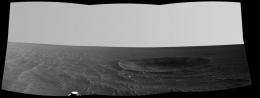
This view of "Intrepid" crater on Mars is presented in false color to make differences in surface materials more visible. NASA's Mars Exploration Rover Opportunity recorded this view of the crater during the 2,417th Martian day, or sol, of the rover's work on Mars (Nov. 11, 2010).

NASA's Mars Exploration Rover Opportunity has visited and photographed two craters informally named for the spacecraft that carried men to the moon 41 years ago this week.

Opportunity drove past "Yankee Clipper" crater on Nov. 4 and reached "Intrepid crater" on Nov. 9. For NASA's , the second mission to put humans onto the moon, the command and service module was called Yankee Clipper, piloted by Dick Gordon, and the lunar module was named Intrepid, piloted by Alan Bean and commanded by the late Pete Conrad. The Intrepid landed on the moon with Bean and Conrad on Nov. 19, 1969, while Yankee Clipper orbited overhead. Their landing came a mere four months after Apollo 11's first lunar landing.

This week, Bean wrote to the team: "I just talked with Dick Gordon about the wonderful honor you have bestowed upon our Apollo 12 spacecraft. Forty-one years ago today, we were approaching the moon in Yankee Clipper with Intrepid in tow. We were excited to have the opportunity to perform some important exploration of a place in the universe other than planet Earth where humans had not gone before. We were anxious to give it our best effort. You and your team have that same opportunity. Give it your best effort."
Mars Rover images honor Apollo 12
Enlarge

"Yankee Clipper" crater on Mars carries the name of the command and service module of NASA's 1969 Apollo 12 mission to the moon. Opportunity recorded this view of the crater during a pause in a 102-meter (365-foot) drive during the 2,410th Martian day of the rover's work on Mars (Nov. 4, 2010). Credit: NASA

Rover science team member James Rice, of NASA's Goddard Space Flight Center, Greenbelt, Md., suggested using the Apollo 12 names. He was applying the rover team's convention of using names of historic ships of exploration for the informal names of craters that Opportunity sees in the Meridian Planum region of Mars.

"The Apollo missions were so inspiring when I was young, I remember all the dates. When we were approaching these craters, I realized we were getting close to the Nov. 19 anniversary for Apollo 12," Rice said. He sent Bean and Gordon photographs that Opportunity took of the two craters.

The images are available online at http://photojourna … log/PIA13593 and http://photojournal.jpl.nasa.gov/catalog/PIA13596 . Intrepid crater is about 20 meters (66 feet) in diameter. Yankee Clipper crater is about half that width.

After a two-day stop to photograph the rocks exposed at Intrepid, Opportunity continued on a long-term trek toward Endeavour crater, a highly eroded crater about 1,000 times wider than Intrepid. Endeavour's name comes from the ship of James Cook's first Pacific voyage.

During a drive of 116.9 meters (383.5 feet) on Nov. 14, Opportunity's "odometer" passed 25 kilometers (15.53 miles). That is more than 40 times the driving-distance goal set for Opportunity to accomplish during its original three-month prime mission in 2004.

Mars Exploration Project Manager John Callas, of NASA's Jet Propulsion Laboratory, Pasadena, Calif., said, "Importantly, it's not how far the rovers have gone but how much exploration and science discovery they have accomplished on behalf of all humankind."

At the beginning of Opportunity's mission, the rover landed inside "Eagle crater," about the same size as Intrepid crater. The team's name for that landing-site crater paid tribute to the lunar module of Apollo 11, the first human landing on the moon. Opportunity spent two months inside Eagle , where it found multiple lines of evidence for a wet environment in the area's ancient past.

The rover team is checking regularly for Opportunity's twin, Spirit, in case the increasing daily solar energy available at Spirit's location enables the rover to reawaken and resume communication. No signal from Spirit has been received since March 22. Spring began last week in the southern hemisphere of Mars.

Provided by JPL/NASA search and more info website

3.7 /5 (3 votes)  

Rank 3.7 /5 (3 votes)
Relevant PhysicsForums posts
  • revamping general concept and cosmological principle
    created9 hours ago
  • Transiting Exoplanet Light Curve
    created19 hours ago
  • Math behind Theoretical Physics
    createdMay 24, 2012
  • Do we know whats at the center of galaxies yet?
    createdMay 23, 2012
  • Structure of the Milky Way?
    createdMay 20, 2012
  • What would it take to terraform Pluto and Charon?
    createdMay 19, 2012
  • More from Physics Forums - General Astronomy

More news stories

Dragon arrives at space station in historic 1st (Update 2)

The privately bankrolled Dragon capsule made a historic arrival at the International Space Station on Friday, triumphantly captured by astronauts wielding a giant robot arm.

Space & Earth / Space Exploration

created 12 hours ago | popularity 5 / 5 (7) | comments 10

Dragon makes history with space station docking

The private company SpaceX made history Friday with the docking of its Dragon capsule to the International Space Station, the most impressive feat yet in turning routine spaceflight over to the commercial ...

Space & Earth / Space Exploration

created 5 hours ago | popularity 4.8 / 5 (6) | comments 0

Aliens don't want to eat us, says former SETI director

Alien life probably isn’t interested in having us for dinner, enslaving us or laying eggs in our bellies, according to a recent statement by former SETI director Jill Tarter.

Space & Earth / Space Exploration

created 13 hours ago | popularity 4.8 / 5 (8) | comments 21

SKA super telescope to be built in Australia, South Africa (Update 2)

A long-running joust to host a radio telescope that would give mankind its farthest peek into the Universe ended on Friday with a Solomon-like judgement to split the site between Australia and South Africa.

Space & Earth / Astronomy

created 13 hours ago | popularity 5 / 5 (5) | comments 2

NASA sees Hurricane Bud threaten western Mexico's coast

NASA satellites are providing rainfall, temperature, pressure, visible and infrared data to forecasters as Hurricane Bud is expected to make a quick landfall in western Mexico this weekend before turning back ...

Space & Earth / Earth Sciences

created 7 hours ago | popularity not rated yet | comments 0


Of mice and mental models: Neuroscientific implications of risk-optimized behavior in the mouse

(Medical Xpress) -- Regardless of an organism’s biological complexity, every encephalized animal continuously makes under-informed behavioral choices that can have serious consequences. Despite its ubiquity, ...

It's in the genes: Research pinpoints how plants know when to flower

Scientists believe they've pinpointed the last crucial piece of the 80-year-old puzzle of how plants "know" when to flower.

High-speed method to aid search for solar energy storage catalysts

Eons ago, nature solved the problem of converting solar energy to fuels by inventing the process of photosynthesis.

Researchers solve structure of human protein critical for silencing genes

In a study published in the journal Cell on May 24, Cold Spring Harbor Laboratory (CSHL) scientists describe the three-dimensional atomic structure of a human protein bound to a piece of RNA that "guides" the pr ...

Landmark calculation clears the way to answering how matter is formed

(Phys.org) -- An international collaboration of scientists, including Thomas Blum, associate professor of physics, is reporting in landmark detail the decay process of a subatomic particle called a kaon – ...

MIT researchers devise new means to synchronize a group of robots (w/ Video)

(Phys.org) -- For several years, roboticists have been working out ways to get a group of robots to perform synchronized activities as demonstrated most often in dance routines. It’s not just about trying ...