Large tree-like sugar clusters provide potential in vivo probes for cancer cells
Nov 26, 2010
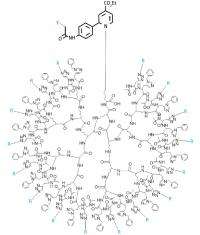
Figure 1: The structure of the tree-like cluster with 16 sugar branches. Reproduced in part, with permission, from Ref. 1 © 2010 Wiley-VCH

Challenges in isolating and synthesizing protein-bound sugar molecules called N-glycans, which help stabilize insulin levels and modulate antibody-dependent immune responses among many other important processes in the body, has limited the investigation of their function and interaction with cultured cells and dissected tissues.

Now, a team led by Yasuyoshi Watanabe and Satoshi Nozaki from the RIKEN Center for Molecular Imaging Science (CMIS), Kobe, Japan, has developed the first series of fluorescent and radioactive probes to track these molecules in living animals, which may eventually be used to track tumors.

According to Nozaki, N-glycans, which contain sialic acid residues, always form clusters in vivo allowing them to maximize their interactions and selectivity towards N-glycan-binding proteins and other . “It is rather rare that a single molecule of N-glycan shows significant biological activity,” he says.

To recreate these in vivo conditions, the researchers worked in close collaboration with Katsunori Tanaka from Osaka University to attach up to 16 sugar molecules to branched lysine oligopeptides, creating the largest tree-like oligosaccharide cluster ever prepared (Fig. 1). After linking the clusters to fluorescent and radioactive labels, they injected the resulting probes into the tail vein of immunodeficient mice.

Positron emission tomography (PET) imaging showed that the number of glycans in the clusters determined their lifetime in vivo. Four- and eight-sugar clusters rapidly disappeared through the kidney in just one hour. Clusters containing 16 N-glycans, however, remained in the body for over four hours before being eliminated through the kidney and the gallbladder—a desirable feature when studying how N-glycans travel in living subjects.

Furthermore, the team discovered that differences in the way the sialic acids are connected to the N-glycans influenced cluster behavior and build up in specific organs. The so-called (2–6)-linked sialic acids stabilized the clusters in serum, leading to their accumulation in the liver through interactions with specific protein receptors. In contrast, their (2–3)-linked congeners rapidly cleared through the bladder. Also, fluorescence imaging revealed that clusters bearing both types of linkages were most fluorescent in the spleen, suggesting their capture by a part of the immune system called the reticuloendothelial system.

The researchers hope to use these clusters as molecular probes for tumors. They are also planning to prepare clusters consisting of three to four different glycans in order to enhance the selectivity of the probes toward tumors and specific organs. “Nobody has done it, but the data shows that we can achieve it,” says Nozaki.

Explore further: RNA capable of catalyzing electron transfer on early earth with iron's help, study says

More information: Tanaka, K., Siwu, E.R.O., Minami, K., Hasegawa, K., Nozaki, S., Kanayama, Y., Koyama, K., Chen, W. C., Paulson, J. C., Watanabe, Y. & Fukase, K. Noninvasive imaging of dendrimer-type N-Glycan clusters: in vivo dynamics dependence on oligosaccharide structure. Angewandte Chemie International Edition 49, 8195–8200 (2010). onlinelibrary.wiley.com/doi/10.1002/anie.201000892/abstract

add to favorites email to friend print save as pdf

Related Stories

Copper-Free Click Chemistry Used in Mice

Jan 19, 2010

(PhysOrg.com) -- For the first time, the widely used molecular synthesis technique known as click chemistry has been safely applied to a living organism. A team of Berkeley Lab and UC Berkeley researchers ...

Carbohydrate acts as tumor suppressor

Jul 06, 2009

Scientists at Burnham Institute for Medical Research (Burnham) have discovered that specialized complex sugar molecules (glycans) that anchor cells into place act as tumor suppressors in breast and prostate cancers. These ...

Going Live With Click Chemistry

Oct 26, 2007

Click chemistry, one of the most exciting and proficient new techniques for labeling biomolecules in vitro, has now been extended to studies in the context of live cells as well. This breakthrough opens the ...

Recommended for you

Attacking MRSA with metals from antibacterial clays

May 17, 2013

In the race to protect society from infectious microbes, the bugs are outrunning us. The need for new therapeutic agents is acute, given the emergence of novel pathogens as well as old foes bearing heightened antibiotic resistance.

Keeping fruit, vegetables and cut flowers fresh longer

May 15, 2013

New technology offers the promise of reducing billions of dollars of losses that occur each year from the silent, invisible killer of fruits, vegetables and cut flowers—a gas whose effects are familiar to everyone who has ...

Why don't beetles freeze in the winter?

May 14, 2013

For 37 years, Queen's University Biochemistry professor Peter Davies has been unraveling the mystery of why some organisms including insects and fish don't freeze in the winter. His research into insect antifreeze protein ...

The molecular basis of strawberry aroma

May 13, 2013

You know that summer is here when juicy red strawberries start to appear on the shelves. In Germany, this seasonal fruit has never been more popular: on average 3.5 kilos per head were consumed in 2012—a ...

A new dimension for 3-D protein structures

May 13, 2013

(Phys.org) —3D structures of biological molecules like proteins directly affect the way they behave in our bodies. EPFL scientists have developed a new infrared-UV laser method to more accurately determine ...

User comments : 1

Adjust slider to filter visible comments by rank

Display comments: newest first

junkd
not rated yet Nov 29, 2010
Reliable supplier, rapid delivery, guarantee!
http://star-of-he..._id=5831

More news stories

Attacking MRSA with metals from antibacterial clays

In the race to protect society from infectious microbes, the bugs are outrunning us. The need for new therapeutic agents is acute, given the emergence of novel pathogens as well as old foes bearing heightened antibiotic resistance.

Beautiful 'flowers' self-assemble in a beaker

By simply manipulating chemical gradients in a beaker of fluid, materials scientists at Harvard have found that they can control the growth behavior of crystals to create precisely tailored structures—such ...

Making gold green: New non-toxic method for mining gold

Northwestern University scientists have struck gold in the laboratory. They have discovered an inexpensive and environmentally benign method that uses simple cornstarch—instead of cyanide—to isolate gold from raw materials ...

Heat-related deaths in Manhattan projected to rise

Residents of Manhattan will not just sweat harder from rising temperatures in the future, says a new study; many may die. Researchers say deaths linked to warming climate may rise some 20 percent by the 2020s, ...

Honeybees trained in Croatia to find land mines

(AP)—Mirjana Filipovic is still haunted by the land mine blast that killed her boyfriend and blew off her left leg while on a fishing trip nearly a decade ago. It happened in a field that was supposedly ...

Mice, gerbils perish in Russia space flight

A number of mice and eight gerbils sent into space in a Russian capsule destined to find out how well organisms can withstand extended flights perished during their journey, scientists said Sunday as the ...