Italy: More building collapses at Pompeii possible
November 8, 2010

Italy: More building collapses at Pompeii possible (AP)

Enlarge

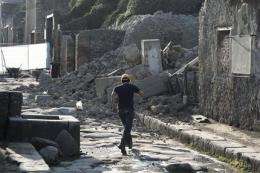
A worker jumps over a puddle among debris in the ancient Roman city of Pompeii, Italy, Saturday, Nov. 6, 2010. Officials say that a house in the ancient Roman city of Pompeii once used by gladiators to train before combat has collapsed. The site was closed at the time and nobody was injured. The office of Pompeii's archaeological superintendent said the collapse occurred Saturday at around 6 a.m. (0500 GMT). Attendants opening the site saw the collapse about an hour later. The 430-square-foot (40-square-meter) space was used by gladiators to train before going to fight in a nearby amphitheater. Pompeii was destroyed in A.D. 79 by an eruption of Mount Vesuvius that killed thousands of people and buried the city in 20 feet (six meters) of volcanic ash. (AP Photo/Salvatore Laporta)

(AP) -- More buildings inside the ancient Roman city of Pompeii could collapse, Italy's culture minister said Sunday, a day after a 2,000-year-old house once used by gladiators disintegrated into rubble.

The collapse Saturday at one of Italy's main tourist attractions was a source of embarrassment for the government and the country. President Giorgio Napolitano said it was a "disgrace for Italy" and demanded an explanation.

Culture Minister Sandro Bondi, who went to Pompeii to survey the damage on Sunday, warned that other buildings could also fall, according to Italian news agencies.

Given the number of buildings that need restoration, further damage is virtually "inevitable," said Daniela Leone, a spokeswoman for Pompeii's archaeological superintendence.

"This is a vast area that requires maintenance, resources," she said.

The house that collapsed on Saturday was used by gladiators to train before going to fight in a nearby amphitheater, as well as by other athletes. It was also a storehouse for weapons and armor.

It was believed to have been built not long before Pompeii was destroyed in A.D. 79 by an eruption of Mount , which killed thousands of people and buried the city in 20 feet (six meters) of .

The house was also partially destroyed during World War II, and the roof and some of the walls had been rebuilt.

Bondi suggested that water infiltration following heavy rains and the heavy roof added during the postwar restoration were to blame.

However, he said some frescoes on the lower parts of the walls may be saved, and urged more government funds for .

©2010 The Associated Press. All rights reserved. This material may not be published, broadcast, rewritten or redistributed.


Rank not rated yet
Relevant PhysicsForums posts

More news stories

Dragon arrives at space station in historic 1st (Update 2)

The privately bankrolled Dragon capsule made a historic arrival at the International Space Station on Friday, triumphantly captured by astronauts wielding a giant robot arm.

Space & Earth / Space Exploration

created 11 hours ago | popularity 5 / 5 (7) | comments 10

Dragon makes history with space station docking

The private company SpaceX made history Friday with the docking of its Dragon capsule to the International Space Station, the most impressive feat yet in turning routine spaceflight over to the commercial ...

Space & Earth / Space Exploration

created 4 hours ago | popularity 4.8 / 5 (6) | comments 0

NASA sees Hurricane Bud threaten western Mexico's coast

NASA satellites are providing rainfall, temperature, pressure, visible and infrared data to forecasters as Hurricane Bud is expected to make a quick landfall in western Mexico this weekend before turning back ...

Space & Earth / Earth Sciences

created 6 hours ago | popularity not rated yet | comments 0

SKA super telescope to be built in Australia, South Africa (Update 2)

A long-running joust to host a radio telescope that would give mankind its farthest peek into the Universe ended on Friday with a Solomon-like judgement to split the site between Australia and South Africa.

Space & Earth / Astronomy

created 12 hours ago | popularity 5 / 5 (5) | comments 2

Aliens don't want to eat us, says former SETI director

Alien life probably isn’t interested in having us for dinner, enslaving us or laying eggs in our bellies, according to a recent statement by former SETI director Jill Tarter.

Space & Earth / Space Exploration

created 12 hours ago | popularity 4.8 / 5 (8) | comments 15


It's in the genes: Research pinpoints how plants know when to flower

Scientists believe they've pinpointed the last crucial piece of the 80-year-old puzzle of how plants "know" when to flower.

High-speed method to aid search for solar energy storage catalysts

Eons ago, nature solved the problem of converting solar energy to fuels by inventing the process of photosynthesis.

Of mice and mental models: Neuroscientific implications of risk-optimized behavior in the mouse

(Medical Xpress) -- Regardless of an organism’s biological complexity, every encephalized animal continuously makes under-informed behavioral choices that can have serious consequences. Despite its ubiquity, ...

Researchers solve structure of human protein critical for silencing genes

In a study published in the journal Cell on May 24, Cold Spring Harbor Laboratory (CSHL) scientists describe the three-dimensional atomic structure of a human protein bound to a piece of RNA that "guides" the pr ...

Landmark calculation clears the way to answering how matter is formed

(Phys.org) -- An international collaboration of scientists, including Thomas Blum, associate professor of physics, is reporting in landmark detail the decay process of a subatomic particle called a kaon – ...

MIT researchers devise new means to synchronize a group of robots (w/ Video)

(Phys.org) -- For several years, roboticists have been working out ways to get a group of robots to perform synchronized activities as demonstrated most often in dance routines. It’s not just about trying ...