Israel's scientists think big with the very, very small
November 9, 2010 by Sara Hussein
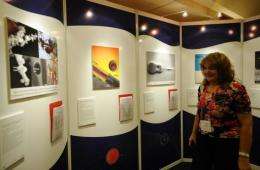
A visitor looks at pictures captured through nano technology at the Nano Israel 2010 conference in Tel Aviv. New drugs and materials have been unveiled at the Nano Israel 2010 conference that has attracted more than 1,500 researchers from around the world who are united in their work with nanotechnology -- the science of manipulating atomic and molecular particles.
A material just one atom thick that is stronger than steel but flexes like rubber. A "mini-submarine" that can trick the immune system and deliver a payload of chemotherapy deep inside a tumour.
They sound like the fantasies of science fiction writers, but they are among the discoveries being presented at Nano Israel 2010, a nanotech conference in Tel Aviv that has attracted researchers from across the science world, united by their work with the very, very small.
The 1,500 participants at the two-day meeting which ends on Tuesday include chemists, physicists and medical researchers, all working with tiny structures around the thickness of a cell wall.
"We are all working to be able to manipulate molecules at an atomic level," said Dan Peer, a professor at Tel Aviv University's Cell Research and Immunology Department.
Physicists are developing new materials by removing or adding to existing structures and nano-medical researchers are building new ways to deliver drugs.
Peer is trying to find out how to more effectively target cancer and the inflammation associated with diseases like multiple sclerosis by better directing toxic treatments like chemotherapy.
"Sometimes the drug is there, but it doesn't operate in a targeted manner," he told AFP.
In such cases, scientists are trying to find ways to build "GPS systems" into the drugs so they travel directly to malignant cells or inflammation.
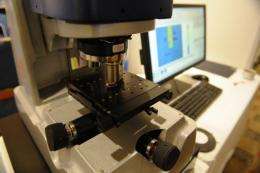
A euro coin is scanned at the Nano Israel 2010 conference in Tel Aviv. The Nano Israel 2010 conference has attracted more than 1,500 researchers from around the world who are united in their work with nanotechnology -- the science of manipulating atomic and molecular particles.
One way of doing that is to attach the cancer treatment to a vitamin that tumours happily suck up, allowing the medication to penetrate the malignant cells with ease."You can potentially create new materials, new vehicles for drugs, like very small bubbles, like mini-submarines, which carry them into the body," Peer told AFP.
Joseph Kost, a professor at Ben Gurion University of the Negev's chemical engineering department, is working on a technique that delivers chemotherapy drug Cisplatin into tumours.
The drug is carried by a tiny vessel through gaps of between 100-1000 nanometres in size, giving scientists a "therapeutic warhead," he said.
Once inside, researchers irradiate the drug vehicles with ultrasound, causing them to "explode" and disperse the treatment inside the tumour.
Others are looking at ways to trick the body's immune system to prevent it from identifying drug treatments as invading viruses and attacking them.
Elsewhere, physicists like Andre Geim, winner of this year's Nobel Prize for Physics, are using nanotechnology to develop new materials with a surprising range of applications.
Geim, a Russian scientist working in Britain, presented his work on graphene, a one-atom-thick slice of graphite that is stiffer than diamond.
"You can imagine you can make a thousand devices out of this graphene," he told an audience of researchers from 35 countries, whose work could one day produce more efficient conductors and roll-up touchscreens for computers.
Graphene's structure could even allow it to be used for faster DNA sequencing, Geim said.
For Israel, hosting the gathering of nano-researchers is a way of showcasing a sector that the government is trying to foster.
"We see this as a major economic initiative for the future of Israel," said Barry Breen, a spokesman for Israel's National Nanotechnology Initiative, a government advisory body. "It should be a dominant economic engine."
INNI works to match Israel's nanotech researchers with private industry.
A recent project saw Jerusalem-based company 3G Solar work with scientists at Bar Ilan University to develop a solar cell that processes energy in a similar way to photosynthesis in plants.
Aharon Gedanken, a professor of chemistry at Bar Ilan University, is using nanotechnology to develop sterile hospital sheets and robes using a technique called sonochemistry.
The process uses a chemical reaction that produces "microjets," which throw out nanoparticles of anti-bacterial metals like zinc oxide at "such a high speed that they are embedded in the surface."
The resulting fabric can be washed, even at the hospital standard of 92 degrees Celsius (197.6 degrees Fahrenheit), without losing its anti-bacterial properties.
"The vision of this project is that in the future all the fabrics in a hospital will be anti-bacterial," he said.
(c) 2010 AFP
-
From lemons to lemonade: Reaction uses carbon dioxide to make carbon-based semiconductor,
28 comments
-
Every black hole contains a new universe: A physicist presents a solution to present-day cosmic mysteries,
216 comments
-
New silicon memory chip developed,
16 comments
-
Thioridazine kills cancer stem cells in human while avoiding toxic side-effects of conventional cancer treatments,
3 comments
-
SpaceX private rocket blasts off for space station (Update),
41 comments
-
Density question
May 24, 2012
-
Mass transport originating from a point source at a solid gas interface
May 22, 2012
-
Ammonia dispersion in Air
May 22, 2012
-
Multi Choice Help
May 21, 2012
-
index of refraction and thickness of materials
May 18, 2012
-
Solar battery maintainer for car
May 17, 2012
- More from Physics Forums - Materials & Chemical Engineering
More news stories
Synthetic nano-waste does not disappear
(Phys.org) -- Tiny particles of cerium oxide do not burn or change in the heat of a waste incineration plant. They remain intact on combustion residues or in the incineration system, as a new study by Swiss ...
Nanotechnology / Bio & Medicine
13 hours ago |
5 / 5 (1) |
1
|
Nanotechnology for solar energy conversion systems
EU researchers extensively characterised the self-organisation of nanotubes and developed novel compositions particularly appropriate to solar energy conversion applications.
Nanotechnology / Nanomaterials
11 hours ago |
not rated yet |
0
Nano-structured polymer-based materials from scrap
EU researchers developed polymer blends and processing techniques facilitating recovery of scrap from industrial processes. Advances in this area have the potential to decrease costs and waste while protecting ...
Nanotechnology / Nanomaterials
12 hours ago |
not rated yet |
0
Dopant gives graphene solar cells highest efficiency yet
(Phys.org) -- By taking advantage of graphenes favorable electrical and optical properties, and then adding an organic dopant, researchers have achieved the highest power conversion efficiency yet for ...
Nanomedicine: Quantum dots appear safe in pioneering study on primates
A pioneering study to gauge the toxicity of quantum dots in primates has found the tiny crystals to be safe over a one-year period, a hopeful outcome for doctors and scientists seeking new ways to battle diseases ...
Nanotechnology / Bio & Medicine
May 20, 2012 |
4.3 / 5 (3) |
8
|
It's in the genes: Research pinpoints how plants know when to flower
Scientists believe they've pinpointed the last crucial piece of the 80-year-old puzzle of how plants "know" when to flower.
High-speed method to aid search for solar energy storage catalysts
Eons ago, nature solved the problem of converting solar energy to fuels by inventing the process of photosynthesis.
Of mice and mental models: Neuroscientific implications of risk-optimized behavior in the mouse
(Medical Xpress) -- Regardless of an organism’s biological complexity, every encephalized animal continuously makes under-informed behavioral choices that can have serious consequences. Despite its ubiquity, ...
Researchers solve structure of human protein critical for silencing genes
In a study published in the journal Cell on May 24, Cold Spring Harbor Laboratory (CSHL) scientists describe the three-dimensional atomic structure of a human protein bound to a piece of RNA that "guides" the pr ...
Dragon arrives at space station in historic 1st (Update 2)
The privately bankrolled Dragon capsule made a historic arrival at the International Space Station on Friday, triumphantly captured by astronauts wielding a giant robot arm.
Landmark calculation clears the way to answering how matter is formed
(Phys.org) -- An international collaboration of scientists, including Thomas Blum, associate professor of physics, is reporting in landmark detail the decay process of a subatomic particle called a kaon ...
