A greenhouse in space
November 10, 2010

A greenhouse in space

Enlarge

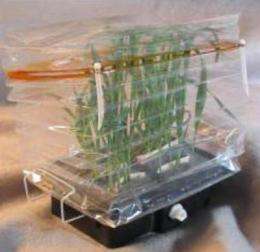
MagISStra greenhouse. Credits: ESA

(PhysOrg.com) -- It's small, but it's a greenhouse for space voyagers – and for you. Paolo Nespoli will take a special greenhouse with him to the International Space Station and he’s inviting young science enthusiasts to conduct an experiment with him.

Growing plants in space will be crucial for the astronauts of the future. When flying to Mars or even further, it will be necessary to produce fresh food onboard and become partially self-sufficient. Setting up greenhouses on the Moon, Mars or other planetary bodies will also be an important part of future exploration missions.

Greenhouses also provide oxygen and bring some life to the bleakness of space. Caring for plants is a good way to maintain memories of Earth and an enjoyable way to pass time during the long and possibly boring interplanetary cruise.

Plants aboard the ISS

There is no danger of boredom during Paolo’s MagISStra mission, as it will be packed with activity and science. The ‘ in space’ project, proposed and conceived by ESA’s Directorate of , is not only a scientific experiment but also an educational opportunity for schoolchildren aged between 12 and 14.

Paolo will use a specially-developed greenhouse in space to grow plants and make observations of the life cycle of a flowering plant. The schoolchildren will be able to follow this with their own experiment on the ground, using a similar greenhouse and the same species of plant.

The experiment starts with watering of some thale cress (Arabidopsis thaliana) set up in the International Space Station’s Columbus laboratory. The children will start their own ground experiments at the same time.

Paolo will take still images of the growth cycle and video recordings of key steps in the germination of the plants and post them on the MagISStra website. The participating children will be able to compare the space experiment with their ground experiment.

The young scientists on the ground and Paolo in orbit will follow the growth cycle of their flowering plants for about 10 weeks. The children will be encouraged to exchange their observations with each other over this period, creating a Europe-wide network that enables one experiment to link young scientists together in a special way.

Order your own greenhouse

Schools who wish to participate in this experiment can order their mini greenhouse ground kits from the ESA's Human Spaceflight education website, where there are limited numbers available.

The instructions can be downloaded in 13 languages from ESA's Human Spaceflight education website as from January 2011.
A greenhouse in space
Enlarge

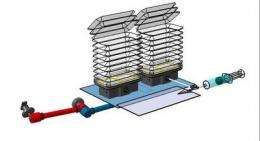
Drawing of the MagISStra greenhouse. Credits: ESA

The children will be invited to send their end results and observations to the ESA Human Space Flight education team, who will create a final lesson online for download by other schools and teachers.

The experiment will be launched in mid February 2011 with a live event linking together nearly 750 children in four locations in Europe: the European Astronaut Centre in Cologne, Germany; ESRIN in Frascati, Italy; Cité de l’Espace in Toulouse, France; and Ciência Viva – Agência Nacional para a Cultura Científica e Tecnológica in Lisbon, Portugal.

Paolo will of course particpate in the event from the station which will have its own minature greenhouse.

Provided by European Space Agency search and more info website

3.9 /5 (7 votes)  

Rank 3.9 /5 (7 votes)
Relevant PhysicsForums posts
  • revamping general concept and cosmological principle
    created3 hours ago
  • Transiting Exoplanet Light Curve
    created13 hours ago
  • Math behind Theoretical Physics
    createdMay 24, 2012
  • Do we know whats at the center of galaxies yet?
    createdMay 23, 2012
  • Structure of the Milky Way?
    createdMay 20, 2012
  • What would it take to terraform Pluto and Charon?
    createdMay 19, 2012
  • More from Physics Forums - General Astronomy

More news stories

Dragon arrives at space station in historic 1st (Update 2)

The privately bankrolled Dragon capsule made a historic arrival at the International Space Station on Friday, triumphantly captured by astronauts wielding a giant robot arm.

Space & Earth / Space Exploration

created 6 hours ago | popularity 5 / 5 (6) | comments 8

Typhoon Sanvu affecting Iwo To, then expected to fade over weekend

Infrared and visible imagery from NASA's Aqua satellite taken on May 25, 2012, showed an impressive Typhoon Sanvu already affecting the islands of Iwo To and Chichi Jima, Japan. The typhoon is expected to ...

Space & Earth / Earth Sciences

created 1 hour ago | popularity not rated yet | comments 0

NASA sees Hurricane Bud threaten western Mexico's coast

NASA satellites are providing rainfall, temperature, pressure, visible and infrared data to forecasters as Hurricane Bud is expected to make a quick landfall in western Mexico this weekend before turning back ...

Space & Earth / Earth Sciences

created 1 hour ago | popularity not rated yet | comments 0

SKA super telescope to be built in Australia, South Africa (Update 2)

A long-running joust to host a radio telescope that would give mankind its farthest peek into the Universe ended on Friday with a Solomon-like judgement to split the site between Australia and South Africa.

Space & Earth / Astronomy

created 7 hours ago | popularity 5 / 5 (2) | comments 2

Get ready for the transit of Venus

Scientists and amateur astronomers around the world are preparing to observe the rare occurrence of Venus crossing the face of the Sun on 5-6 June, an event that will not be seen again for over a hundred years.

Space & Earth / Space Exploration

created 8 hours ago | popularity 5 / 5 (1) | comments 0


Yahoo! ditches digital newsstand for iPads

Yahoo! shuttered its fledgling digital newsstand for iPads on Friday in what it said was the start of a product purge intended to make the floundering Internet pioneer more nimble.

Of mice and mental models: Neuroscientific implications of risk-optimized behavior in the mouse

(Medical Xpress) -- Regardless of an organism’s biological complexity, every encephalized animal continuously makes under-informed behavioral choices that can have serious consequences. Despite its ubiquity, ...

Math predicts size of clot-forming cells

UC Davis mathematicians have helped biologists figure out why platelets, the cells that form blood clots, are the size and shape that they are. Because platelets are important both for healing wounds and in strokes and other ...

Skp2 activates cancer-promoting, glucose-processing Akt

HER2 and its epidermal growth factor receptor cousins mobilize a specialized protein to activate a major player in cancer development and sugar metabolism, scientists report in the May 25 issue of Cell.

MIT researchers devise new means to synchronize a group of robots (w/ Video)

(Phys.org) -- For several years, roboticists have been working out ways to get a group of robots to perform synchronized activities as demonstrated most often in dance routines. It’s not just about trying ...

Landmark calculation clears the way to answering how matter is formed

(Phys.org) -- An international collaboration of scientists, including Thomas Blum, associate professor of physics, is reporting in landmark detail the decay process of a subatomic particle called a kaon – ...