Ears tuned to water
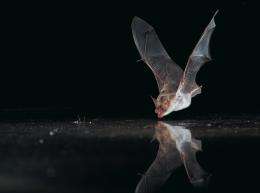
(PhysOrg.com) -- For bats any smooth, horizontal surface is water. Even so if vision, olfaction or touch tells them it is actually a metal, plastic or wooden plate. Bats therefore rely more on their ears than on any other sensory system. This is due to how smooth surfaces reflect the echolocation calls of bats: they act just like mirrors. In nature there are no other extended, smooth surfaces, so these mirror properties prove to be a reliable feature for recognition of water surfaces.
Scientists from the Max Planck Institute for Ornithology in Seewiesen investigated this phenomenon in 15 different species from three big bat families and found that all tried to drink from smooth plates. In addition they found that this acoustic recognition of water is innate. (Published in Nature Communications November, 2nd 2010).
Water is important for bats to get a drink. However many species also use rivers, lakes or ponds for foraging as water insects are soft and easily digestible. In addition prey is easily detectable with echolocation as the water surface acts like a mirror, reflecting the calls back almost completely. Only if there is an insect on the surface, it reflects back an echo.
In their study Stefan Greif and Björn Siemers from the Max Planck Institute for Ornithology simulated water surfaces in a large flight room and offered the bats a smooth and a structured plate each from either metal, wood or plastic. In weak red illumination the researchers observed whether the bats would fall for this trick and try to drink from the smooth plate. They could hardly believe what they saw: "The Schreiber’s bat tried to drink up to a hundred times in ten minutes from the smooth plate", says Stefan Greif. Three different species - the greater mouse-eared bat, the Daubenton’s bat and the greater horseshoe bat - showed the same results on all three materials. Only from the wooden plates some bats tried to drink a little less. To test how widespread this behaviour is, the scientists tested 11 additional species with one individual each on the metal plate - likewise with a positive result. At least with the insect eating bats this behaviour thus seems to be wide spread.
.jpeg "Fig. 2 A Schreiber’s bat (Miniopterus schreibersii), trying to drink from a smooth metal plate. Image: Stefan Greif, MPI f. Ornithology")
The researchers were astonished that the animals did not learn that these artificial, acoustic mirrors are not water surfaces. They observed bats that accidentally landed on the smooth plate, took off again and after a few rounds flying resumed their drinking attempts. Even when the scientists placed the plate on a garden table, the bats flew partly underneath the table and then tried to drink, although this certainly is not a natural situation for a pond.
The association of a smooth, horizontal surface with water seems to be hardwired in the bat’s brain. Nevertheless, how do they process the contradictory information coming from other sensory systems? Only in the world of echolocation the metal plate corresponds to water, other sensory systems like vision, olfaction and touch surely tell the bat otherwise. The researchers repeated their experiment in darkness, thereby eliminating the input of vision. The result: the number of drinking attempts increased from 100 to 160 in ten minutes. "So it seems like the bats integrate and weigh up their sensory information, but echolocation dominates all the others", explains Stefan Greif.
Finally the scientists wanted to know if the acoustic information on water is fixed already in the animals’ genes. They repeated the experiment with juveniles who had never seen a lake or a river before. Flightless juveniles were captured in a cave together with their mothers and were raised until they were able to fly. These young bats likewise tried to drink on first contact in their life with a smooth surface. The behaviour therefore seems to be not learned but innate.
In nature, all smooth horizontal surfaces might be bodies of water, but what about all those man-made smooth surfaces like skylights, car roofs or winter gardens? If bats so persistently take horizontal mirrors for water, do they also try to drink from these artificial surfaces until exhausted? This question remains so far unanswered. "We think that bats in nature have other possibilities. They show high site fidelity and probably have their established water surfaces. Maybe they try new surfaces, but eventually they will move on", speculates Stefan Greif. Future studies are needed to evaluate the occurrence, extent and potential ecological consequences of such a scenario.
More information: Stefan Greif & Björn Siemers, Innate recognition of water bodies in echolocating bats, Nature Communications. Published online November 2nd, 2010
Provided by Max-Planck-Gesellschaft


