Researchers discover baby sauropod tracks
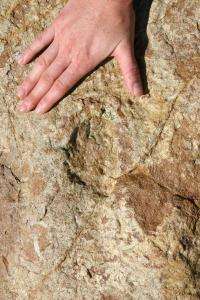
Staff at the Morrison Natural History Museum have again discovered infant dinosaur footprints in the foothills west of Denver, Colorado, near the town of Morrison. Dating from the Late Jurassic, some 148 million years ago, these tracks were made before the Rocky Mountains rose, when Morrison was a broad savanna full of dinosaurs.
The fossil tracks represent infant sauropods, according to discoverer Matthew Mossbrucker, the museum's director. Sauropods are giant, herbivorous long-necked dinosaurs, sometimes known as "brontosaurs." The sauropod Apatosaurus was first discovered in Morrison in 1877. As long as three school buses parked end to end, and weighing as much as eight Asian elephants combined, Apatosaurus is the largest dinosaur found in the Denver metro area.
Information regarding the new tracks will be presented at the 2010 Geologic Society of America Annual Meeting & Exposition in Denver on Monday, 1 November.
In 1877, Arthur Lakes uncovered the very first apatosaurs - three skeletons of the 30-ton giant that was named Apatosaurus ajax. Later discoveries in Wyoming and Utah proved that sauropods were among the dominant giant herbivores in the Late Jurassic.
Lakes was brilliant - he scrutinized the soft grey-green mudrock and the granite-hard sandstone at the Town of Morrison and recovered great blocks of stone filled with bone. But he did miss some things. He didn't realize that the top of the bone layer was churned by dinosaur feet.
Leading paleontologist Dr. Robert T. Bakker of the Houston Museum of Natural Sciences (who also serves as the Morrison Museum's volunteer curator of paleontology) remarks, "The latest discovery by the Morrison Natural History Museum is a tribute to Director Matt Mossbrucker and his crew of sharp-eyed volunteers. Never before has science given us such an intimate glimpse of baby brontosaurs - a window into Jurassic Family Values."
"Three years ago the Morrison Museum crew detected adult and baby Stegosaurus, hinting that the area had been near a stego nesting ground. The new baby sauropod tracks may well be the very smallest, youngest apatosaurs ever discovered, in the form of bone or trackways. Was Morrison an apatosaur nursery? The evidence is fascinating," muses Bakker.
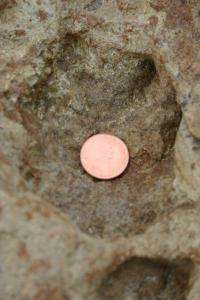
The tracks are ovular and can be nearly eclipsed by a coffee mug, suggesting that the infant sauropods were about the size of a small dog. While one animal left average walking footprints, another infant dinosaur ran parallel to adult tracks.
The running trackway is unusual. "The distance between each step is two–times wider than what we observe in walking tracks indicating the animal was at a low speed run," remarks Mossbrucker. "I am not aware of any running sauropod tracks anywhere." Nor is Bakker.
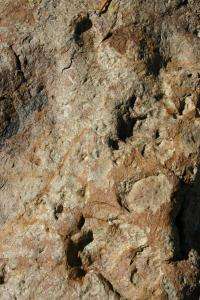
Mossbrucker jokes that the diminutive dinosaur was "the world's fastest long-neck." How fast is unknown, but Mossbrucker thinks his brood of four kids wouldn't have a problem catching up to "Speedy the Sauropod."
Surprising to Mossbrucker and colleagues is that the running trackway demonstrates only hindpaw tracks. "Perhaps while the little dinosaur was running the hindpaw eclipsed and crushed the frontpaw track leaving no trace, or perhaps this critter was running only on its hind paws," Mossbrucker states. The walking-gait tracks do show a forepaw track.
Tail drag troughs are absent on both trackways, which is not surprising, because most sauropod trackways do not show a tail drag mark. This evidence, combined with detailed studies of the tail point, lead researchers to believe that sauropod tails were carried off the ground.
"In the end, we might have a baby sauropod that is running like a Basilisk lizard, a modern lizard that is mostly a quadroped, but when spooked it runs on its hindlegs." Studies are underway to understand the biomechanics of Morrison's sauropods and what a running baby sauropod would look like.
Although collected five years ago, these tracks were a part of a backlog of new discoveries made by Museum staff. The continuous stream of discoveries coming from the Morrison Museum lab demonstrates that an energetic small natural history institution can make unique contributions to science and science education.
The tracks are on permanent display at the Morrison Natural History Museum in the recently redesigned "Fossils of the Foothills" exhibition funded by Scientific and Cultural Facility District (SCFD) grants. The Museum is open daily.
More information: gsa.confex.com/gsa/2010AM/fina … /abstract_182427.htm
Provided by Geological Society of America


