Atoms-for-Peace: A galactic collision in action (w/ Video)
November 10, 2010

Atoms-for-Peace: A galactic collision in action

Enlarge

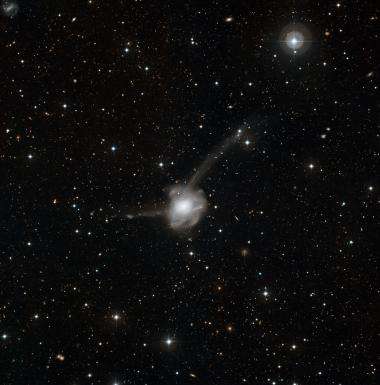
This new image shows the results of a vast collision between two galaxies. This strange object is known as NGC 7252, or Arp 226, and has the odd nickname Atoms-for-Peace. The picture was taken by the Wide Field Imager on the MPG/ESO 2.2-meter telescope at ESO's La Silla Observatory in Chile. It is a combination of exposures taken through blue and red filters, for a total exposure time of more than four hours. The field of view is about 18 arcminutes across. Credit: ESO

(PhysOrg.com) -- European Southern Observatory astronomers have produced a spectacular new image of the famous Atoms-for-Peace galaxy (NGC 7252). This galactic pile-up, formed by the collision of two galaxies, provides an excellent opportunity for astronomers to study how mergers affect the evolution of the Universe.

Atoms-for-Peace is the curious name given to a pair of interacting and merging galaxies that lie around 220 million light-years away in the constellation of Aquarius. It is also known as NGC 7252 and Arp 226 and is just bright enough to be seen by amateur astronomers as a very faint small fuzzy blob. This very deep image was produced by ESO's Wide Field Imager on the MPG/ESO 2.2-metre telescope at ESO's La Silla Observatory in Chile.

A is one of the most important processes influencing how our Universe evolves, and studying them reveals important clues about galactic ancestry. Luckily, such collisions are long drawn-out events that last hundreds of millions of years, giving astronomers plenty of time to observe them.

This video is not supported by your browser at this time.

In this pan sequence we take a closer look at a new image showing the results of a vast collision between two galaxies. This strange object is known as NGC 7252, or Arp 226, and has the odd nickname Atoms-for-Peace. The picture has been taken with the Wide Field Imager on the MPG/ESO 2.2-metre telescope at ESO’s La Silla Observatory in Chile. It is a combination of exposures taken through blue and red filters, for a total exposure time of more than four hours. (ESO)

This picture of Atoms-for-Peace represents a snapshot of its collision, with the chaos in full flow, set against a rich backdrop of distant galaxies. The results of the intricate interplay of gravitational interactions can be seen in the shapes of the tails made from streams of stars, gas and dust. The image also shows the incredible shells that formed as gas and stars were ripped out of the and wrapped around their joint core. While much material was ejected into space, other regions were compressed, sparking bursts of star formation. The result was the formation of hundreds of very young , around 50 to 500 million years old, which are speculated to be the progenitors of globular clusters.

Atoms-for-Peace may be a harbinger of our own galaxy's fate. predict that in three or four billion years the Milky Way and the will collide, much as has happened with Atoms-for-Peace. But don't panic: the distance between stars within a galaxy is vast, so it is unlikely that our Sun will end up in a head-on collision with another star during the merger.

The object's curious nickname has an interesting history. In December 1953, President Eisenhower gave a speech that was dubbed Atoms for Peace. The theme was promoting nuclear power for peaceful purposes — a particularly hot topic at the time. This speech and the associated conference made waves in the scientific community and beyond to such an extent that NGC 7252 was named the Atoms-for-Peace galaxy. In many ways, this is oddly appropriate: the curious shape that we can see is the result of two galaxies merging to produce something new and grand, a little like what occurs in nuclear fusion. Furthermore, the giant loops resemble a textbook diagram of electrons orbiting an atomic nucleus.

Provided by ESO search and more info website

3.5 /5 (8 votes)  

Rank 3.5 /5 (8 votes)
Relevant PhysicsForums posts

More news stories

SKA super telescope to be built in Australia, South Africa

Australia and South Africa will share the location for the world's most powerful radio telescope, the Square Kilometre Array's scientific consortium announced on Friday.

Space & Earth / Astronomy

created 35 minutes ago | popularity not rated yet | comments 0

ESA: Unveiling Venus

With Venus about to get its day in the Sun — very much literally — the European Space Agency has assembled an excellent video about our planetary neighbor.

Space & Earth / Space Exploration

created 36 minutes ago | popularity not rated yet | comments 0

Aliens don't want to eat us, says former SETI director

Alien life probably isn’t interested in having us for dinner, enslaving us or laying eggs in our bellies, according to a recent statement by former SETI director Jill Tarter.

Space & Earth / Space Exploration

created 33 minutes ago | popularity 5 / 5 (1) | comments 0

Dragon capsule on course for space station arrival

The privately bankrolled Dragon capsule approached the International Space Station for a historic docking Friday after sailing through a practice rendezvous the day before.

Space & Earth / Space Exploration

created 1 hour ago | popularity 5 / 5 (2) | comments 1

Sea sponges could act as early warning system

(Phys.org) -- Sea sponges may hold clues to climate change and other impending environmental risks, researchers from Flinders University believe.

Space & Earth / Environment

created 1 hour ago | popularity not rated yet | comments 0


Of mice and mental models: Neuroscientific implications of risk-optimized behavior in the mouse

(Medical Xpress) -- Regardless of an organism’s biological complexity, every encephalized animal continuously makes under-informed behavioral choices that can have serious consequences. Despite its ubiquity, ...

Researchers demonstrate possible primitive mechanism of chemical info self-replication

(Phys.org) -- When scientists think about the replication of information in chemistry, they usually have in mind something akin to what happens in living organisms when DNA gets copied: a double-stranded molecule ...

Researchers identify key brain cell in antidepressant action

(Medical Xpress) -- Antidepressant medications such as Prozac have helped improve mood and lessen anxiety in millions of people with major depression. But scientists know surprisingly little about how these drugs work.

Looking out for the Myanmar snub-nosed monkey

A new genetic study has shed light on how the newly discovered Myanmar snub-nosed monkey evolved.

Alibaba.com $2.5B privatization bid approved

(AP) -- Chinese e-commerce firm Alibaba Group's $2.5 billion bid to take its Hong Kong-listed unit private was cleared Friday by minority shareholders, easing the way for CEO Jack Ma to gain more control over his company's ...

New prostate cancer screening guidelines face a tough sell, study suggests

(Medical Xpress) -- Recent recommendations from the U.S. Preventive Services Task Force (USPSTF) advising elimination of routine prostate-specific antigen (PSA) screening for prostate cancer in healthy men are likely to encounter ...