ARMAR-III, the robot that learns via touch (w/ Video)
Nov 17, 2010 by Lin Edwards report

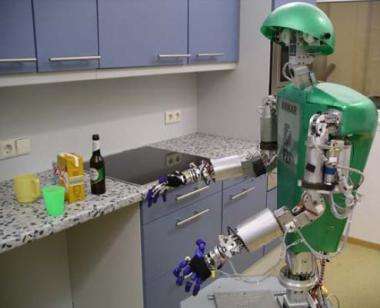
(PhysOrg.com) -- Researchers in Europe have created a robot that uses its body to learn how to think. It is able to learn how to interact with objects by touching them without needing to rely on a massive database of instructions for every object it might encounter.

The is a product of the Europe-wide PACO-PLUS research project and operates on the principle of “embodied cognition,” which relies on two-way communication between the robot’s sensors in its hands and “eyes” and its processor. Embodied cognition enables AMAR to solve problems that were unforeseen by its programmers, so when faced with a new task it investigates ways of moving or looking at things until the processor makes the required connections.

AMAR has learned to recognize common objects to be found in a kitchen, such as cups of various colors, plates, and boxes of cereal, and it responds to commands to interact with these objects by fetching them or placing them in a dishwasher, for example. One example of the tasks AMAR has learned to carry out is setting a table, and it is able to do this even if a cup is placed in its way. The robot worked out that the cup was in the way, was movable, and would be knocked over if left in the way, and so it moved the cup out of the way before continuing with its task.

This video is not supported by your browser at this time.
This video presentation introduce a fully integrated and autonomous humanoid robot performing complex manipulation and grasping tasks in a kitchen environment.

Project coordinator, Tamim Asfour from the Karlsruhe Institute of Technology in Germany, said the robot’s tasks can be broken down into three components: understanding verbal commands, creating representations of objects and actions, and using these to work out how to carry out the command. Asfour said having the robot learn all three by trial and error would have taken too long, so they provided one of the components and the robot worked out the rest. They reducing the trial and error time by giving AMAR hints via programming, by naming objects, and via a demonstrations from a human.

Asfour said the main scientific achievement of the research was to build a system capable of forming representations of objects that worked at the sensory level and combining that with planning and two-way verbal communication.

This video is not supported by your browser at this time.
A humanoid robot learns primitive action of pushing. In the learng phase the robot experiments different pushing actions and learns object response. In the next phase the learned knowledge is used in order to push general flat object to a desired direction.

The type of thinking demonstrated by AMAR mimics the way humans perceive their environment in terms that depend on their ability to interact with it physically, and it is similar to the way babies and young children learn by exploring the world around them and interacting with objects under guidance.

The four-year PACO-PLUS project was funded by the European Commission’s Cognition Unit with the aim of developing increasing advanced robots able to operate in the real world and communicate with humans.

This video is not supported by your browser at this time.
Humanoid Robot ARMAR-IIIa: Dual Arm Manipulation


Explore further: Congress gets mixed advice on regulating drones

More information: PACO-PLUS: paco-plus.org/

Related Stories

Robot, object, action!

Oct 29, 2010

Robotic demonstrators developed by European researchers produce compelling evidence that ‘thinking-by-doing’ is the machine cognition paradigm of the future. Robots act on objects and teach themselves ...

Robots use their hands to 'think'

Oct 18, 2010

Action-centred cognition is a groundbreaking concept in robotics where robots learn to 'think' in terms of what actions they can perform on an object. This new trend in cognition theory opens exciting new ...

Care-O-bot 3: Always at your service

Jul 01, 2008

Who doesn’t long for household help at times? Service robots will soon be able to relieve us of heavy, dirty, monotonous or irksome tasks. Research scientists have now presented a new generation of household ...

iCub, the Toddler Robot (w/ Videos, Pictures)

Sep 09, 2009

(PhysOrg.com) -- A little humanoid robot called iCub is learning how to think for itself, bringing the world of science fiction to reality. The major goal of the "RobotCub" project is to study how humans learn ...

Recommended for you

Congress gets mixed advice on regulating drones

May 17, 2013

(AP)—The growing use of unmanned surveillance "eyes in the sky" aircraft raises a thicket of privacy concerns, but the U.S. Congress is getting mixed advice on what, if anything, to do about it.

Makr Shakr uses three arms for drink-recipe collabs

May 15, 2013

(Phys.org) —We're told it's the wave of the future. Design, make, enjoy. Beyond home-based 3-D printers, there will be new machines and display screens and apps that will invite you to have day to day products ...

Nokia unveils metallic smartphone, stock tumbles (Update)

May 14, 2013

Nokia Corp. on Tuesday unveiled its first Lumia smartphone with a metal cover, low-light camera features and new social network apps. But the new model failed to impress investors, who sent the company's stock down more than ...

User comments : 0

More news stories

Congress gets mixed advice on regulating drones

(AP)—The growing use of unmanned surveillance "eyes in the sky" aircraft raises a thicket of privacy concerns, but the U.S. Congress is getting mixed advice on what, if anything, to do about it.

Makr Shakr uses three arms for drink-recipe collabs

(Phys.org) —We're told it's the wave of the future. Design, make, enjoy. Beyond home-based 3-D printers, there will be new machines and display screens and apps that will invite you to have day to day products ...

RIM unveils cheaper BlackBerry (Update 2)

Research In Motion unveiled a lower-cost BlackBerry aimed at consumers in emerging markets on Tuesday, and said it will offer its once-popular BlackBerry Messenger service on iPhones and devices running Google's ...

Heat-related deaths in Manhattan projected to rise

Residents of Manhattan will not just sweat harder from rising temperatures in the future, says a new study; many may die. Researchers say deaths linked to warming climate may rise some 20 percent by the 2020s, ...

Mice, gerbils perish in Russia space flight

A number of mice and eight gerbils sent into space in a Russian capsule destined to find out how well organisms can withstand extended flights perished during their journey, scientists said Sunday as the ...