Cracks in the Universe: Physicists are searching for the fingerprints of cosmic strings
October 11, 2010 By Mike Lucibella

Cracks in the Universe: Physicists are searching for the fingerprints of cosmic strings

Enlarge

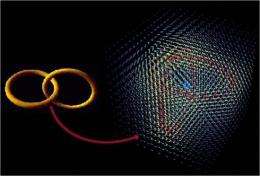
The blue dot in the center shows the Earth's location within the two linked cosmic strings in this simulated image. The arrows show how the magnetic field from the two stings affected the orientation of nearby quasars. Credit: Robert Poltis, University at Buffalo

Physicists are hot on the trail of one of strangest theorized structures in the universe. A team of researchers have announced what they think are the first indirect observations of ancient cosmic strings, bizarre objects thought to have contributed to the arrangement of objects throughout the universe.

First predicted back in the 1970s, are thought to be enormous fault lines that once existed in space. Not to be confused with the subatomic strings of , cosmic strings are widely believed by astrophysicists to have formed billions of years ago, just moments after the Big Bang when the universe was still a soupy mass of extremely hot matter. As the universe cooled, defects formed between different regions of space that cooled in different ways, much like cracks forming in the ice on a frozen pond. These defects in space were the cosmic strings.

Although researchers have not yet directly observed the strings themselves, the team believes they found evidence of them hidden in ancient quasars, enormous that shoot out mighty jets of light and radiation, found at the heart of many galaxies.

The presumed cosmic strings were incredibly narrow, thinner than the diameter of a proton, but so dense that a string less than a mile in length would weigh more than the Earth. As the universe expanded, so too did these strings until they either stretched across the known universe, or into enormous rings thousands of times larger than our galaxy.

"Their sort of hitches a ride with the expansion of the universe," said Robert Poltis from the University at Buffalo in N.Y. and lead author of the paper reporting the findings.

Poltis' team analyzed the observational data of 355 quasars that reside in the far off corners of the universe. With careful scrutiny of the light emitted by these quasars, it is possible to determine the direction their jets are facing in space. The team found that 183 of them lined up to form two enormous rings that stretch across the sky in a pattern unlikely to have formed by chance.

The team members think that the magnetic fields of the two cosmic strings affected the direction the quasars are pointing. The strings themselves should have long since dissipated by emitting gravitational radiation as they vibrated; however the original effect on the alignment of the quasars would have remained.

"The string itself is gone, but you get the magnetic field imprinted in the early universe," Poltis said. To check their hypothesis, they modeled the theorized effects of the strings on the formation of quasars, and found their predictions closely matched their observations.

Poltis added also that they still need to conduct more follow-up observations and analysis before they can be completely sure they have found evidence of the strings. The detection of a cosmic string would be an important cosmological discovery because of their theorized importance to the formation of galaxies in the early . However, other researchers are cautious about the results.

Jon Urrestilla of the University of the Basque Country in Biscay, Spain, doesn't want to jump to conclusions too quickly. He said that Poltis' research is exciting because his team is making testable predictions.

"It is still early to say that this work has discovered evidence for cosmic strings. It is promising, the science is sound, but one should be careful. There are assumptions made that need be checked," Urrestilla said, "But it is yet another piece to the puzzle, and the more predictions we can make from the same basic science into presumably independent effects, the closer we will be to detecting whether strings really were there."

Tanmay Vachaspati from Arizona State University in Tempe, a leading expert on cosmic strings, said he thought that the observation of lined-up quasars was puzzling, but he was skeptical it was caused by cosmic strings. He said that had the strings formed nanoseconds after the , they probably would have decayed so quickly that their magnetic effect wouldn't last until today.

"I don't see them staying around until today to provide observational signals," Vachaspati said.

Their paper was published in Physical Review Letters on Oct. 11.

More information: Can Primordial Magnetic Fields Seeded by Electroweak Strings Cause an Alignment of Quasar Axes on Cosmological Scales? Phys. Rev. Lett. 105, 161301 (2010) DOI:10.1103/PhysRevLett.105.161301

Provided by Inside Science News Service search and more info website

4.7 /5 (50 votes)  

Filter


Move the slider to adjust rank threshold, so that you can hide some of the comments.


Display comments: newest first

TDK
Oct 11, 2010

Rank: 1.3 / 5 (12)
"Cosmic strings" are just one of many misconceptions of string theory. These things were actually observed already as a streaks of dark matter, connecting the galaxies.

http://www.mpa-ga...06_1.jpg

Here you can find a computer simulation of strings in five dimension as a consequence of Gregory-Laflamme instability

http://prl.aps.or.../e101102

Due the presence of extradimensions, the gravity collapses these artifacts into strings in similar way, like the polymer strings are coalesce into dropplets.

http://www.chemie...h_e.html

Such polymers are formed with stringy fluid, similar to those predicted with Kipp Thorne's membrane paradigm for description of black hole interior before years.

Compare the result of these simulation with models of dark matter at cosmic scales. The droplets of galaxies hanging on strings are clearly apparent here, so it's not surprising, their axes are aligned.
brainiac125
Oct 11, 2010

Rank: 5 / 5 (5)
5 stars if you just read this and nodded in quiet, confused acceptance of quantum physics
Zed123
Oct 11, 2010

Rank: 5 / 5 (20)
"Cosmic strings" are just one of many misconceptions of string theory.


Cosmic Strings are not a misconception of String Theory. They are not related to the strings in String Theory, just as the article mentions.
yyz
Oct 12, 2010

Rank: 4.1 / 5 (7)
There have been other cosmic string candidates proposed. Two recent candidates were thought to have lensed more distant objects. CSL-1 was thought to be a single distant galaxy split into two objects by the gravity of an unseen cosmic string. An observation by Hubble telescope later found them to be two different galaxies: http://arxiv.org/...94v2.pdf

The second candidate was claimed to be revealed by brightness fluctuations of the famous lensed quasar Q0957+561: http://arxiv.org/...34v1.pdf

Although this work was published in 2004, followup observations and independent analysis in support of this cosmic string interpretation have not been made AFAIK (and is rather dubious IMO). But it would be fair to say that most of the recent work has focused on distant(and long gone) primordial cosmic strings.
yyz
Oct 12, 2010

Rank: 4.3 / 5 (6)
""Cosmic strings" are just one of many misconceptions of string theory. These things were actually observed already as a streaks of dark matter, connecting the galaxies.

http://www.mpa-ga...g"

Do you have a link to a published paper that presents that image and describes the telescopic OBSERVATIONS used to construct this image? That looks very much like an image derived from the Millenium Simulation:

http://en.wikiped...mulation
http://www.mpa-ga...lennium/

I know of no dark matter filament maps with anything near the res of that image, to begin with. Cosmic strings are not interchangeable with dark matter, though dark matter haloes may exist around them (if CS exist), or not. That cosmic strings are not related to string theory has been pointed out to you before, so why do you persist in the notion?


nuge
Oct 12, 2010

Rank: not rated yet
Someone please answer this question: If one of these cosmic strings collided with the sun, or even worse the Earth, what would happen? Is it like a sort of linear black hole?
DamienS
Oct 12, 2010

Rank: not rated yet
Someone please answer this question: If one of these cosmic strings collided with the sun, or even worse the Earth, what would happen?

Why even worse Earth? Take out the sun, you take out Earth. Either way, we'd be toast!
nuge
Oct 12, 2010

Rank: 5 / 5 (1)
Well, if it took out the sun first, at least we'd get a cool fireworks show out of it.
DamienS
Oct 12, 2010

Rank: not rated yet
Well, if it took out the sun first, at least we'd get a cool fireworks show out of it.

I doubt it. I reckon the sun would appear as normal one second and the next it would disappear. Well, there may be some visuals depending on how fast the string is moving, though it would be less fireworks and more tidal smearing...
KBK
Oct 12, 2010

Rank: 1 / 5 (4)
Decay into high frequency 2-d waves of near infinite size.

Integrating with one another to form spiral torsionally spinning 3-d quanta wave-particle duality constructs.

With a stable past and a splitting future probability in unilinear temporal quanta, quanta which is relative in flow the respective matter constructs.
NameIsNotNick
Oct 12, 2010

Rank: not rated yet
Why even worse Earth? Take out the sun, you take out Earth. Either way, we'd be toast!

Something else to worry about...
genastropsychicallst
Oct 12, 2010

Rank: 1 / 5 (5)
... core twistor 2 categorie eclip ...
Ulg
Oct 12, 2010

Rank: 1 / 5 (1)
"Someone please answer this question: If one of these cosmic strings collided with the sun, or even worse the Earth, what would happen? "

Considering the sun is 99% of the mass in our solar system a 1 mile long string with close the mass of earth I imagine would not have much consequence to us on earth- passing through the earth on the other hand... At the very least I'd bet we all get pretty sea sick as gravity would get very screwy hehe
vidyunmaya
Oct 13, 2010

Rank: 1 / 5 (5)
Sub:Origins-Cosmology Vedas Interinks-Field UniverseThe String theory origins -Cosmic Dance of Lord SIVA. The Fields Spread functional Index is 2x5 multiplier modes. My research paper at Carnegie-Jan 2003 Symposium [Centennial series] provide the projection. Plasma Regulated EM Universe [Book 1995] Provide all details .See also Cosmic Pot Energy Universe-2003 [STSCI-Symp-May 2003]
see:http://www.scribd...ORMATION
Regarding its Links to Sun, I am providing Infprmation to ESA - Cluster and Solar orbiter missions. Comprehension of the Universe helps.
Vidyardhi Nanduri [Cosmology Vedas Interlinks]
TheWalrus
Oct 15, 2010

Rank: 5 / 5 (1)
Wow! KBK and TDK need to contact the real scientists who did the research, and explain to them what they treated us to here. I'll bet the real scientists will be ever so grateful.
JES
Oct 17, 2010

Rank: not rated yet
Should make a nice topic of a good relaxing SciFi read!
TDK
Oct 17, 2010

Rank: 1 / 5 (1)
TDK need to contact the real scientists
I did so at the case of Sabine Hossenfelder - and the result was, lets say, suboptimal...
Rank 4.7 /5 (50 votes)
Relevant PhysicsForums posts
  • AC Electric field in the conducting media
    created25 minutes ago
  • The physics of the greenhouse effect.
    created46 minutes ago
  • Electric Dipole Moment
    created7 hours ago
  • Paradox of motion implies discrete space?
    created11 hours ago
  • acceleration decceleration
    created12 hours ago
  • Spiral motion and the centripetal force
    created12 hours ago
  • More from Physics Forums - General Physics

More news stories

Is a classical electrodynamics law incompatible with special relativity?

(Phys.org) -- The laws of classical electromagnetism that were developed in the 19th century are the same laws that scientists use today. They include Maxwell’s four equations along with the Lorentz la ...

Physics / General Physics

created 21 hours ago | popularity 5 / 5 (11) | comments 26 | with audio podcast feature

Thousands of invisibility cloaks trap a rainbow

Many people anticipating the creation of an invisibility cloak might be surprised to learn that a group of American researchers has created 25 000 individual cloaks.

Physics / General Physics

created 12 hours ago | popularity 4.8 / 5 (6) | comments 0 | with audio podcast

Excitons: Exotic particles, chilled and trapped, form giant matter wave

Physicists have trapped and cooled exotic particles called excitons so effectively that they condensed and cohered to form a giant matter wave.

Physics / General Physics

created 19 hours ago | popularity 4.9 / 5 (9) | comments 1 | with audio podcast

Slip-and-slide power generators

Researchers from Vestfold University College in Norway have created a simple, efficient energy harvesting device that uses the motion of a single droplet to generate electrical power.

Physics / General Physics

created 13 hours ago | popularity 4 / 5 (1) | comments 0

Photonics: Beam me up

'Tractor beams' of light that pull objects towards them are no longer science fiction. Haifeng Wang at the A*STAR Data Storage Institute and co-workers have now demonstrated how a tractor beam can in fact be realized on a ...

Physics / General Physics

created 21 hours ago | popularity 4.5 / 5 (4) | comments 0


New study should end debate over magnesium treatment for preventing poor outcome after haemorrhagic stroke

An international randomised trial and meta-analysis published Online First in The Lancet should put an end to the debate about the use of intravenous magnesium sulphate to prevent poor outcomes after haemorrhagic stroke. The in ...

Computers excel at identifying smiles of frustration (w/ Video)

(Phys.org) -- Researchers at the Massachusetts Institute of Technology (MIT) in the US have trained computers to recognize smiles, and they have turned out to be more adept at recognizing smiles of frustration ...

OmniVision tops up sensors for cameras, phones

(Phys.org) -- OmniVision has announced two high-resolution image sensors for the digital still and digital video camera market (DS/DVC) and higher end smartphones. In end-user language, it is a claim for superior ...

Research: Negative leakage could be key to reducing carbon emissions

(Phys.org) -- The unilateral efforts of a single country or region to reduce the emissions of greenhouse gases could reduce exports, increase imports and lead to higher emissions elsewhere – what economists call “leakage.” ...

Progestin treatment for polycystic ovarian syndrome may reduce pregnancy chances

(Medical Xpress) -- The hormone progestin, often given as a first step in infertility treatment for polycystic ovary syndrome (PCOS), appears to decrease the odds of conception and of giving birth, according to a study by ...

Talking works: UB professor develops method to analyze creative problem solving

(Phys.org) -- Talk -- if it's the right kind -- can increase creativity, leading students to create useful, new ideas that solve problems, a University at Buffalo professor has found by using a statistical tool that he invented.