Is team science productive? Study measures the collaborative nature of translational medicine
(PhysOrg.com) -- Taking a cue from the world of business-performance experts and baseball talent scouts, Penn Medicine translational medicine researchers are among the first to find a way to measure the productivity of collaborations in a young, emerging institute. They published their findings the most recent issue of Science Translational Medicine.
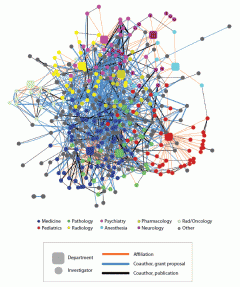
While metrics exist to measure the contributions of individual scientists, judging the effectiveness of team science has been more challenging. Reasoning that team science produces papers and grants, first author postdoctoral fellow Michael Hughes, PhD, (now at Yale University) and colleagues measured these endpoints and analyzed them over time using network analysis, which examines a social structure made up of individuals connected by a common interdependency.
Using the numbers of publications and grants as their raw data, researchers from Penn's Institute for Translational Medicine and Therapeutics (ITMAT) measured how their productivity changed with increasing collaborations over the last five years.
"We're applying quantitative methods to evaluate the collaborative nature of academic science and medicine," says senior author John Hogenesch, PhD, associate professor of Pharmacology in the University of Pennsylvania School of Medicine. Hogenesch is also an ITMAT member and interim director of the Penn Center for Bioinformatics.
They found that the number of collaborative papers for ITMAT members doubled since 2006. They also found that researchers were more likely to collaborate within their own departments and institutions than between them. "While understandable, if the purpose of an institute is to facilitate cross-disciplinary interactions, then encouraging people to collaborate across departments and institutes is critical," says Hogenesch.
The authors concluded that studies such as these could help inform decisions about which institutes, centers, or departments are most likely to facilitate collaboration, and learn how they're doing it. This will point the way to ideas to increase cross-discipline collaborations such as trans-center grants to facilitate collaborations between departments.
"The most challenging aspect of the study was acquiring the data. At this point, we've analyzed PubMed and research grants and only for ITMAT. Ideally, we would be able to compare these metrics to those from other similar institutes including more data sources. Also, as time goes by, having downstream measures of this productivity such as literature citations and investigational new drug applications will point the way towards learning the operational rules of translational science," says Hogenesch.
Inspired by America's Pastime
First author Hughes is a baseball fan, and he realized that professional baseball has kept detailed statistics on the outcomes of every at-bat in every game for the last 100-plus years. These data provide a wealth of information to quantitatively address the traits that predict a successful baseball career, and the types and combinations of players needed to win games. By quantitatively and objectively studying performance, baseball analysts have been able to identify and exploit inefficiencies in the labor market -- highly skilled players were sometimes under-valued because of widely-held, but incorrect, assumptions. "If they're measuring performance quantitatively in baseball, shouldn't we do the same for science?," asks Hughes.
But how do investigators evaluate their performance quantitatively -- especially the scientific output of an institution comprising hundreds of active researchers, let alone comparing performance among centers and institutes with similar missions at different universities. Using ITMAT's roster of members over time, the team used network dynamics as a first step towards measuring scientific performance of cross-disciplinary institutes and centers.
ITMAT was founded in 2004 as the world's first translational medicine institute, and as of January 2009, included over 500 active investigators spanning four institutions and dozens of academic departments. "We reasoned that ITMAT's productivity could be partly measured by how it facilitates collaborations between its members," says Hogenesch.
To collect data, the team generated special data-mining programs to automatically extract publication information from PubMed. In addition, they analyzed grant proposals submitted by ITMAT faculty during the last five years and additional data from NIH Reporter. From this they quantified the number of papers and grants by ITMAT investigators over time, and how these collaborative interactions changed over time.
ITMAT's overall size and complexity grew significantly since its inception. Not only has the total number of investigators actively collaborating within ITMAT increased during this time, the average investigator has been collaborating more.
"This finding was not surprising since as the size of the network grows, the probability that two investigators would interact to co-publish papers or co-submit grants grows," explains Hogenesch. "In network-speak, the number of edges – co-published papers and grants - per node – two or more investigators - grew nearly twice as fast during the past five years, as the growth of ITMAT's membership has grown, suggesting that ITMAT's expansion increased the number of collaborations. What's more, the percentage of ITMAT investigators actively collaborating within ITMAT grew every year, with nearly two-thirds actively engaged in collaborations in 2009."
Provided by University of Pennsylvania School of Medicine


