'SpectroPen' could aid surgeons in detecting edges of tumors
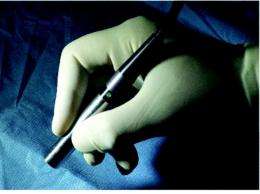
This hand-held device called a SpectroPen could help surgeons see the edges of tumors in human patients in real time during surgery.
Biomedical engineers are developing a hand-held device called a SpectroPen that could help surgeons see the edges of tumors in human patients in real time during surgery.
Scientists at Emory University School of Medicine, the Georgia Institute of Technology, and the University of Pennsylvania describe the device in an article published this week in the journal Analytical Chemistry.
What a patient with a tumor wants to know after surgery can be expressed succinctly: Did you get everything? Statistics indicate that complete removal, or resection, is the single most important predictor of patient survival for most solid tumors.
This technology could allow a surgeon to directly visualize where the tumors are, in real time. In addition, a post-surgery scan could check tumor margins, said Shuming Nie, a professor in the Wallace H. Coulter Department of Biomedical Engineering at Georgia Tech and Emory University. A major challenge is to completely remove the tumor as well as identify lymph nodes that may be involved.
The SpectroPen can be used to detect fluorescent dyes, and also scattered light from tiny gold particles, a technology that Nie and his colleagues have been refining.
The particles consist of polymer-coated gold, coupled to a reporter dye and an antibody that sticks to molecules on the outsides of tumor cells more than it sticks to normal cells. Through an effect called surface-enhanced Raman scattering, the gold in the particle greatly amplifies the signal from the reporter dye. Nie and his team have been able to show that the particles can detect tumors smaller than one millimeter grafted into rodents.
The SpectroPen combines a near-infrared laser and a detector for fluorescence or scattered light. It is connected by a fiber optic cable to a spectrometer that can record fluorescence and Raman signals.
In the Analytical Chemistry paper, the researchers used the pen to detect the dye indocyanine green, infused intravenously into mice with implanted human breast cancer cells. The dye accumulates at a higher rate in tumor cells because of the leaky blood vessels and membranes surrounding tumors. The SpectroPens signal from the tumor is ten times higher than from normal tissue. Indocyanine green has been approved by the FDA for purposes such as measuring cardiac output and liver function.
The cancer cells had a gene from fireflies added, so that tumors glow after the mice are given a luciferin solution. This allowed the scientists to check that the outline of the tumor seen through the SpectroPen matched the glow.
Our in vivo studies demonstrate that the tumor borders can be precisely detected preoperatively and intraoperatively, and that the contrast signals are strongly correlated with tumor bioluminescence, Nie said.
In the laboratory, the fluorescence and Raman signals are resolvable when the nanoparticles are buried 5-10 mm deep in fresh animal tissues. However, the gold nanoparticles are 40 to 50 times more sensitive than fluorescent dyes.
Future plans include in vivo tests of the nanoparticle contrast agents, along with the SpectroPen.
The research was carried out by an interdisciplinary team of senior investigators including May Wang, Coulter Department at Georgia Tech and Emory University; Sunil Singhal, University of Pennsylvania; and James Provenzale and Brian Leyland-Jones, Emory University. They are developing an integrated spectroscopic and wide-field color imaging system for image-guided surgery and cancer detection during surgery using animal models.
Provenzale and surgeons at the University of Georgia College of Veterinary Medicine are currently using this device to operate on dogs with naturally occurring tumors. Singhal, who is director of the Thoracic Surgery Research Laboratory at the University of Pennsylvania School of Medicine, is applying to conduct clinical trials involving patients with lung cancer.
More information: Research paper: http://dx.doi.org/ … 21/ac102058k
Provided by Georgia Institute of Technology
-
From lemons to lemonade: Reaction uses carbon dioxide to make carbon-based semiconductor,
28 comments
-
Every black hole contains a new universe: A physicist presents a solution to present-day cosmic mysteries,
215 comments
-
New silicon memory chip developed,
16 comments
-
Thioridazine kills cancer stem cells in human while avoiding toxic side-effects of conventional cancer treatments,
2 comments
-
SpaceX private rocket blasts off for space station (Update),
41 comments
-
Electrons And Radiation
4 hours ago
-
Acid Base Theories
May 24, 2012
-
Stability of phenyl cation
May 23, 2012
-
Carbon dioxide density & distribution in the atmosphere
May 23, 2012
-
Question regarding classification of halogen derivatives of alkanes
May 23, 2012
-
the concept of mole
May 23, 2012
- More from Physics Forums - Chemistry
More news stories
Discarded data may hold the key to a sharper view of molecules
(Phys.org) -- There's nothing like a new pair of eyeglasses to bring fine details into sharp relief. For scientists who study the large molecules of life from proteins to DNA, the equivalent of new lenses have come in the ...
16 hours ago |
4.7 / 5 (3) |
0
|
Pivotal role for proteins -- from helping turn carbs into energy to causing devastating disease
Research into how carbohydrates are converted into energy has led to a surprising discovery with implications for the treatment of a perplexing and potentially fatal neuromuscular disorder and possibly even cancer and heart ...
16 hours ago |
5 / 5 (1) |
0
|
Nuisance seaweed found to produce compounds with biomedical potential
A seaweed considered a threat to the healthy growth of coral reefs in Hawaii may possess the ability to produce substances that could one day treat human diseases, a new study led by scientists at Scripps ...
18 hours ago |
5 / 5 (2) |
1
|
New CO2-removing catalyst can take the heat
(Phys.org) -- The current method of removing the greenhouse gas carbon dioxide (CO2) from the flues of coal-fired power plants uses so much energy that no one bothers to use it. So says Roger Aines, principal ...
23 hours ago |
5 / 5 (7) |
6
|
Study cracks a secret of methanol production
(Phys.org) -- Whats the best way to make methanol? The question is more pressing than it sounds. Not only is methanol an important industrial chemical some 50 million tons are used each year to ...
23 hours ago |
5 / 5 (1) |
0
|
Research: Negative leakage could be key to reducing carbon emissions
(Phys.org) -- The unilateral efforts of a single country or region to reduce the emissions of greenhouse gases could reduce exports, increase imports and lead to higher emissions elsewhere what economists call leakage. ...
Progestin treatment for polycystic ovarian syndrome may reduce pregnancy chances
(Medical Xpress) -- The hormone progestin, often given as a first step in infertility treatment for polycystic ovary syndrome (PCOS), appears to decrease the odds of conception and of giving birth, according to a study by ...
World 'no tobacco day' puts spotlight on dangers of smoking
Its not just smokers who are at-risk when it comes to tobacco smoke exposureand the health concerns of smoking cigarettes are not limited to the most known consequence: lung cancer.
Talking works: UB professor develops method to analyze creative problem solving
(Phys.org) -- Talk -- if it's the right kind -- can increase creativity, leading students to create useful, new ideas that solve problems, a University at Buffalo professor has found by using a statistical tool that he invented.
Nonsmoking lung cancer survivor encourages others to consider risk
Carol Seibert had an upper respiratory infection she just couldnt seem to shake. The timing of her illness was awful, as she had just returned from a trip to Florida for her youngest sons surgery and was preparing ...
OmniVision tops up sensors for cameras, phones
(Phys.org) -- OmniVision has announced two high-resolution image sensors for the digital still and digital video camera market (DS/DVC) and higher end smartphones. In end-user language, it is a claim for superior ...