Restaurant customers willing to pay more for local food
October 26, 2010

Restaurant customers willing to pay more for local food

Enlarge

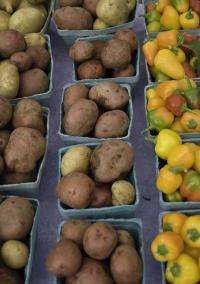
Potatoes and scotch bonnet peppers are for sale at a local farmers' market. Credit: Heather Annette Miller, Penn State

Not only are restaurant patrons willing to pay more for meals prepared with produce and meat from local providers, the proportion of customers preferring local meals actually increases when the price increases, according to a team of international researchers.

A recent study of how customers perceive and value local food shows that restaurant patrons prefer meals made with local ingredients when they are priced slightly higher than meals made with non-local ingredients, said Amit Sharma, assistant professor, School of , Penn State. The research will appear in the fall/winter issue of the International Journal of Revenue Management.

In the experiment, researchers first set prices for both non-local and local selections on the menu of a student-led restaurant at $5.50. When the price was the same for non-local and local food, customers showed no significant preference for either option. However, when the local food selection was priced at $6.50, or 18 percent higher than the non-local option, a higher proportion of the customers picked the meal made with local foods and ingredients, said Sharma, who worked with Frode Alfnes, associate professor, department of economics and resource management, Norwegian University of Life Sciences.

"This is partly good news for restaurants," said Sharma. "It shows that customers were willing to pay slightly more for a local dish, with the emphasis on 'slightly.'"

preference for premium-priced local food has its limits, however, Sharma warned.

Once researchers raised the price of the local option to $7.50, or 36 percent higher than the non-local alternative, a higher proportion of customers chose the regular menu.

Value cues--signals that attract increased attention from consumers--may influence the customers' preference for the higher-priced local option. The results indicate that the main value cue of local food for customers is its freshness.

"The higher price of the local dish was an indicator of higher value," said Sharma. "So, customers were comfortable with a slightly higher price for the local food."

Sharma said the research could help restaurant owners decide how to set prices for local foods and estimate whether the potential to charge higher prices will compensate for the additional costs associated with adding to the menu.

"The study helps restaurants make decisions on whether it makes sense to offer local foods," said Sharma. "If local foods are a natural fit for some of these restaurants, then it would definitely be a good strategy to price the food higher because there is an indication of value with fresh food."

Sharma said another important finding of the research was that customers indicated they had no preference between restaurants that offered local foods and ones that did not.

The study of 322 customers was conducted at a training restaurant on a Midwest university that serves between 45 and 85 customers each day.

Researchers designed a real-time choice experiment to meet several challenges they anticipated from conducting an in-restaurant experiment. Customers who dine at a restaurant are less inclined to fill out long questionnaires. To avoid bias, the researchers asked questions only after the customers chose their food.

"We literally put the customers in the situation and let them choose," said Sharma. "Then we asked them why they made the choices they did."

Provided by Pennsylvania State University search and more info website


Rank not rated yet
Relevant PhysicsForums posts

More news stories

Social welfare cuts ultimately come with heavy price, researchers say

(Phys.org) -- Slashing government funding for Medicaid, food stamps and other programs that serve the poor – while politically popular with some lawmakers and many conservatives – may do more harm ...

Other Sciences / Social Sciences

created 17 hours ago | popularity 4.5 / 5 (8) | comments 52

Relatively speaking: Researchers identify principles that shape kinship categories across languages

Different languages refer to family relationships in different ways. For example, English speakers use two terms — grandmother and grandfather — to refer to grandparents, while Mandarin Chinese uses four terms. ...

Other Sciences / Social Sciences

created 10 hours ago | popularity 3.7 / 5 (3) | comments 0 | with audio podcast

Psychologists examine how race affects juvenile sentencing

When it comes to holding children accountable for crimes they commit, race matters.

Other Sciences / Social Sciences

created 8 hours ago | popularity 3 / 5 (2) | comments 1

CWRU class earns Science magazine prize for innovation

Science magazine has awarded a prize for Inquiry-Based Instruction to a Case Western Reserve University class that melds biology, computer modeling, mathematical analysis and writing.

Other Sciences / Social Sciences

created 10 hours ago | popularity not rated yet | comments 0

Oldest art even older

New dates from Geißenklösterle Cave in Southwest Germany document the early arrival of modern humans and early appearance of art and music.

Other Sciences / Archaeology & Fossils

created 5 hours ago | popularity 5 / 5 (1) | comments 0


Is a classical electrodynamics law incompatible with special relativity?

(Phys.org) -- The laws of classical electromagnetism that were developed in the 19th century are the same laws that scientists use today. They include Maxwell’s four equations along with the Lorentz la ...

HyperSolar shows dirty water no barrier to power world

(Phys.org) -- The Santa Barbara, California, company, HyperSolar, is set to transparently share the ups and downs of its research experiences toward the company’s ultimate vision, successfully producing ...

Organic carbon from Mars, but not biological

Molecules containing large chains of carbon and hydrogen--the building blocks of all life on Earth--have been the targets of missions to Mars from Viking to the present day. While these molecules have previously ...

In nanorod crystal growth, nanoparticles seen as artificial atoms

In the growth of crystals, do nanoparticles act as "artificial atoms" forming molecular-type building blocks that can assemble into complex structures? This is the contention of a major but controversial theory ...

First direct observation of oriented attachment in nanocrystal growth

Berkeley Lab researchers have reported the first direct observation of nanoparticles undergoing oriented attachment, the critical step in biomineralization and the growth of nanocrystals. A better understanding ...

Asteroid nudged by sunlight: Most precise measurement of Yarkovsky effect

Scientists on NASA's asteroid sample return mission, Origins, Spectral Interpretation, Resource Identification, Security, Regolith Explorer (OSIRIS-REx), have measured the orbit of their destination asteroid, ...