Orchid tricks hoverflies: Eastern marsh helleborine mimics aphid alarm pheromones to attract pollinators
Even Darwin was a self-admitted orchid lover. Dictionaries describe orchids as exotic ornamentals. Indeed, these plants – more than 30000 different species are thought to exist – are exotic due their extraordinary and diverse flower morphology. However, they are also exotic from a point of view other than beauty: as crafty imposters in order to achieve reproduction and to make sure that their ovaries are pollinated. Orchids depend on the assistance of pollinators, and like many other flowering plants, attract insects.
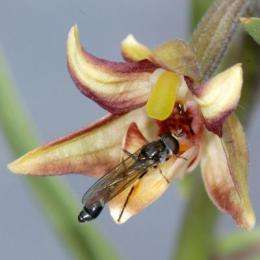
Epipactis veratrifolia, an orchid native in South Turkey, the Middle East, and Cyprus, has specialized in hoverflies. Because these insects prefer aphids as food for their larvae, the orchid produces three aphid alarm substances, α- and β-pinene, and β-myrcene and β-phellandrene, all of which attract hoverfly females. Interestingly, as the scientists observed, even male hoverflies hang around the orchids, hoping for a chance to copulate with the attracted females.
A bit of nectar as reward
"Hoverfly females as well as males enjoy the small amount of nectar the orchid flower provides. Both sexes serve as pollen transmitters," says ecologist Johannes Stökl. The alarm substances lure five of the different hoverfly species that feed on aphids. Females lay all their eggs in the flower of the orchid, although no aphids are there. "We assume that the insects are not only deceived by the aphid alarm pheromones, but also fall for the aphid-like dark warts in the orchid's flower," explains Bill Hansson, director at the Max Planck Institute.
Mass spectra and electroantennograms
The aphid species Megoura viciae preferred by Episyrphus balteatus hoverflies produces α- and β-pinene as well as β-myrcene. These volatile substances generate measurable electrical impulses in the hoverfly antennae. Behavioral experiments carried out by the research team supported the assumption that it is exactly these substances that attract hoverflies and encourage oviposition. Further analyses revealed that the orchid Epipactis veratrifolia does not mimic the alarm pheromones of just one aphid species, because the volatiles emitted by the aphids and the flower differ in amount and constitution.
An evolutionary dead end?
Is Epipactis veratrifolia a ruthless imposter? Johannes Stökl answers: "At least the plant provides a small amount of nectar for the deceived hoverflies. This is comparable to two related species, the wasp-pollinated orchids E. helleborine and E. purpurata, which lure stingy insects by mimicking their prey, mostly butterfly larvae. However, unlike Epipactis veratrifolia these species reward their pollinators by providing large amounts of nectar."
Nevertheless, the scientist would classify the Eastern marsh helleborine as a treacherous imposter, because hoverfly larvae hatching from the eggs laid in its flowers won't find any food there and must die. From an evolutionary perspective this seems to be a contradiction: If hoverfly larvae die, the population of this species is decimated and as a consequence the number of pollinators decreases.
"We cannot provide a coherent explanation of this conflict. However, we can imagine where the mimicry of the alarm pheromone is originated," says Bill Hansson. The plant is remarkably aphid-free, probably due to the emission of α- and β-pinine. These two volatiles are produced by aphids in case of danger. Therefore aphids avoid everything that smells of α- and β-pinine. Both substances may have originally been used by the Eastern marsh helleborine as a defense against aphids. Once hoverflies were fooled and mistook the volatiles for aphids, they also served the purpose of attracting pollinators.
More information: Johannes Stökl, Jennifer Brodmann, Amots Dafni, Manfred Ayasse, Bill S. Hansson: Smells like aphids: orchid flowers mimic aphid alarm pheromones to attract hoverflies for pollination. Proceedings of the Royal Society B, Online, October 2010, DOI: 10.1098/rspb.2010.1770
Provided by Max Planck Institute


