Optical quantification of the spatial distribution of cosmetic facial foundation
Oct 26, 2010 By Adarsh Sandhu
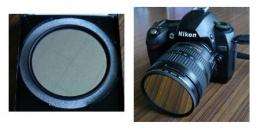
Fig.1: The role of the filter used for visualizing the finish of foundation applied to the face. The theoretically derived spectral transmittance was realized experimentally using a multilayer film filter made by vacuum deposition technology. Copyright : Toyohashi University of Technology

Shigeki Nakauchi at Toyohashi Tech in collaboration with Kanebo Cosmetics Inc., Japan, has developed a technology enabling the quantification and visualization of the ‘quality’ and finish of foundation applied to the face.

Beauty may indeed be in the eye of the beholder, but we could all do with a little help to maintain the ‘natural look’ just to be on the safe side.

Applying creams and liquids—foundation—to the face and body has a long history, with records showing the ancient Egyptians using ‘body paint’ to improve their complexion and looks.

Intriguingly, in spite of the countless products offered by the cosmetics industry, the appropriate application of foundation is still more of an art than a science. That is, there is not a scientific way to quantify the spatial distribution of foundation applied to the face.

Now, Shigeki Nakauchi at Toyohashi Tech’s Department of Computer Science and Engineering in collaboration with Kanebo Cosmetics Inc., , has developed a technology enabling the quantification and of the ‘quality’ and finish of foundation applied to the face.

Using this technology, it is possible to produce an optical image of the amount of foundation applied to the face by simply inserting a special filter in front of a camera lens (Fig.1).

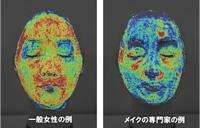
For example, this technology enables a direct comparison of the finish of foundation applied by a untrained person (Fig.2 (left) and a professional make-up artist (Fig.2 (right)).
Optical quantification of the spatial distribution of cosmetic facial foundation
Fig.2: Visualization of the finish of foundation applied by an untrained women (left) and a professional make-up artist (right). The amount of the foundation applied by the professional is much less than an inexperienced woman, which shows that a trained person applies foundation efficiently in order to achieve a ‘natural looking’ finish to the make-up. Copyright : Toyohashi University of Technology

This technology will be used for the development of materials for base make-up, more informed make-up counseling and techniques for beauticians and so on.

Explore further: Research shows black box could increase safety, efficiency of collegiate flight training

More information: Shigeki Nakauchi Group : www.vpac.cs.tut.ac.jp/en/index.php?FrontPage

Provided by Toyohashi University of Technology

not rated yet
add to favorites email to friend print save as pdf

Related Stories

Pore 'vision' improved

Oct 18, 2010

A team led by Naoko Imamoto of the RIKEN Advanced Science Institute in Wako, Japan, has uncovered processes governing the formation of functionally important structures called nuclear pore complexes (NPCs) ...

Baby boomers are reinventing retirement

Oct 11, 2010

(PhysOrg.com) -- The challenges faced by recent retirees are changing how we plan for and expect to experience retirement in the future, say the academics working on a new University of Melbourne study.

The noise about graphene

Oct 15, 2010

(PhysOrg.com) -- In last week’s announcement of the Nobel Prize in Physics, the Royal Swedish Academy of Sciences lauded graphene’s "exceptional properties that originate from the remarkable world ...

Solving single molecule mobility

Oct 18, 2010

Nanotechnologists assemble intricate nanodevices, such as computer chips, molecule by molecule using ‘bottom-up’ techniques that mirror nature. One approach shuttles molecules along surfaces into ...

Recommended for you

AP probe further strains Obama, press rapport

21 hours ago

Reports emerged last week that the Department of Justice had secretly obtained two months' worth of phone records of journalists at The Associated Press as part of a larger investigation into a failed al-Qaida ...

Pakistan adopts Chinese rival GPS satellite system

May 18, 2013

Pakistan is set to become the fifth Asian country to use China's domestic satellite navigation system which was launched as a rival to the US global positioning system, a report said Saturday.

British children's on-screen reading overtakes books

May 16, 2013

For the first time, British children are reading more on computers and other electronic devices than they are reading books, magazines, newspapers and comics, according to a study of nearly 35,000 youngsters ...

Exploring the artsy side of 3-D printing

May 16, 2013

Three-D printing technology is a game changer in the arts and crafts world. "It really takes the lid off of what's possible," says Andrej Suskavcevic, president and CEO of the Craft and Hobby Association, ...

User comments : 0

More news stories

After a decade, global AIDS program looks ahead

(AP)—The decade-old law that transformed the battle against HIV and AIDS in developing countries is at a crossroads. The dream of future generations freed from the epidemic is running up against an era ...