Image: Hubble's lagoon
Oct 15, 2010
Image Credit: NASA

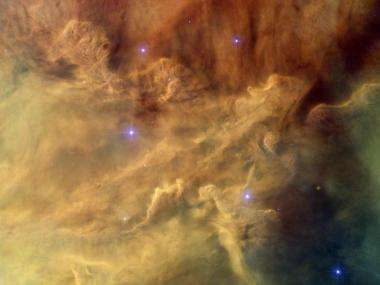
Like brush strokes on a canvas, ridges of color seem to flow across the Lagoon Nebula, a canvas nearly 3 light-years wide.

The colors map emission from ionized gas in the nebula were recorded by the Hubble Space Telescope's Advanced Camera for Surveys.

Also known as M8, the nebula is a star-forming region in the constellation Sagittarius. Hubble's remarkably sharp, close-up view reveals undulating shapes sculpted by the energetic light and winds from the region's new born stars.

Of course, the is a popular target for earthbound skygazers, too.

Explore further: Collisions of coronal mass ejections can be super-elastic

add to favorites email to friend print save as pdf

Related Stories

Breaking waves in the stellar lagoon (w/ Video)

Sep 22, 2010

The Advanced Camera for Surveys (ACS) on the NASA/ESA Hubble Space Telescope has captured a dramatic view of gas and dust sculpted by intense radiation from hot young stars deep in the heart of the Lagoon ...

Hubble Catches Scattered Light From The Boomerang Nebula

Sep 15, 2005

The Hubble Space Telescope has "caught" the Boomerang Nebula in these new images taken with the Advanced Camera for Surveys. This reflecting cloud of dust and gas has two nearly symmetric lobes (or cones) ...

Hubble's Celestial Landscape

Oct 02, 2008

(PhysOrg.com) -- The landmark 10th anniversary of the Hubble Space Telescope's Hubble Heritage Project is being celebrated with a "landscape" image from the cosmos. Cutting across a nearby star-forming region ...

Cosmic ice sculptures: Dust pillars in the Carina Nebula

Sep 16, 2010

Enjoying a frozen treat on a hot summer day can leave a sticky mess as it melts in the Sun and deforms. In the cold vacuum of space, there is no edible ice cream, but there is radiation from massive stars ...

The Last Confessions of a Dying Star

Mar 04, 2008

Probing a glowing bubble of gas and dust encircling a dying star, NASA's Hubble Space Telescope reveals a wealth of previously unseen structures.

Hubble Observes Infant Stars in Nearby Galaxy

Jan 08, 2007

This new image taken with NASA's Hubble Space Telescope depicts bright, blue, newly formed stars that are blowing a cavity in the center of a star-forming region in the Small Magellanic Cloud.

Recommended for you

Forecast for Titan: Wild weather could be ahead

21 hours ago

(Phys.org) —Saturn's moon Titan might be in for some wild weather as it heads into its spring and summer, if two new models are correct. Scientists think that as the seasons change in Titan's northern hemisphere, ...

SDO observes mid-level solar flare

21 hours ago

UPDATE 16:30 p.m. EDT: The M7-class flare was also associated with a coronal mass ejection or CME, another solar phenomenon that can send billions of tons of particles into space. While this CME was not Ea ...

NASA's IRIS mission readies for a new challenge

May 22, 2013

(Phys.org) —The time draws near. NASA is getting ready to launch a new mission, a mission to observe a largely unexplored region of the solar atmosphere that powers its dynamic million-degree outer atmosphere and drives ...

User comments : 1

Adjust slider to filter visible comments by rank

Display comments: newest first

Gawad
5 / 5 (1) Oct 15, 2010
Magnificent!

More news stories

A hidden population of exotic neutron stars

(Phys.org) —Magnetars – the dense remains of dead stars that erupt sporadically with bursts of high-energy radiation - are some of the most extreme objects known in the Universe. A major campaign using ...

Russia evacuates drifting Arctic research station

Russia has ordered the urgent evacuation of the 16-strong crew of a drifting Arctic research station after ice floe that hosts the floating laboratory began to disintegrate, officials said Thursday.

A quantum simulator for magnetic materials

Physicists understand perfectly well why a fridge magnet sticks to certain metallic surfaces. But there are more exotic forms of magnetism whose properties remain unclear, despite decades of intense research. ...

Scientists discover molecule triggers sensation of itch

Scientists at the National Institutes of Health report they have discovered in mouse studies that a small molecule released in the spinal cord triggers a process that is later experienced in the brain as the sensation of ...