Changes in energy R&D needed to combat climate change
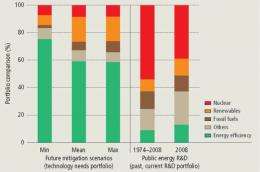
Past and current investments into developing climate-friendly technologies (R&D, right) versus uture technology needs (min/mean/max across scenarios, left) by technology category.
A new assessment of future scenarios that limit the extent of global warming cautions that unless current imbalances in R&D portfolios for the development of new, efficient, and clean energy technologies are redressed, greenhouse gas (GHG) emission reduction targets are unlikely to be met, or met only at considerable costs.
The study identifies energy efficiency as the single most important option for achieving significant and long-term reductions in GHG emissions, accounting for up to 50 percent of the reduction potential across the wide range of scenarios analyzed. However, investment in energy efficiency R&D has typically been less than 10 percent of the overall public sector R&D budget in the countries of the International Energy Agency (IEA). Conversely, although nuclear energy accounts for less than 10 percent of the GHG emission reduction potentials across all scenarios, it has received some 50 percent of the total public investment in energy technology R&D.
The analysis, conducted by Drs' Arnulf Grubler and Keywan Riahi from the International Institute for Applied Systems Analysis (IIASA), Austria, and published in the inaugural issue of the journal Carbon Management (2010 1(1):79-87), compared historical and current government spending on R&D by the 28 member countries of the International Energy Agency, with a "needs"-based analysis of the technologies required to achieve long-term climate stabilization. The assessment is based on the analysis of a wide range of scenarios of future technology deployment rates under a range of future uncertainties and climate constraints.
"Current investments in energy technology R&D by the public sector, in all industrialized countries, are heavily biased in favor of nuclear energy, to the detriment of energy efficiency research," says IIASA energy expert, Dr Keywan Riahi. "Given their respective importance for future climate mitigation this is a significant imbalance. Based on current investments, we estimate that a five-fold increase in investment in energy efficiency is needed to address this imbalance. Importantly, if the current rate and allocation of investment in energy R&D is maintained there is a high chance that technology development will be insufficient to meet stringent GHG reduction targets."
While technological development is critical the authors also emphasize the need for accompanying market deployment incentives for an aligned and consistent technology policy framework.
"The drastic emission cuts required to limit climate change will only be possible if we can achieve a major a transformation of the energy system," adds IIASA co-author Arnulf Grubler. "This will require the adoption of a range of policies and measures beyond an expanded and restructured energy technology R&D portfolio to include incentives for niche market applications and the large-scale deployment of climate-friendly technologies."
Because the future is inherently uncertain, the study uses a range of scenarios -22 in total - to examine what successful, or unsuccessful adoption of different technologies (such as nuclear or carbon capture and sequestration) might achieve for reducing GHG emissions. The scenarios include a "do nothing" or business-as-usual scenario, where, for example, R&D policies remain uncoordinated and market incentives for new technologies to minimize emissions remain unchanged. The study concludes that a business-as-usual approach to energy technology R&D will make combating climate change very difficult and more costly, reducing both the likelihood of success and the political and social acceptability of a transition to climate-friendly, energy-efficient technologies.
Based on the scenarios the authors outline a forward looking energy R&D 'portfolio' that they propose would provide the best hedging strategy for making sure future GHG emissions can be actually reduced and at reasonable costs. In order to achieve this goal currently unbalanced energy technology R&D portfolios need to change, reflecting the respective "option value" for future GHG mitigation of different options, which are particularly large for energy efficiency.
The study focused primarily on public or government-funded, R&D but the authors say the findings in terms of energy technology investment is similar to that of private sector investment, where there is a similar preference for large-scale supply-side energy technology investments, to the detriment of energy efficiency.
More information: Grubler A. and Riahi K., Do Governments have the right mix in their energy R&D portfolios? Carbon Management 2010 1(1):79-87.
Provided by International Institute for Applied Systems Analysis
-
From lemons to lemonade: Reaction uses carbon dioxide to make carbon-based semiconductor,
27 comments
-
Every black hole contains a new universe: A physicist presents a solution to present-day cosmic mysteries,
209 comments
-
New silicon memory chip developed,
16 comments
-
Computing experts unveil superefficient 'inexact' chip,
45 comments
-
SpaceX private rocket blasts off for space station (Update),
41 comments
-
Conversion from aircraft bearing to normal degrees
15 hours ago
-
Interpretation/Analysis of the Lab results(HEPA filter)
May 22, 2012
-
Has anyone here attended the The Urbino Summer School in Paleoclimatology?
May 22, 2012
-
Earthquakes: Mag 6 N. Italy and Mag 5.6 W. Bulgaria
May 21, 2012
-
determining time frame for most recent geological layers
May 17, 2012
-
solar radiation - conversion to calculate radiation impacting vertical surface
May 16, 2012
- More from Physics Forums - Earth
More news stories
Robot monitors toxic red tides
A robotic device suspended under the ocean surface from a buoy off the New Hampshire coast is monitoring seawater for evidence of the red tide, clusters of microscopic plants that release toxins into fish ...
55 minutes ago |
not rated yet |
0
|
Pair call for public discourse on treating wastewater contaminated with birth control pill chemicals
(Phys.org) -- As people go about their daily lives, its easy to overlook the impact their lifestyle has on the environment. Resources are used and as a result of their use, certain elements are placed ...
Warming could exceed 3.5 C, say climate scientists
Climate researchers said Thursday the planet could warm by more than 3.5 degrees Celsius (6.3 degrees Fahrenheit), boosting the risk of drought, flood and rising seas.
34 minutes ago |
3 / 5 (2) |
0
Private supply ship flies by space station in test (Update)
The world's first private supply ship flew tantalizingly close to the International Space Station on Thursday but did not stop, completing a critical test in advance of the actual docking.
Space & Earth / Space Exploration
1 hour ago |
5 / 5 (1) |
0
Did ancient Mars have a runaway greenhouse?
Cosmic impacts that once bombed Mars might have sent temperatures skyrocketing upward on the Red Planet in ancient times, enough to set warming of the surface on a runaway course, researchers say.
Space & Earth / Space Exploration
1 hour ago |
3.7 / 5 (3) |
0
|
Is a classical electrodynamics law incompatible with special relativity?
(Phys.org) -- The laws of classical electromagnetism that were developed in the 19th century are the same laws that scientists use today. They include Maxwell’s four equations along with the Lorentz la ...
Researchers find a way to delay aging of stem cells
Stem cells are essential building blocks for all organisms, from plants to humans. They can divide and renew themselves throughout life, differentiating into the specialized tissues needed during development, ...
Robotics: Gesturing for control
New intelligent algorithms could help robots to quickly recognize and respond to human gestures. Researchers at A*STAR Institute for Infocomm Research in Singapore have created a computer program which recognises ...
Real-time monitoring of RNA splicing in living cells moves step closer with novel fluorescent probe
Numerous biological processes depend on molecules called lariat RNAs (LaRNAs). These lasso-shaped structures form in the cell during RNA splicing. During this process, transcribed RNA strands convert to messenger ...
TV maker Vizio turns to computers, takes on Apple, Dell and HP
Vizio is no stranger to defying the odds. The once little-known company came from practically nowhere to become one of the USA's biggest TV makers, wresting the title from the top electronics companies, including Sony. Its ...
Positive words: the glue to social interaction
(Phys.org) -- Scientists at ETH Zurich have studied the use of language, finding that words with a positive emotional content are more frequently used in written communication. This result supports the theory that social ...
Oct 25, 2010
Rank: 4 / 5 (4)
That's not explicitly true. I'd like to see the evidence they use to support that statement. Consumer electronics research to reduce power consumption and improve battery efficiency (cell phones, laptops, home appliances, cars, etc.) is huge and is largely privately funded. Without a quantitative analysis, I don't think thier statement holds much weight. It's an educated guess at best, and perhaps even wishful thinking at worst.
This doesn't qualify as very good science in my book. The initial assumptions are based on fictional scenarios and may not reflect reality in any way. Predictions of the future of technology have never been very good. A breakthrough in super capacitors or conductors, thermoelectrodynamics, photovoltaics, etc. would change the landscape overnight.
Oct 26, 2010
Rank: not rated yet
Oct 27, 2010
Rank: 1 / 5 (1)