Elephant seals improve maps of Antarctic seafloor
October 19, 2010 By Donna Hesterman
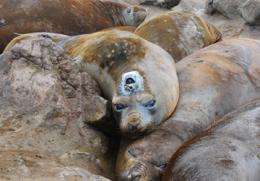
The satellite tag attached to the fur of this southern elephant seal can collect data for a year before being shed along with the fur during an annual molt. Photo by D. Costa.
(PhysOrg.com) -- Oceanographers are using data collected by elephant seals to improve their map of the seafloor on Antarctica's continental shelf. The new map results from a collaboration between Daniel Costa, a professor of ecology and evolutionary biology at UC Santa Cruz, who has been studying southern elephant seals in the region, and oceanographer Laurie Padman of Earth & Space Research in Corvallis, Oregon.
Between 2005 and 2009, Costa tagged 57 southern elephant seals with satellite transmitters as part of a habitat ecology study. "We were interested in the animals--where they went and what they did," he said.
When the Wilkins Ice Shelf extending from the Antarctic Peninsula began to crumble in 2008, Costa realized that the data collected by his tagged seals might help oceanographers figure out why the shelf was collapsing. "I knew that we had animals that had been swimming around and collecting data in that area," he said.
Costa's research focuses on the food-web relationships that support large ocean predators like elephant seals and how climate change affects them. He developed and pioneered the satellite tags used in the study in collaboration with the Sea Mammal Research Unit at the University of St. Andrews, Scotland. The tags record temperature, salinity, and pressure data wherever the animals roam. Attached to the seals' fur, the instruments collect information for one year before being shed along with the fur in an annual molt.
The tags store data as the elephant seals dive to the bottom to search for food and then transmit it to a centralized database via the Argos satellite system when the animal surfaces. Costa's study gathered data over a period of four years, during which the seals made tens of thousands of dives to the ocean bottom. As the researchers analyzed the data, a picture of the seafloor emerged that didn't match the existing maps. The animals were diving to depths that, according to the maps, were below the sea floor.
The extreme conditions around Antarctica make seafloor mapping a challenge. Traditionally, ships pass over an area and take direct measurements to chart the ocean floor, but the icy waters around the Antarctic Peninsula are difficult to navigate, so many of the areas around it are charted based only on estimates gleaned indirectly from satellites.
When the Wilkins Ice Shelf began to disintegrate, oceanographers analyzing the waters below it needed an accurate picture of the seafloor to understand the currents swirling under the ice shelf. Thinking his data might help, Costa contacted Padman, and they began to piece together an improved picture of the ocean floor around the Antarctic Peninsula.
The new map they constructed shows deep troughs cut into the continental slope that deliver warm water from the open ocean past the continental slope and up into the frigid waters below the Wilkins Ice Shelf. Padman said he suspects that the warm water flow may have played a role in setting off the ice-shelf collapse.
The researchers reported their findings in a paper published in Geophysical Research Letters. The coauthors include Tom Bolmer of Woods Hole Oceanographic Institute; Michael Goebel of the NOAA Antarctic Marine Living Resources Program; UCSC graduate student Luis Huckstadt; Adrian Jenkins and Deborah Shoosmith of the British Antarctic Survey, U.K.; and Birgitte McDonald of Scripps Institution of Oceanography.
For Costa, the satellite tags provided valuable information about how the Southern Ocean is changing and how large animals like the elephant seals may respond to those changes. For Padman, the seals let him see an ocean floor previously inaccessible to man. And for both, the exercise revealed a new application for an existing technology that is likely to be used again in the future. As a pioneer of this technology, Costa said that he is always looking for ways to push the technology along in support of better science.
Provided by
University of California - Santa Cruz
-
From lemons to lemonade: Reaction uses carbon dioxide to make carbon-based semiconductor,
27 comments
-
Every black hole contains a new universe: A physicist presents a solution to present-day cosmic mysteries,
209 comments
-
New silicon memory chip developed,
16 comments
-
Computing experts unveil superefficient 'inexact' chip,
45 comments
-
SpaceX private rocket blasts off for space station (Update),
41 comments
-
Conversion from aircraft bearing to normal degrees
15 hours ago
-
Interpretation/Analysis of the Lab results(HEPA filter)
May 22, 2012
-
Has anyone here attended the The Urbino Summer School in Paleoclimatology?
May 22, 2012
-
Earthquakes: Mag 6 N. Italy and Mag 5.6 W. Bulgaria
May 21, 2012
-
determining time frame for most recent geological layers
May 17, 2012
-
solar radiation - conversion to calculate radiation impacting vertical surface
May 16, 2012
- More from Physics Forums - Earth
More news stories
Robot monitors toxic red tides
A robotic device suspended under the ocean surface from a buoy off the New Hampshire coast is monitoring seawater for evidence of the red tide, clusters of microscopic plants that release toxins into fish ...
55 minutes ago |
not rated yet |
0
|
Pair call for public discourse on treating wastewater contaminated with birth control pill chemicals
(Phys.org) -- As people go about their daily lives, its easy to overlook the impact their lifestyle has on the environment. Resources are used and as a result of their use, certain elements are placed ...
Warming could exceed 3.5 C, say climate scientists
Climate researchers said Thursday the planet could warm by more than 3.5 degrees Celsius (6.3 degrees Fahrenheit), boosting the risk of drought, flood and rising seas.
34 minutes ago |
3 / 5 (2) |
0
Private supply ship flies by space station in test (Update)
The world's first private supply ship flew tantalizingly close to the International Space Station on Thursday but did not stop, completing a critical test in advance of the actual docking.
Space & Earth / Space Exploration
1 hour ago |
5 / 5 (1) |
0
Did ancient Mars have a runaway greenhouse?
Cosmic impacts that once bombed Mars might have sent temperatures skyrocketing upward on the Red Planet in ancient times, enough to set warming of the surface on a runaway course, researchers say.
Space & Earth / Space Exploration
1 hour ago |
3.7 / 5 (3) |
0
|
Is a classical electrodynamics law incompatible with special relativity?
(Phys.org) -- The laws of classical electromagnetism that were developed in the 19th century are the same laws that scientists use today. They include Maxwell’s four equations along with the Lorentz la ...
Researchers find a way to delay aging of stem cells
Stem cells are essential building blocks for all organisms, from plants to humans. They can divide and renew themselves throughout life, differentiating into the specialized tissues needed during development, ...
Robotics: Gesturing for control
New intelligent algorithms could help robots to quickly recognize and respond to human gestures. Researchers at A*STAR Institute for Infocomm Research in Singapore have created a computer program which recognises ...
Real-time monitoring of RNA splicing in living cells moves step closer with novel fluorescent probe
Numerous biological processes depend on molecules called lariat RNAs (LaRNAs). These lasso-shaped structures form in the cell during RNA splicing. During this process, transcribed RNA strands convert to messenger ...
TV maker Vizio turns to computers, takes on Apple, Dell and HP
Vizio is no stranger to defying the odds. The once little-known company came from practically nowhere to become one of the USA's biggest TV makers, wresting the title from the top electronics companies, including Sony. Its ...
Positive words: the glue to social interaction
(Phys.org) -- Scientists at ETH Zurich have studied the use of language, finding that words with a positive emotional content are more frequently used in written communication. This result supports the theory that social ...
Oct 19, 2010
Rank: not rated yet
Oct 19, 2010
Rank: not rated yet