Scientists track an insidious toxic substance in China
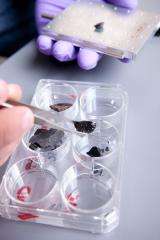
(PhysOrg.com) -- Scientists at the University at Buffalo and the Chinese University of Mining and Technology/Beijing are tracing a toxic trajectory of excess fluorine, which may be crippling millions of people with skeletal fluorosis in a poor, remote Chinese province.
The disease causes chronic joint pain and leads to muscle wasting and crippling spine and major joint deformities. Most often, the source is excess fluorine in polluted water, but in certain areas in China it comes from coal.
The UB and CUMTB research, focused on Guizhou province in southwest China, uses an advanced chemical analysis technique, a specialty of the team, to pinpoint the origin of the excess fluorine in order to develop ways to minimize exposure. The technique is being performed using state-of-the-art chemical instrumentation facilities in the UB Department of Chemistry.
"We need to better understand the chemistry and mechanism of this exposure," says Joseph A. Gardella Jr, PhD, Larkin Professor of Chemistry in the UB College of Arts and Sciences. "When the coal is burned, is excess fluorine released into particulates that are then deposited on food that people eat, or is it released into the smoke that people then breathe? And are there other chemicals that combine with the fluorine to make it even more toxic?"
Several million people are believed to be afflicted with skeletal fluorosis in China, with as many as a million of them in Guizhou, which has a population of 14 million. The disease can be so devastating that it leaves its victims unable to walk; many of Guizhou's residents also have dental fluorosis, which badly discolors teeth and which, in some cases, can be a precursor to the skeletal form of the disease.
Gardella traveled to Guizhou province last year to obtain samples and to collaborate with scientists at the CUMTB.
He notes that the Chinese government has been proactive in trying to protect residents, providing villagers with new stoves with high chimneys in order to improve ventilation. But important scientific questions remain unanswered.
"The subsurface coal that is mined in Guizhou and sold to power plants doesn't contain such high fluorine levels," says Gardella. "It's the coal that the poorest villagers pick up along the road, which gets mixed with clay and soil that has the high levels. That's what they use to cook, to heat their homes and to dry vegetables."
So, with funding from a National Science Foundation Award for Special Creativity, a special grant award encouraging "high-risk" research for which scientists do not apply, Gardella has been working to figure out exactly how fluorine is released from these chunks of coal.
In 2008, Gardella, one of the world's foremost experts in a sophisticated chemical analysis method called Time-of-Flight Secondary Ion Mass Spectrometry (ToF-SIMS), was contacted by Hangdong Liang, PhD, of CUMTB, who studies fluorosis exposure in China, and who consults with the Chinese government on resources and the environment.
Liang, well-versed in earlier versions of the technique, was interested in learning from Gardella how the power of the newest ToF-SIMS instrument can be harnessed to discover how the fluorine is being released from the coal.
ToF-SIMS is well-suited to the research, according to the UB scientists.
"While other techniques give primarily information about the elements present in the sample, ToF-SIMS, coupled with scanning transmission X-ray microscopy, allows us to determine, at the molecular level, the chemical structure of fluorine-containing species in the coal," explains Brett Yatzor, a doctoral candidate in the UB Department of Chemistry, who is working in Gardella's lab.
"Before we can develop ideas about how the fluorine is released once it is combusted, and what it might be bound to once it's released, it's important to first understand the types of fluorine in its native state," says Gardella.
He notes that imaging techniques, such as scanning electron microscopy, previously revealed that the fluorine is found in the clay used as an additive in the mining process and which villagers add to the coal to make briquettes for burning.
That's why he and Yatzor are using ToF-SIMS to study cross-sections of coal and coal-clay mixtures, examining its organic and inorganic composition and its sulfur content and searching for other contaminants that may be synergistic, making the fluorine more toxic when it is released.
They also are studying pieces of corn and chili peppers that villagers have hung to dry over their stoves in order to determine if they might be a source of the fluorine exposure.
"Our goal is to gather basic information about the chemistry of the fluorine, what happens to it during combustion and what chemical structure and reactions lead to the exposure," says Gardella.
Since beginning the joint research with Liang, Gardella has traveled to Guizhou, China to obtain samples; he also has given presentations on the research both in China and in the US and he has chaired international meetings on secondary ion mass spectrometry in Canada and China.
This research is the second project for which Gardella has received an NSF Special Creativity Award; he received the first such award in 1991, which he used to study and develop new methods to determine chemical reaction rates at the surfaces of polymer materials, resulting in the awarding of several patents.
Provided by University at Buffalo


