Coral algae (symbiodinium) discovered in black corals at never seen before depths
October 20, 2010

Coral algae (symbiodinium) discovered in black corals at never seen before depths

Enlarge

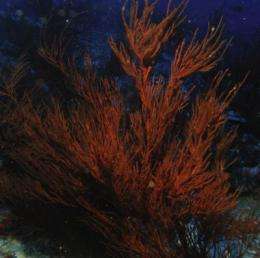
This is an image of a Hawaiian Black Coral, Antipathes griggi. Credit: Daniel Wagner, HIMB/SOEST/UHM

Researchers at the Hawai'i Institute of Marine Biology (HIMB), an organized research unit in the University of Hawai'i at Mānoa's School of Ocean and Earth Science and Technology have made a remarkable new discovery.

When most people envision coral, they typically think of shallow-water reef-building corals found along beaches and tropical nearshore habitats. These "typical" corals are dependent upon photosynthetic algae (also known as Symbiodinium or zooxanthellae) found in their tissues to obtain nutrients to live off of. In deeper less known waters, closely related black corals were considered to be void of these algae because of the light shortage to support photosynthesis.

In fact, all black corals were considered to lack Symbiodinium (algae), because they are typically found at great depths where light levels are very low. Black corals are of substantial cultural and economic importance in Hawai'i. Some species are harvested commercially for the precious coral jewelry industry in deep waters off Maui, and black coral is considered the official gemstone of the State of Hawai'i. Even though most people have heard of black coral jewelry, very few ever get to see these corals in their natural environments because of the depths they are found in. As a result of their remote habitats, very little is known about the basic biology of black corals.
Coral algae (symbiodinium) discovered in black corals at never seen before depths
Enlarge

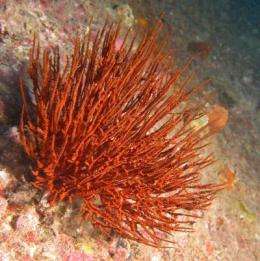
This is an image of a Hawaiian Black Coral, Antipathes griggi. Credit: Daniel Wagner, HIMB

Scientists at the Hawai'i Institute of (HIMB), examined 14 black coral species collected between 10 and 396 m from around Hawai'i for the presence of algae using molecular and histological (tissue studies) techniques. Surprisingly, 71% of the examined species were found to contain algae, even at depths approaching 400 m. These black corals exhibited very similar traits to those of corals commonly found in shallow-water (use of algae). PhD student, Daniel Wagner at HIMB was the one who led the investigation.

He states: "because black corals are predominantly found in deep and dark environments, most people assumed that they could not harbor these photosynthetic symbiotic algae. At this point we do not know how these algae are able to exist in extreme environments, and it certainly highlights how little we know about deep reefs."

This is a new and important discovery for coral biology, representing the deepest record of Symbiodinium to date. This research also implies that some members of these have extremely diverse habitat preferences and broad environmental ranges. The prestigious Royal Society will be publishing the full research report in their journal, Proceedings of the Royal Society B this month.

More information: "Azooxanthellate? Most Hawaiian black corals contain Symbiodinium", Daniel Wagner, Xavier Pochon, Leslie Irwin, Robert J. Toonen and Ruth D. Gates doi: 10.1098/rspb.2010.1681

Provided by University of Hawaii at Manoa


Rank 5 /5 (1 vote)
Relevant PhysicsForums posts

More news stories

Fungi shifted plant balance of power

Cooperating with fungi didn't just help the earliest plants spread across a barren, rocky landscape; it also played a decisive role in the rise of more complex plants with roots and leaves that make up most ...

Biology / Plants & Animals

created 54 minutes ago | popularity not rated yet | comments 0 | with audio podcast

Researchers find a way to delay aging of stem cells

Stem cells are essential building blocks for all organisms, from plants to humans. They can divide and renew themselves throughout life, differentiating into the specialized tissues needed during development, ...

Biology / Cell & Microbiology

created 6 minutes ago | popularity not rated yet | comments 0 | with audio podcast

Marine scientist discusses cod colonization

New evidence suggests that Atlantic cod may have the ability to affect entire food webs in both benthic and pelagic marine ecosystems, according to a University of Maine marine scientist, writing in the Proceedings of ...

Biology / Ecology

created 1 hour ago | popularity not rated yet | comments 0

Plants could use light even more effectively for food production

(Phys.org) -- Scientists from Wageningen University have concluded that it is possible to develop plants that produce even more food by reducing the level of pigments which make no contribution to photosynthesis. The conclusion ...

Biology / Cell & Microbiology

created 13 minutes ago | popularity not rated yet | comments 0

Social media used to collect information on marine wilderness

(Phys.org) -- Researchers from Murdoch University's Cetacean Research Unit are working with colleagues from Duke University in the US and Marine Ventures Foundation on an innovative project that will use social ...

Biology / Ecology

created 36 minutes ago | popularity not rated yet | comments 0


Did ancient Mars have a runaway greenhouse?

Cosmic impacts that once bombed Mars might have sent temperatures skyrocketing upward on the Red Planet in ancient times, enough to set warming of the surface on a runaway course, researchers say.

The search for the earliest signs of Alzheimer's

(Medical Xpress) -- For the past five years, volunteers from the City of Berkeley and surrounding areas have come to Lawrence Berkeley National Laboratory to participate in an ongoing study that’s changing ...

Private supply ship flies by space station in test (Update)

The world's first private supply ship flew tantalizingly close to the International Space Station on Thursday but did not stop, completing a critical test in advance of the actual docking.

Study links mental health problems to poor prognosis in male cancer patients

Men suffering from psychiatric problems when diagnosed with cancer are more likely to die from the disease, according to a new study part-funded by the Wellcome Trust. The findings also reveal that those with ...

The myth of the disconnected telecommuter

(Phys.org) -- The assumption that employees who regularly telecommute will feel less attached to the organization they work for due to feeling isolated and disconnected is a myth, according to a study led ...

Formal recognition of PMDD will lift stigma for women

A decision to recognise premenstrual dysphoric disorder as a genuine psychiatric condition will finally provide “validation for this awful and poorly understood” syndrome and alleviate the stigma ...