China says manned space station possible around 2020
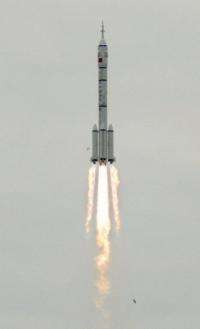
The Long March 2F rocket carrying a Shenzhou VI blasts off at Jiuquan Satellite Launch Center, in China's northwestern province of Gansu, 2005. China said that it planned to complete a manned space station around 2020, as the Asian nation pushes ahead with its ambitious space exploration programme.
China said Wednesday that it planned to complete a manned space station around 2020, as the Asian nation pushes ahead with its ambitious space exploration programme.
China's Manned Space Engineering Project announced in a statement that it expected to launch a space laboratory before 2016 to study key technology involved in a space station, such as living conditions for astronauts.
The country would then develop and launch a core cabin and a second laboratory module around 2020, which would be assembled in orbit into a space station, it added.
The station would study technologies involved in long-term manned space flights, the statement said.
China had already announced plans to launch two unmanned modules next year, which are expected to undergo the nation's first space docking -- an essential step towards building the space station.
These steps are all part of the nation's ambitious space exploration programme, which experts say it wants to put on a par with those of the United States and Russia.
China sees the programme as a symbol of its global stature, growing technical expertise, and the Communist Party's success in turning around the fortunes of the formerly poverty-stricken nation.
The nation became only the third in the world to put a man in space independently -- after the United States and Russia -- when Yang Liwei piloted the one-man Shenzhou-5 space mission in 2003.
And in September 2008, the Shenzhou-7, piloted by three astronauts, carried out China's first space walk.
China has also made strides in lunar exploration, aiming to become the second country to put a man on the moon.
It launched its second lunar probe on October 1, hopes to bring a moon rock sample back to Earth in 2017, and has planned a manned mission to the moon for around 2020, according to state media.
(c) 2010 AFP
-
From lemons to lemonade: Reaction uses carbon dioxide to make carbon-based semiconductor,
27 comments
-
Every black hole contains a new universe: A physicist presents a solution to present-day cosmic mysteries,
209 comments
-
New silicon memory chip developed,
16 comments
-
Computing experts unveil superefficient 'inexact' chip,
45 comments
-
SpaceX private rocket blasts off for space station (Update),
41 comments
-
Math behind Theoretical Physics
8 hours ago
-
Do we know whats at the center of galaxies yet?
9 hours ago
-
Structure of the Milky Way?
May 20, 2012
-
What would it take to terraform Pluto and Charon?
May 19, 2012
-
Whats is volume of mass at the centre of the sun
May 19, 2012
-
Galaxies moving faster than the speed of light?
May 18, 2012
- More from Physics Forums - General Astronomy
More news stories
Rapid coral death by a deadly chain reaction
(Phys.org) -- Most people are fascinated by the colorful and exotic coral reefs, which form habitats with probably the largest biodiversity. But human civilisation is the top danger to these fragile ecosystems ...
45 minutes ago |
3 / 5 (2) |
2
|
Did ancient Mars have a runaway greenhouse?
Cosmic impacts that once bombed Mars might have sent temperatures skyrocketing upward on the Red Planet in ancient times, enough to set warming of the surface on a runaway course, researchers say.
Space & Earth / Space Exploration
15 minutes ago |
not rated yet |
0
|
Ancient rocks provide critical clues about modern earthquakes
At first glance, there's nothing remarkable about the rocky Maine blueberry field in which University of Maine graduate student Nancy Price does her research. But those rocks are crucial to our understanding ...
Space & Earth / Earth Sciences
15 minutes ago |
not rated yet |
0
Colliding galaxy cluster unravelled
An international team of astronomers has used the International LOFAR Telescope from ASTRON, the Netherlands Institute for Radio Astronomy, to study the formation of the galaxy cluster Abell 2256.
26 minutes ago |
not rated yet |
0
Neil Armstrong gives rare interview - to accountant
The famously private Neil Armstrong, the first man to walk on the moon, has been coaxed into giving a rare interview -- with an Australian accountant.
Space & Earth / Space Exploration
4 hours ago |
5 / 5 (3) |
3
Young alum creates iPad user experience improvement (w/ Video)
(Phys.org) -- When Daniel Hooper became frustrated with editing text on his iPad, he wrote an application that could revolutionize the way users select and arrange their words on tablets.
Fungi shifted plant balance of power
Cooperating with fungi didn't just help the earliest plants spread across a barren, rocky landscape; it also played a decisive role in the rise of more complex plants with roots and leaves that make up most ...
The search for the earliest signs of Alzheimer's
(Medical Xpress) -- For the past five years, volunteers from the City of Berkeley and surrounding areas have come to Lawrence Berkeley National Laboratory to participate in an ongoing study thats changing ...
USDA links gene flow between weedy and domesticated rice to rising carbon dioxide levels
(Phys.org) -- New research at the U.S. Department of Agriculture (USDA) confirms that rising levels of atmospheric carbon dioxide facilitate the flow of genes from wild or weedy rice plants to domesticated ...
Long-term meditation leads to different brain organization
(Medical Xpress) -- People who practice mindfulness meditation learn to accept their feelings, emotions, and states of mind without judging or resisting them. They simply live in the moment.
Malware intelligence system enables organizations to share threat information
As malware threats expand into new domains and increasingly focus on industrial espionage, Georgia Tech researchers are launching a new weapon to help battle the threats: a malware intelligence system that ...