Ariane 5's fourth launch of 2010
October 29, 2010

Ariane 5's fourth launch of 2010

Enlarge

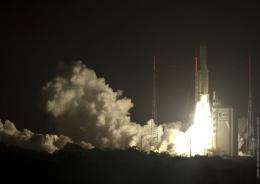
Ariane 5 flight V197 liftoff

Last night, an Ariane 5 lifted off from Europe's Spaceport in French Guiana on a journey to place two telecommunications satellites, W3B and BSAT-3b, into orbit. Flight V197 was Ariane 5's fourth dual-payload mission of the year.

Liftoff of the 53rd Ariane 5 mission came at 23:51 CEST (21:51 GMT; 18:51 French Guiana). The target injection orbit had a perigee altitude of 250 km, an apogee altitude at injection of 35 913 km and an inclination of 2º.
The satellites were accurately injected into their transfer orbits about 28 minutes and 37 minutes after , respectively.

W3B will be positioned in ‘geostationary orbit’ above the equator at 30.5°E and will provide a wide range of services, from TV broadcasting to professional data networks and broadband access in Europe, the Middle East, Central Asia, Africa and islands in the Indian Ocean.

BSAT-3b, to be positioned over 110°E, will provide direct-to-home broadcasting services in Japan using eight 130-watt Ku-band transponders.

Satellites in a circular orbit with an altitude of 35 800 km keep pace with Earth’s rotation and appear stationary when observed from the ground, hence 'geostationary'.

The payload mass for this launch was approximately 8260 kg; the satellite masses totalled 7460 kg, with payload adapters and dispensers making up the additional 800 kg.

Arianespace and Europe’s are planning two more Ariane launches in 2010, maintaining the heavy-lift vehicle’s flight rate. The ability to sustain high launch rates has been demonstrated: during the 12-month period from August 2007 to August 2008 there were nine launches (V177 – V185).

This video is not supported by your browser at this time.

On 28 October 2010 an Ariane 5 lifted off from Europe’s Spaceport in French Guiana on a journey to place two telecommunications satellites, W3B and BSAT-3b, into orbit. Flight V197 was Ariane 5’s fourth dual-payload mission of the year. Liftoff of the 53rd Ariane 5 mission came at 23:51 CEST (21:51 GMT; 18:51 French Guiana). The target injection orbit had a perigee altitude of 250 km, an apogee altitude at injection of 35 913 km and an inclination of 2º. Credits: Arianespace

V197 flight timeline

The Ariane 5’s cryogenic, liquid-propellant main engine was ignited first. Seven seconds later, the solid-propellant boosters were also fired, and the vehicle lifted off a fraction of a second later.

The solid boosters were jettisoned 2 min 22 sec after main , and the fairing protecting the payload during the climb through Earth’s atmosphere was discarded at 3 min 9 sec. The launcher’s main engine was shut down at 8 min 50 sec; six seconds later, the main cryogenic stage separated from the upper stage and its payload.

Ten seconds after main stage separation, the engine of the cryogenic upper stage was ignited to continue the journey. The engine was shut down at 24 min 47 sec into the flight, at which point the vehicle was travelling at 9358 m/s (33 689 km/h) at an altitude of 646 km. Geostationary transfer orbit had been achieved.

At 28 min 11 sec after main engine ignition, W3B separated from the upper stage, followed by BSAT-3b at 37 min 50 sec. ’s flight operations were completed 49 min 50 sec after main engine ignition.

Provided by European Space Agency search and more info website


Rank not rated yet
Relevant PhysicsForums posts

More news stories

Nasa concludes wind tunnel testing to aid in SpaceX reusable launch system design

(Phys.org) -- NASA's Marshall Space Flight Center in Huntsville, Ala., completed wind tunnel testing for Space Exploration Technologies (SpaceX) of Hawthorn, Calif., to provide Falcon 9 first stage re-entry data for the company's ...

Space & Earth / Space Exploration

created 38 minutes ago | popularity 5 / 5 (1) | comments 0

Neil Armstrong gives rare interview - to accountant

The famously private Neil Armstrong, the first man to walk on the moon, has been coaxed into giving a rare interview -- with an Australian accountant.

Space & Earth / Space Exploration

created 3 hours ago | popularity 5 / 5 (1) | comments 3

Study shows how to keep a Mars tumbleweed rover moving on rocky terrain

New research from North Carolina State University shows that a wind-driven "tumbleweed" Mars rover would be capable of moving across rocky Martian terrain – findings that could also help the National ...

Space & Earth / Space Exploration

created 21 hours ago | popularity 3 / 5 (6) | comments 10 | with audio podcast

Kyoto Protocol architect 'frustrated' by climate dialogue

UN climate talks are going nowhere, as politicians dither or bicker while the pace of warming dangerously speeds up, one of the architects of the Kyoto Protocol told AFP.

Space & Earth / Environment

created 21 hours ago | popularity 3.5 / 5 (6) | comments 22

Dark shadows on Mars: Scene from durable NASA rover

(Phys.org) -- Like a tourist waiting for just the right lighting to snap a favorite shot during a stay at the Grand Canyon, NASA's Mars Exploration Rover Opportunity has used a low sun angle for a memorable ...

Space & Earth / Space Exploration

created 23 hours ago | popularity 5 / 5 (9) | comments 9 | with audio podcast


Research team uncovers mechanism behind drugs that cause altered immunity

(Medical Xpress) -- An Australian research team has opened the door to understanding why certain drugs cause a so called altered immunity response when offered as treatment for certain specific ailments. In their paper published ...

New genetic method pinpoints geographic origin

(Medical Xpress) -- Understanding the genetic diversity within and between populations has important implications for studies of human disease and evolution. This includes identifying associations between genetic variants ...

Researchers film rare striped rabbit in Sumatra (w/ Video)

(Phys.org) -- With cameras set up in Sumatra looking for medium- and small-sized wild cats, such as leopards, a research group involving the University of Delaware's Kyle McCarthy, found images of something ...

Bees at risk from chemicals increase, scientists say

Pesticide use rose by 6.5% between 2005 and 2010, increasing the risk to bee populations, according to new research from the University of Reading launched today by Friends of the Earth.

Older African-Americans use religious songs to cope with stress, study shows

(Medical Xpress) -- New research from the University of North Carolina Chapel Hill School of Nursing has shown that older African-Americans use religious songs in a personal way to cope with stressful life events. Songs long ...

Study reveals who profits and who incur losses from provision of immediacy in the stock market

While mutual funds and issue of stocks cause price impact, hedge funds and repurchase of shares decrease this. The doctoral dissertation by Kalle Rinne, M. Sc. (Econ.), studies how demand and provision of immediacy affects ...