What physicists can learn from shark intestines

In 1920, inventor Nikola Tesla patented a type of pipe that he called a "valvular conduit," which was built to draw fluid in one direction without any moving parts or added energy, and has applications ranging from soft robotics ...
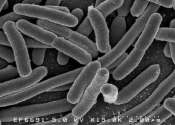
Bacteria used to create superfluids

(Phys.org)—A team of researchers with Université Paris-Sud and Université P.M. Curie/Université Paris-Diderot, both in France, has discovered that putting certain types of bacteria into an ordinary fluid, can cause it to ...

A numerical protocol to estimate local entropy production

In physics, equilibrium is a state in which a system's motion and internal energy do not change over time. Videos of systems in equilibrium would look exactly the same if they were watched in their normal chronological progression ...

Researchers develop printable lasers

(Phys.org)—A way of printing lasers using everyday inkjet technology has been created by scientists. The development has a wide range of possible applications, ranging from biomedical testing to laser arrays for displays.

Mathematicians model fluids at the mesoscale

When it comes to boiling water—or the phenomenon of applying heat to a liquid until it transitions to a gas—is there anything left for today's scientists to study? The surprising answer is, yes, quite a bit. How the bubbles ...

Bubbles that break rules: A fluid discovery that defies logic

A team led by researchers at UNC-Chapel Hill have made an extraordinary discovery that is reshaping our understanding of bubbles and their movement. Picture tiny air bubbles inside a container filled with liquid. When the ...

Slow road to stability for emulsions

By studying the behavior of tiny particles at an interface between oil and water, researchers at Harvard have discovered that stabilized emulsions may take longer to reach equilibrium than previously thought.

page 17 from 40