Page 18: Research news on Quantum many-body systems

Quantum many-body systems are physical systems composed of a large number of interacting quantum particles (such as electrons, atoms, or spins) whose collective behavior cannot be reduced to a simple sum of single-particle properties. They are described by many-body Hamiltonians on high-dimensional Hilbert spaces, where quantum statistics, entanglement, and correlations play central roles. Such systems exhibit emergent phenomena including quantum phase transitions, superconductivity, magnetism, and topological order, and are studied using methods like second quantization, Green’s functions, tensor networks, and quantum Monte Carlo to understand their equilibrium and nonequilibrium properties across different interaction and dimensionality regimes.

Steering toward quantum simulation at scale

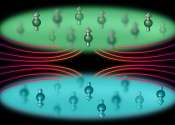
Researchers simulated a key quantum state at one of the largest scales reported, with support from the Quantum Computing User Program, or QCUP, at the Department of Energy's Oak Ridge National Laboratory.

Computing how quantum states overlap

Quantum many-body systems are things such as atomic nuclei that consist of many tiny particles moving in complex ways. This makes it extremely difficult to predict how the systems behave as the particles interact. To study ...

page 18 from 20