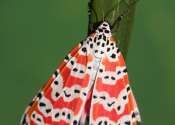
Just what makes that little old ant… change a flower's nectar content?
Ants play a variety of important roles in many ecosystems. As frequent visitors to flowers, they can benefit plants in their role as pollinators when they forage on sugar-rich nectar. However, a new study ...
New Caledonia bans shark fishing
ESF scientist rediscovers long-lost giant fish from Amazon
(Phys.org) —A professor at the SUNY College of Environmental Science and Forestry (ESF) has put aside nearly a century and a half of conventional wisdom with the rediscovery of a species of giant Amazonian ...
Cheetahs in race to survive
Scientists seek an answer to an existential question for an East Texas hibiscus
Whether human or hyena, there's safety in numbers
Humans, when alone, see threats as closer than they actually are. But mix in people from a close group, and that misperception disappears. In other words, there's safety in numbers, according to a new study by two Michigan ...
Flexible partnership allows lichens to occur in different habitats
Lichens are symbiotic organisms consisting of a fungal partner and one or several algal partners. The association is so close that scientists until 1867 were not aware that lichens actually consist of two di ...
Researchers map primate networks to predict pandemics
71 new parasitoid wasp species discovered from Southeast Asia
A new study greatly expands knowledge of the wasp genus Oxyscelio. A total of 90 species are recognized from the Indo-Malayan and Palearctic realms of Asia, 71 of which are described here as new species. A tota ...
A beautiful species of tree iguana redescribed 179 years after its discovery
Tree iguanas (Liolaemus) are one of the most diverse genus of lizards in the world with 230 described species. Within these, Liolaemus nigromaculatus - the second described species of the genus Liolaemus - is usually ...
Researchers study code that allows bacteria to either bet on the present or travel in time
(Phys.org)—Individual freedom and social responsibility may sound like humanistic concepts, but an investigation of the genetic circuitry of bacteria suggests that even the simplest creatures can make difficult choices ...
New study shows how Salmonella colonises the gut
(Phys.org) —Salmonella is a major cause of human diarrhoeal infections and is frequently acquired from chickens, pigs and cattle, or their products. Around 94 million such infections occur in people worldwide ...
Reverse extinction: Should we redo the dodo?
Woolly mammoths stomp through the Siberian tundra as the giant moa strides the forest floor of New Zealand and Tasmania's dog-like "tigers" stalk their prey under the cover of night. This is not a snapshot ...