Frontpage » Tag » planets

News tagged with planets

Solar Dynamics Observatory to observe Venus transit

On June 5, 2012 at 6:03 PM EDT, the planet Venus will do something it has done only seven times since the invention of the telescope: cross in front of the sun. This transit is among the rarest of planetary ...

Space & Earth / Space Exploration

created 20 hours ago | popularity 5 / 5 (1) | comments 0

Mars methane linked to meteorites

Tiny amounts of methane in the Martian atmosphere may come not from living things, but from meteorites on the red planet's surface, the latest findings suggest.

Space & Earth / Space Exploration

created May 31, 2012 | popularity 4.7 / 5 (3) | comments 3 | with audio podcast

Research team uses a laser frequency comb to calibrate spectrographs

(Phys.org) -- In the never ending quest to find out if there is life out there beyond our own planet, astronomers, astrophysicists and other researchers use all manner of tools to scan the sky looking for ...

Space & Earth / Astronomy

created May 31, 2012 | popularity 5 / 5 (1) | comments 0 | with audio podcast report

Astronomers probe 'evaporating' planet around nearby star with Hobby-Eberly telescope

(Phys.org) -- Astronomers from The University of Texas at Austin and Wesleyan University have used the Hobby-Eberly Telescope at UT Austin’s McDonald Observatory to confirm that a Jupiter-size planet ...

Space & Earth / Astronomy

created May 31, 2012 | popularity not rated yet | comments 0

Venus transit may boost hunt for other worlds

Astronomers around the world will be using advanced telescopes to watch Venus cross in front of the Sun on June 5 and 6 in the hopes of finding clues in the hunt for other planets where life may exist.

Space & Earth / Astronomy

created May 31, 2012 | popularity not rated yet | comments 1

Did ancient Mars have a runaway greenhouse?

Cosmic impacts that once bombed Mars might have sent temperatures skyrocketing upward on the Red Planet in ancient times, enough to set warming of the surface on a runaway course, researchers say.

Space & Earth / Space Exploration

created May 24, 2012 | popularity 3 / 5 (4) | comments 1 | with audio podcast

Newfound exoplanet may turn to dust

Researchers at MIT, NASA and elsewhere have detected a possible planet, some 1,500 light years away, that appears to be evaporating under the blistering heat of its parent star. The scientists infer that a ...

Space & Earth / Astronomy

created May 18, 2012 | popularity 4.4 / 5 (10) | comments 7 | with audio podcast

Capturing planets

(Phys.org) -- The discovery of planets around other stars has led to the realization that alien solar systems often have bizarre features - at least they seem bizarre to us because they were so unexpected. ...

Space & Earth / Astronomy

created May 22, 2012 | popularity 4.3 / 5 (4) | comments 5 | with audio podcast

Spitzer sees the light of alien 'super earth'

(Phys.org) -- NASA's Spitzer Space Telescope has detected light emanating from a "super-Earth" planet beyond our solar system for the first time. While the planet is not habitable, the detection is a historic ...

Space & Earth / Astronomy

created May 08, 2012 | popularity 4.7 / 5 (18) | comments 16 | with audio podcast

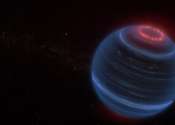
Ultra-cool companion helps reveal giant planets

(Phys.org) -- An international team of astronomers led by David Pinfield of the University of Hertfordshire has found a brown dwarf that is more than 99% hydrogen and helium. Described as ultra-cool, it has ...

Space & Earth / Astronomy

created May 10, 2012 | popularity 4.8 / 5 (6) | comments 0 | with audio podcast

Baby galaxies grew up quickly

Baby galaxies from the young Universe more than 12 billion years ago evolved faster than previously thought, shows new research from the Niels Bohr Institute. This means that already in the early history of ...

Space & Earth / Astronomy

created May 16, 2012 | popularity 4.8 / 5 (5) | comments 67 | with audio podcast

A planetary system that never was teaches about those that may be

While Kepler and similar missions are turning up planets by the fist full, there’s long been many places that astronomers haven’t expected to find planetary systems. The main places include regions ...

Space & Earth / Astronomy

created May 23, 2012 | popularity 4.5 / 5 (2) | comments 1

New super-earth detected within the habitable zone of a nearby star

(PhysOrg.com) -- An international team of scientists has discovered a potentially habitable super-Earth orbiting a nearby star. With an orbital period of about 28 days and a minimum mass 4.5 times that of ...

Space & Earth / Astronomy

created Feb 02, 2012 | popularity 4.8 / 5 (37) | comments 47 | with audio podcast

Kepler announces 11 planetary systems hosting 26 planets

(PhysOrg.com) -- NASA's Kepler mission has discovered 11 new planetary systems hosting 26 confirmed planets. These discoveries nearly double the number of verified Kepler planets and triple the number of stars ...

Space & Earth / Astronomy

created Jan 26, 2012 | popularity 5 / 5 (24) | comments 7 | with audio podcast

Researchers say galaxy may swarm with 'nomad planets'

(PhysOrg.com) -- Our galaxy may be awash in homeless planets, wandering through space instead of orbiting a star.

Space & Earth / Astronomy

created Feb 23, 2012 | popularity 4.3 / 5 (23) | comments 31 | with audio podcast

Planet

A planet (from Greek πλανήτης, from the verb πλανώμαι planōmai I wander), is a celestial body orbiting a star or stellar remnant that is massive enough to be rounded by its own gravity, is not massive enough to cause thermonuclear fusion, and has cleared its neighbouring region of planetesimals.[a]

The term planet is ancient, with ties to history, science, myth, and religion. The planets were originally seen by many early cultures as divine, or as emissaries of the gods. Even today, many people believe in astrology, which holds that the movement of the planets affects people's lives, although such a causation is rejected by the scientific community. As scientific knowledge advanced, human perception of the planets changed, incorporating a number of disparate objects. Even now there is no uncontested definition of what a planet is. In 2006, the IAU officially adopted a resolution defining planets within the Solar System. This definition has been both praised and criticized, and remains disputed by some scientists.

The planets were thought by Ptolemy to orbit the Earth in deferent and epicycle motions. Though the idea that the planets orbited the Sun had been suggested many times, it was not until the 17th century that this view was supported by evidence from the first telescopic astronomical observations, performed by Galileo Galilei. By careful analysis of the observation data, Johannes Kepler found the planets' orbits to be not circular, but elliptical. As observational tools improved, astronomers saw that, like Earth, the planets rotated around tilted axes, and some share such features as ice-caps and seasons. Since the dawn of the Space Age, close observation by probes has found that Earth and the other planets share characteristics such as volcanism, hurricanes, tectonics, and even hydrology. Since 1992, through the discovery of hundreds of extrasolar planets (planets around other stars), scientists are beginning to understand that planets throughout the Milky Way Galaxy share characteristics in common with our own.

Planets are generally divided into two main types: large, low-density gas giants, and smaller, rocky terrestrials. Under IAU definitions, there are eight planets in the Solar System. In order from the Sun, they are the four terrestrials, Mercury, Venus, Earth, and Mars, then the four gas giants, Jupiter, Saturn, Uranus, and Neptune. The Solar System also contains at least five dwarf planets: Ceres, Pluto (originally classified as the Solar System's ninth planet), Makemake, Haumea and Eris. With the exception of Mercury, Venus, Ceres and Makemake, all of these are orbited by one or more natural satellites.

As of June 2009, there are 353 known extrasolar planets, ranging from the size of gas giants to that of terrestrial planets.

For more information about Planet, read the full article at Wikipedia.
This text uses material from Wikipedia and is available under the GNU Free Documentation License.

Related topics: stars , solar system , earth , nasa , orbit