News tagged with moths
Got nectar? To hawkmoths, humidity is a cue
(Phys.org) -- Humidity emanating from a flower's nectar stores tells a moth if the flower is worth a visit, research led by a UA entomologist has discovered.
May 30, 2012 |
not rated yet |
1
|
Diagnostic labs analyze from bugs to toenails
Found an odd bug in your closet? Rhododendrons inexplicably wilting? Need a toenail analyzed? There's a lab for that.
May 25, 2012 |
not rated yet |
0
Silk moth's antenna inspires new nanotech tool with applications in Alzheimer's research
By mimicking the structure of the silk moth's antenna, University of Michigan researchers led the development of a better nanopore---a tiny tunnel-shaped tool that could advance understanding of a class of ...
Nanotechnology / Bio & Medicine
Feb 28, 2011 |
4.4 / 5 (5) |
0
|
Low oxygen triggers moth molt
A new explanation for one of nature's most mysterious processes, the transformation of caterpillars into moths or butterflies, might best be described as breathless.
Aug 22, 2011 |
5 / 5 (2) |
0
|
Caterpillars aren't so bird brained after all
(PhysOrg.com) -- Caterpillars that masquerade as twigs to avoid becoming a bird's dinner are actually using clever behavioural strategies to outwit their predators, according to a new study.
Apr 04, 2011 |
5 / 5 (6) |
0
|
Glue, fly, glue: Caddisflies' underwater silk adhesive might suture wounds
Like silkworm moths, butterflies and spiders, caddisfly larvae spin silk, but they do so underwater instead on dry land. Now, University of Utah researchers have discovered why the fly's silk is sticky when ...
Mar 01, 2010 |
4.2 / 5 (5) |
0
|
Using plants to silence insect genes in a high-throughput manner
Scientists at the Max Planck Institute for Chemical Ecology, Germany, are now using a procedure which brings forward ecological research on insects: They study gene functions in moth larvae by manipulating ...
Feb 02, 2012 |
5 / 5 (2) |
1
|
Scientists learn how insects 'remodel' their bodies between life stages
It's one of life's special moments: a child finds a fat caterpillar, puts it in a jar with a twig and a few leaves, and awakens one day to find the caterpillar has disappeared and an elegant but apparently ...
Feb 29, 2012 |
4.5 / 5 (2) |
1
|
Viral gene drives sick gypsy moth caterpillars to climb high and die
For a century, scientists have watched European gypsy moth caterpillars infected with a virus use their last strength to do something that a healthy gypsy moth caterpillar would never do in daylight hours ...
Sep 08, 2011 |
4.5 / 5 (2) |
4
|
Fossil moths reveal their true colors
Moths dead for 47 million years are again showing their true colors. For the first time, scientists have reconstructed the colors of an ancient fossil moth. The findings detailed not just a few spots of color, ...
Other Sciences / Archaeology & Fossils
Oct 12, 2011 |
5 / 5 (2) |
0
|
California uses wasps in battle against apple moths
California agricultural officials will release hundreds of tiny, stinger-less wasps this month to combat the fruit- and leaf-eating light-brown apple moth, in a move to find alternatives to aerial pesticide spraying.
Jul 10, 2011 |
5 / 5 (1) |
0
New bacteria toxins against resistant insect pests
Toxins from Bacillus thuringiensis bacteria (Bt toxins) are used in organic and conventional farming to manage pest insects. Sprayed as pesticides or produced in genetically modified plants, Bt toxins, us ...
Oct 19, 2011 |
5 / 5 (3) |
0
|
Symbiotic species reconnect across distances, study finds
(PhysOrg.com) -- Species that are mutually dependent on each other can, in some cases, become separated and reconnect again over distances of thousands of miles, a new study from UC Berkeley has found.
Sep 08, 2011 |
5 / 5 (3) |
0
|
For certain orchids, relatives more important than pollinators in shaping floral attractants
Bees, bats, and moths all follow their noses in search of food from flowers. Plants that rely on such animals for pollination often produce particular chemical scents that attract specific pollinators. However, ...
Oct 26, 2011 |
5 / 5 (2) |
0
|
Plants and caterpillars make the same cyanide
(PhysOrg.com) -- With an amazing example of convergent evolution, Niels Bjerg Jensen of the University of Copenhagen published a report in Nature Communications discussing the bird's-foot trefoil plant and th ...
Moth
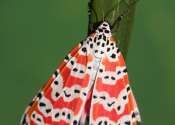
A moth is an insect closely related to the butterfly, both being of the order Lepidoptera. Moths form the majority of this order; there are thought to be 150,000 to 250,000 different species of moth (about ten times the number of species of butterfly), with thousands of species yet to be described. Most species of moth are nocturnal, but there are crepuscular and diurnal species.
For more information about Moth, read the full article at
Wikipedia.
This text uses material from Wikipedia and is available under the GNU Free Documentation License.