Clues from deep magma reservoirs could improve volcanic eruption forecasts
New research into molten rock 20km below the Earth's surface could help save lives by improving the prediction of volcanic activity.
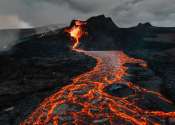
New research into molten rock 20km below the Earth's surface could help save lives by improving the prediction of volcanic activity.
Earth Sciences
4 hours ago
0
36
Little is known about the nature and evolution of Earth's continental crust before a few billion years ago because cratons, or stable swaths of the lithosphere more than 2–3 billion years old, are relatively rare.
Earth Sciences
Apr 24, 2024
0
309

Orange lava bubbles and pops, occasionally spewing large fountains from a volcano that has been erupting for a month in Iceland, the second-longest eruption since the region's volcanic activity reawakened in March 2021.
Environment
Apr 16, 2024
0
3

Zircons, a mineral nearly as old as Earth itself, crystalize when magmas (molten rocks) cool and can be found in trace quantities in magmatic rocks. The formation of magma constitutes the mountains on the Earth. Through interactions ...
Earth Sciences
Mar 13, 2024
0
14

In the search for potentially life-supporting exoplanets, liquid water is the key indicator. Life on Earth requires liquid water, and scientists strongly believe the same is true elsewhere. But from a great distance, it's ...
Astronomy
Jan 17, 2024
0
29

A volcanic eruption that has engulfed homes in an Icelandic fishing port confirms that a long-dormant faultline running under the country has woken up, threatening to belch out lava with little warning for years to come, ...
Environment
Jan 16, 2024
4
40

New research has cracked a vital process in the creation of a unique rock type from the moon. The discovery explains its signature composition and very presence on the lunar surface at all, unraveling a mystery that has long ...
Astronomy
Jan 15, 2024
1
76

University of Oregon researchers are adding new details to the geological history of the iconic Columbia River Gorge, a wide river canyon that cuts through the volcanic peaks of the Cascades along the border between Oregon ...
Earth Sciences
Jan 8, 2024
0
196

The signs started appearing in early November, and people waited anxiously as earthquakes and ground swells indicated a volcanic eruption near Grindavik, Iceland, was imminent.
Earth Sciences
Dec 20, 2023
0
2

Can a volcano erupt after tens of thousands of years of dormancy? If so, how can this be explained and what makes volcanic eruptions more dangerous?
Earth Sciences
Dec 12, 2023
0
123
Magma is molten rock that is found beneath the surface of the Earth, and may also exist on other terrestrial planets. Besides molten rock, magma may also contain suspended crystals and gas bubbles. Magma often collects in a magma chamber inside a volcano. Magma is capable of intrusion into adjacent rocks, extrusion onto the surface as lava, and explosive ejection as tephra to form pyroclastic rock.
Magma is a complex high-temperature fluid substance. Temperatures of most magmas are in the range 700°C to 1300°C (or 1292°F to 2372°F), but very rare carbonatite melts may be as cool as 600°C, and komatiite melts may have been as hot as 1600°C. Most are silicate solutions.
Environments of magma formation and compositions are commonly correlated. Environments include subduction zones, continental rift zones, mid-oceanic ridges, and hotspots, some of which are interpreted as mantle plumes. Despite being found in such widespread locales, the bulk of the Earth's crust and mantle is not molten. Rather, most of the Earth takes the form of a rheid, a form of solid that can move or deform under pressure. Magma, as liquid, preferentially forms in high temperature, low pressure environments within several kilometers of the Earth's surface.
Magma compositions may evolve after formation by fractional crystallization, contamination, and magma mixing. By definition, all igneous rock is formed from magma.
While the study of magma has historically relied on observing magma in the form of lava outflows, magma was discovered in situ for the first time in 2008.
This text uses material from Wikipedia, licensed under CC BY-SA
