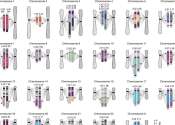
A gene is the basic unit of heredity in a living organism. All living things depend on genes. Genes hold the information to build and maintain their cells and pass genetic traits to offspring. A modern working definition of a gene is "a locatable region of genomic sequence, corresponding to a unit of inheritance, which is associated with regulatory regions, transcribed regions, and or other functional sequence regions " . In common usage, the term gene often refers to what is known more accurately as an allele.
The notion of a gene has evolved with the science of genetics, which began when Gregor Mendel noticed that biological variations are inherited from parent organisms as specific, discrete traits. The biological entity responsible for defining traits was termed a gene, but the biological basis for inheritance remained unknown until DNA was identified as the genetic material in the 1940s. All organisms have many genes corresponding to many different biological traits, some of which are immediately visible, such as eye color or number of limbs, and some of which are not, such as blood type or increased risk for specific diseases, or the thousands of basic biochemical processes that comprise life.
In cells, a gene is a portion of DNA that contains both "coding" sequences that determine what the gene does, and "non-coding" sequences that determine when the gene is active (expressed). When a gene is active, the coding and non-coding sequences are copied in a process called transcription, producing an RNA copy of the gene's information. This piece of RNA can then direct the synthesis of proteins via the genetic code. In other cases, the RNA is used directly, for example as part of the ribosome. The molecules resulting from gene expression, whether RNA or protein, are known as gene products, and are responsible for the development and functioning of all living things.
In more technical terms, a gene is a locatable region of genomic sequence, corresponding to a unit of inheritance, and is associated with regulatory regions, transcribed regions and/or other functional sequence regions. The physical development and phenotype of organisms can be thought of as a product of genes interacting with each other and with the environment. A concise definition of a gene, taking into account complex patterns of regulation and transcription, genic conservation and non-coding RNA genes, has been proposed by Gerstein et al.: "A gene is a union of genomic sequences encoding a coherent set of potentially overlapping functional products".