How fish won the oxygen war
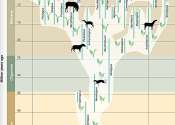
(Phys.org) —A missing link in the story of how the fishes triumphed over toxic oceans and past climate changes has been revealed by an international team of scientists.
A comprehensive new study of more than 7,000 species of fish documents for the first time correlation on a grand scale between the rapidity of the origin of the species and the rate of morphological change.
Efforts to restore sturgeon in the Great Lakes region have received a lot of attention in recent years, and many of the news stories note that the prehistoric-looking fish are "living fossils" virtually unchanged ...
Humans, like other animals, compare things. We care not only how well off we are, but whether we are better or worse off than others around us, or than we were last year. New research by scientists at the University of Bristol ...
Scientists studying how early land vertebrates evolved from fishes long thought that the animals developed legs for moving around on land well before their feeding systems and dietary habits changed enough ...
If you thought the only way to solve a puzzle was by looking at a picture of its end result as you go, guess again. Using an innovative approach to the study of genetic diversity, an international research ...
(Phys.org) —If you've owned a pet guppy, you know they often jump out of their tanks. Many a child has asked why the guppy jumped; many a parent has been stumped for an answer. Now a study by University ...
An international research team in including Christian Schlötterer and Alistair McGregor of the Vetmeduni Vienna has discovered a completely new mechanism by which evolution can change the appearance of an ...
We might be what our bacteria eat, says a Cornell entomology professor, who is using the tiny fruit fly to investigate this gutsy idea.
Model calculations predict a sea level rise of about one meter by the end of this century and of up to five and a half meters by the year 2500. Until now there are few studies on the potential impacts of ...