Gigantic Jurassic raptor footprints unearthed in China
Scientists have discovered the tracks of a 5 meter-long raptor dinosaur, challenging what was previously known about the species' size range.
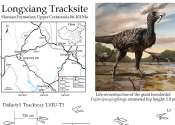
Scientists have discovered the tracks of a 5 meter-long raptor dinosaur, challenging what was previously known about the species' size range.
Paleontology & Fossils
21 hours ago
0
63

As a scientist, lab work can sometimes get monotonous. But in 2017, while a Ph.D. student of paleobiology at the University of Bristol in the U.K., I heard a gleeful exclamation from across the room. Kirsty Penkman, head ...
Paleontology & Fossils
Apr 10, 2024
0
965

The earliest dinosaurs had rapid growth rates, but so did many of the other animals living alongside them, according to a study published in PLOS ONE by Kristina Curry Rogers of Macalester College, Minnesota and colleagues.
Paleontology & Fossils
Apr 3, 2024
0
88

A team of archaeologists and paleontologists affiliated with several institutions in Brazil has found evidence that ancient artists living in what is now Brazil may have created petroglyphs that were inspired by preserved ...

A large find of dinosaur tracks and fossilized plants and tree stumps in far northwestern Alaska provides new information about the climate and movement of animals near the time when they began traveling between the Asian ...
Paleontology & Fossils
Mar 12, 2024
8
179

Have you ever wondered what it would be like travel back in time to the age of dinosaurs? If you stumble upon a time machine, remember to bring your binoculars. Birdwatching is a popular hobby today, with an around 3 million ...
Paleontology & Fossils
Mar 12, 2024
0
2

66 million years ago, the last dinosaurs vanished from Earth. We're still trying to understand why. New fossils of abelisaurs—distant relatives of the tyrannosaurs—from north Africa suggest that African dinosaurs remained ...
Ecology
Feb 12, 2024
0
82

Kilat, the largest living lizard at the Toronto Metro Zoo, like other members of his species (Varanus komodoensis), truly deserves to be called the Komodo dragon. His impressive size and the way he looks at you and tracks ...
Plants & Animals
Feb 7, 2024
0
351
What are the origins of wings and tails in birds? This is one of the key questions in the evolution of animals. It has long been accepted that their evolution began in feathered dinosaurs.
Plants & Animals
Jan 25, 2024
0
255

Were dinosaurs already on their way out when an asteroid hit Earth 66 million years ago, ending the Cretaceous, the geologic period that started about 145 million years ago? It's a question that has vexed paleontologists ...
Paleontology & Fossils
Jan 25, 2024
0
234
Dinosaurs (Greek: δεινόσαυρος, deinosauros) were the dominant vertebrate animals of terrestrial ecosystems for over 160 million years, from the late Triassic period (about 230 million years ago) until the end of the Cretaceous period (65 million years ago), when most of them became extinct in the Cretaceous–Tertiary extinction event. The 10000 living species of birds may be classified as dinosaurs.
The term "dinosaur" was coined in 1842 by Sir Richard Owen and derives from Greek δεινός (deinos) "terrible, powerful, wondrous" + σαῦρος (sauros) "lizard". It is sometimes used informally to describe other prehistoric reptiles, such as the pelycosaur Dimetrodon, the winged pterosaurs, and the aquatic ichthyosaurs, plesiosaurs and mosasaurs, although none of these animals were dinosaurs. Through the first half of the 20th century, most of the scientific community believed dinosaurs to have been slow, unintelligent cold-blooded animals. Most research conducted since the 1970s, however, has supported the view that dinosaurs were active animals with elevated metabolisms and numerous adaptations for social interaction. The resulting transformation in the scientific understanding of dinosaurs has gradually filtered into popular consciousness.
The 1861 discovery of the primitive bird Archaeopteryx first suggested a close relationship between dinosaurs and birds. Aside from the presence of fossilized feather impressions, Archaeopteryx was very similar to the contemporary small predatory dinosaur Compsognathus. Research has since identified theropod dinosaurs as the most likely direct ancestors of birds; most paleontologists today regard birds as the only surviving dinosaurs, and some suggest that dinosaurs and birds should be grouped into one biological class. Aside from birds, crocodilians are the only other close relatives of dinosaurs to have survived until the present day. Like dinosaurs and birds, crocodilians are members of Archosauria, a group of reptiles that first appeared in the very late Permian and came to predominate in the mid-Triassic.
Since the first dinosaur fossils were recognized in the early nineteenth century, mounted dinosaur skeletons have become major attractions at museums around the world. Dinosaurs have become a part of world culture and remain consistently popular. They have been featured in best-selling books and films (notably Jurassic Park), and new discoveries are regularly covered by the media.
This text uses material from Wikipedia, licensed under CC BY-SA
