News tagged with coffee
Physicists undo the 'coffee ring effect' (w/ video)
A team of University of Pennsylvania physicists has shown how to disrupt the "coffee ring effect" the ring-shaped stain of particles leftover after coffee drops evaporate by changing the particle ...
Aug 17, 2011 |
4.5 / 5 (13) |
1
|
Gene found to have jumped from gut bacteria to beetle
(PhysOrg.com) -- Genes jumping between bacteria are rather common which in part explains their ability to rapidly develop immunity to antibacterial agents. Whats not so common are examples of genes jumping ...
Balloon filled with ground coffee makes ideal robotic gripper (w/ Video)
(PhysOrg.com) -- The human hand is an amazing machine that can pick up, move and place objects easily, but for a robot, this "gripping" mechanism is a vexing challenge. Opting for simple elegance, researchers ...
Oct 25, 2010 |
5 / 5 (26) |
7
|
Coffee is good for women working in pairs, but bad for men
(PhysOrg.com) -- A new study from the UK suggests that women who drink coffee may perform better in stressful situations than those on decaffeinated beverages. For men, it's the opposite.
Got a craving for fast food? Skip the coffee, study says
Eating a fatty fast food meal is never good for you, but washing that meal down with a coffee is even worse, according to a new University of Guelph study.
Apr 01, 2011 |
4.9 / 5 (8) |
6
|
How granular material becomes solid: Stress causes clogs in coffee and coal
It's easy to get in a jam. But it's much harder to explain exactly how or when it started.
Dec 14, 2011 |
5 / 5 (4) |
4
|
BBC Science Team Builds Coffee Fueled Car... The Carpuccino
(PhysOrg.com) -- Think you need a lot of coffee to get going in the morning? How about 56 espressos? That’s the kind of power the experimental car, the "Carpuccino," needs just to travel one mile!
Coffee consumption unrelated to alertness
(PhysOrg.com) -- The stimulatory effects of caffeine may be nothing more than an illusion according to new research, which shows there is no real benefit to be gained from the habitual morning cup of coffee.
Medicine & Health / Psychology & Psychiatry
Jun 02, 2010 |
3.5 / 5 (10) |
6
|
How world's smallest 'coffee ring' may help biosensors detect disease
(PhysOrg.com) -- The field of biosensing has recently found an unlikely partner in the quest for increased sensitivity: coffee rings. The next time you spill your coffee on a table, look at the spot left after ...
May 05, 2010 |
3.5 / 5 (2) |
0
|
Carbonized coffee grounds remove foul smells
For coffee lovers, the first cup of the morning is one of life's best aromas. But did you know that the leftover grounds could eliminate one of the worst smells around sewer gas?
Feb 08, 2012 |
5 / 5 (4) |
2
|
Physicists see the cosmos in a coffee cup
(PhysOrg.com) -- A Duke University professor and his graduate student have discovered a universal principle that unites the curious interplay of light and shadow on the surface of your morning coffee with ...
Apr 14, 2009 |
4.6 / 5 (22) |
4
Engineers introduce 'beans' to cool and then maintain hot beverage temps
(PhysOrg.com) -- Buddies and mechanical engineers, Dave Petrillo and Dave Jackson, have, thanks to Kickstart.com, begun a business selling the Coffee Joulie (clearly a play on the word for joule, a unit of ...
Coffee Consumption Associated with Reduced Risk of Advanced Prostate Cancer
(PhysOrg.com) -- While it is too early for physicians to start advising their male patients to take up the habit of regular coffee drinking, data presented at the American Association for Cancer Research Frontiers ...
Dec 07, 2009 |
4.6 / 5 (5) |
0
Rebuilding the head of an armoured dinosaur (w/ video)
(PhysOrg.com) -- A University of Alberta-led research team has taken a rare look inside the skull of a dinosaur and come away with unprecedented details on the brain and nasal passages of the 72 million year ...
Other Sciences / Archaeology & Fossils
Sep 29, 2011 |
5 / 5 (4) |
2
|
A multi-touch coffee table display may be coming to an office near you
(PhysOrg.com) -- Multi-touch tables and displays are not really a new thing. They have been used in museum exhibitions for a few years now, and even in some medial applications. The idea of having a multi-touch ...
Coffee
Coffee is a brewed beverage prepared from roasted seeds, commonly called coffee beans, of the coffee plant. Due to its caffeine content, coffee can have a stimulating effect in humans. Today, coffee is one of the most popular beverages worldwide.
It is supposed that the Ethiopians, the ancestors of today's Galla tribe, were the first to have discovered and recognized the energizing effect of the coffee bean plant. However, no direct evidence has ever been found revealing exactly where in Africa coffee grew or who among the natives might have used it as a stimulant or even known about it there earlier than the seventeenth century. The earliest credible evidence of either coffee drinking or knowledge of the coffee tree appears in the middle of the fifteenth century, in the Sufi monasteries of the Yemen in southern Arabia. From Yemen, coffee spread to Egypt and Ethiopia, and by the 15th century, had reached Armenia, Persia, Turkey, and northern Africa. From the Muslim world, coffee spread to Italy, then to the rest of Europe, to Indonesia, and to the Americas.
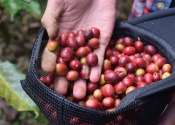
Coffee berries, which contain the coffee bean, are produced by several species of small evergreen bush of the genus Coffea. The two most commonly grown species are Coffea canephora (also known as Coffea robusta) and Coffea arabica; less popular species are Liberica, Excelsa, Stenophylla, Mauritiana, Racemosa. These are cultivated primarily in Latin America, Southeast Asia, and Africa. Once ripe, coffee berries are picked, processed, and dried. The seeds are then roasted, undergoing several physical and chemical changes. They are roasted to varying degrees, depending on the desired flavor. They are then ground and brewed to create coffee. Coffee can be prepared and presented in a variety of ways.
Coffee has played an important role in many societies throughout history. In Africa and Yemen, it was used in religious ceremonies. As a result, the Ethiopian Church banned its secular consumption until the reign of Emperor Menelik II of Ethiopia. It was banned in Ottoman Turkey in the 17th century for political reasons, and was associated with rebellious political activities in Europe.
Coffee is an important export commodity. In 2004, coffee was the top agricultural export for 12 countries, and in 2005, it was the world's seventh-largest legal agricultural export by value.
Some controversy is associated with coffee cultivation and its impact on the environment. Many studies have examined the relationship between coffee consumption and certain medical conditions; whether the overall effects of coffee are positive or negative is still disputed.
For more information about Coffee, read the full article at
Wikipedia.
This text uses material from Wikipedia and is available under the GNU Free Documentation License.