Hubble digs up galactic glow worm
(Phys.org) —This charming and bright galaxy, known as IRAS 23436+5257, was captured by the NASA/ESA Hubble Space Telescope. It is located in the northern constellation of Cassiopeia, which is named after ...
A European research team has published the results of a 30-year study of an extraordinary hypergiant star. They have found that the surface temperature of the super-luminous star HR 8752 increased by about ...
(Phys.org)—Just in time for the holidays, a spectacular image of the Bubble Nebula (NGC 7635) demonstrates the potential of the new camera known as the One Degree Imager, or ODI, that is being commissioned ...
(Phys.org)—A team of scientists from six European countries reported today they have finalized a thirty years long investigation of a hypergiant star that crossed the Yellow Evolutionary Void. In that period ...
In the late eighth century, Earth was hit by a mystery blast of cosmic rays, according to a Japanese study that found a relic of the powerful event in cedar trees.
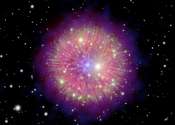
(PhysOrg.com) -- A new X-ray study of the remains of an exploded star indicates that the supernova that disrupted the massive star may have turned it inside out in the process. Using very long observations ...
(PhysOrg.com) -- In early November 1572, observers on Earth witnessed the appearance of a "new star" in the constellation Cassiopeia, an event now recognized as the brightest naked-eye supernova in more than ...
(PhysOrg.com) -- To visible-light telescopes, this star-forming cloud appears to be chomping through the cosmos, earning it the nickname the "Pacman" nebula, like the famous Pac-Man video game that debuted ...
One of the abiding legends of Britain's royal family is that a noon-day star appeared at the birth in 1630 of King Charles II, who was to restore the English monarchy after the execution of his father.
In its first five years in orbit, NASA's Swift satellite has given astronomers more than they could have hoped for. Its discoveries range from a nearby nascent supernova to a blast so far away that it happened ...
(PhysOrg.com) -- Since Galileo first pointed a telescope at the sky 400 years ago, a myriad of technological advances have allowed astronomers to look at very faint objects, very distant objects, and even ...
(PhysOrg.com) -- Evidence for a thin veil of carbon has been found on the neutron star in the Cassiopeia A supernova remnant. This discovery, made with NASA's Chandra X-ray Observatory, resolves a ten-year ...
Scientists from NRL's Space Science and Remote Sensing Divisions, in collaboration with researchers from the University of New Mexico and the National Radio Astronomy Observatory located in Socorro, N.M., ...
(PhysOrg.com) -- Two new efforts have taken a famous supernova remnant from the static to the dynamic. A new movie of data from NASA's Chandra X-ray Observatory shows changes in time never seen before in ...