Frontpage » Tag » ants

News tagged with ants

Carnivorous plants rely on the services and wastes of a symbiotic ant for nutrition

In a mutualistic relationship between an ant species and a carnivorous plant, the ants contribute to both prey capture and prey digestion of their host-plant and provide significant amounts of nutrients derived from their ...

Biology / Plants & Animals

created May 09, 2012 | popularity not rated yet | comments 0

Insect glands may illuminate human fertilization process

Insect glands are responsible for producing a host of secretions that allow bees to sting and ants to lay down trails to and from their nests. New research from Carnegie scientists focuses on secretions from glands in the ...

Biology / Plants & Animals

created May 03, 2012 | popularity 5 / 5 (3) | comments 0 | with audio podcast

The zombie-ant fungus is under attack, research reveals

A parasite that fights the zombie-ant fungus has yielded some of its secrets to an international research team led by David Hughes of Penn State University. The research reveals, for the first time, how an ...

Biology / Plants & Animals

created May 02, 2012 | popularity 5 / 5 (4) | comments 1 | with audio podcast

Ant queens lay more eggs as they age

Ant queens get better at laying eggs as they get older, researchers report in the Apr. 11 issue of the open access journal PLoS ONE. Furthermore, this high egg-laying rate did not shorten the queens' life spans, as would ...

Biology / Plants & Animals

created Apr 11, 2012 | popularity not rated yet | comments 0

Fire ant colonies seem to be down dramatically

The red imported fire ant, one of the most horrifying of the foreign species that have established themselves in the United States, appears to be in retreat.

Biology / Ecology

created Apr 04, 2012 | popularity 5 / 5 (1) | comments 0

How social contact with sick ants protects their nestmates

In a research article published April 3 in the online, open-access journal PLoS Biology, Prof. Sylvia Cremer and colleagues at the Institute of Science and Technology, Austria show how micro-infections promot ...

Biology / Plants & Animals

created Apr 03, 2012 | popularity 4.8 / 5 (6) | comments 1 | with audio podcast

Ants can learn vibrational and magnetic landmarks

(PhysOrg.com) -- Foraging desert ants always find their way back to the nest, even when it is only marked by a magnetic cue, vibration, or carbon dioxide.

Biology / Plants & Animals

created Mar 07, 2012 | popularity 5 / 5 (1) | comments 0 | with audio podcast

Ant identification boosts blue butterflies

Scientists have developed a fast, cheap and reliable technique that vastly improves the chances of successfully reintroducing the endangered large blue butterfly to the UK.

Biology / Ecology

created Mar 05, 2012 | popularity 5 / 5 (1) | comments 1 | with audio podcast

Flying robots swoop and swarm as a team

Tech-savvy TED-goers watched in wonder as flying robots darted through tossed hoops, worked together in swarms and even formed a band to play trademark "James Bond" film theme music.

Electronics / Robotics

created Mar 03, 2012 | popularity 4.3 / 5 (12) | comments 7

Bacteria tend leafcutter ants' gardens

(PhysOrg.com) -- Leafcutter ants, the tiny red dots known for carrying green leaves as they march through tropical forests, are also talented farmers that cultivate gardens of fungi and bacteria. Ants eat ...

Biology / Cell & Microbiology

created Mar 01, 2012 | popularity 5 / 5 (1) | comments 0 | with audio podcast

Ant colonies remember rivals' odor and compete like sports fans

A new study led by the University of Melbourne has shown that weaver ants share a collective memory for the odour of ants in rival nests, and use the information to identify them and compete, similar to how sports fans know ...

Biology / Plants & Animals

created Feb 21, 2012 | popularity not rated yet | comments 0 | with audio podcast

New studies show promise for biological control methods against insects

(PhysOrg.com) -- For years, scientists have tried to use environmentally friendly fungi to control fire ant infestations.

Biology / Biotechnology

created Feb 01, 2012 | popularity 3.5 / 5 (2) | comments 0 | with audio podcast

Supersoldier ants created in the lab by reactivating ancestral genes

(PhysOrg.com) -- There are over 1100 species of Pheidole genus ants, and most individual ants belong to either the worker or soldier caste. In only eight of the Pheidole species, some individuals can belong ...

Biology / Biotechnology

created Jan 06, 2012 | popularity 4.1 / 5 (23) | comments 21 | with audio podcast report

Worker ants paralyze and kill termites from afar

Worker ants from a particular species of African ants have potent venom that can paralyze and kill termites from a distance, according to a study published Dec. 14 in the online journal PLoS ONE.

Biology / Plants & Animals

created Dec 14, 2011 | popularity 5 / 5 (2) | comments 10

Populations of invasive ants die out naturally, saving millions in control and eradication

(PhysOrg.com) -- New research shows populations of an invasive species of ants frequently collapse without human involvement, potentially saving millions of dollars on control and eradication.

Biology / Plants & Animals

created Dec 01, 2011 | popularity 2.5 / 5 (2) | comments 0 | with audio podcast

Ant

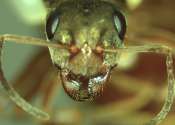
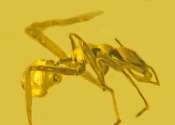
Ants are social insects of the family Formicidae (pronounced /fɔrˈmɪsəˌdiː/), and along with the related wasps and bees, they belong to the order Hymenoptera. Ants evolved from wasp-like ancestors in the mid-Cretaceous period between 110 and 130 million years ago and diversified after the rise of flowering plants. Today, more than 12,000 species are classified with upper estimates of about 14,000 species. They are easily identified by their elbowed antennae and a distinctive node-like structure that forms a slender waist.

Ants form colonies that range in size from a few dozen predatory individuals living in small natural cavities to highly organised colonies which may occupy large territories and consist of millions of individuals. These larger colonies consist mostly of sterile wingless females forming castes of "workers", "soldiers", or other specialised groups. Nearly all ant colonies also have some fertile males called "drones" and one or more fertile females called "queens". The colonies are sometimes described as superorganisms because the ants appear to operate as a unified entity, collectively working together to support the colony.

Ants have colonised almost every landmass on Earth. The only places lacking indigenous ants are Antarctica and certain remote or inhospitable islands. Ants thrive in most ecosystems, and may form 15–25% of the terrestrial animal biomass. Their success has been attributed to their social organisation and their ability to modify habitats, tap resources, and defend themselves. Their long co-evolution with other species has led to mimetic, commensal, parasitic, and mutualistic relationships.

Ant societies have division of labour, communication between individuals, and an ability to solve complex problems. These parallels with human societies have long been an inspiration and subject of study.

Many human cultures make use of ants in cuisine, medication and rituals. Some species are valued in their role as biological pest control agents. However, their ability to exploit resources brings ants into conflict with humans, as they can damage crops and invade buildings. Some species, such as the red imported fire ant, are regarded as invasive species, since they have established themselves in new areas where they have been accidentally introduced.

For more information about Ant, read the full article at Wikipedia.
This text uses material from Wikipedia and is available under the GNU Free Documentation License.

Related topics: species , genes , fungus , bees , wasps