An anarchic region of star formation
(Phys.org) —The Danish 1.54-meter telescope located at ESO's La Silla Observatory in Chile has captured a striking image of NGC 6559, an object that showcases the anarchy that reigns when stars form inside ...
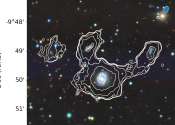
(Phys.org) —Scientists have used Chandra to make a detailed study of an enormous cloud of hot gas enveloping two large, colliding galaxies. This unusually large reservoir of gas contains as much mass as ...
(Phys.org) —Staring at a small patch of sky for more than 50 hours with the ultra-sensitive Karl G. Jansky Very Large Array (VLA), astronomers have for the first time identified discrete sources that account ...
An international team of astronomers, including Alexandre Santerne of the EXOEarths team at CAUP, identified and characterized two new exoplanets, thanks to combined observations from the Kepler space telescope, ...
Europe's deep-space Herschel telescope has given up the ghost—running out of coolant after a successful mission to observe the birth of stars and galaxies, the European Space Agency said Monday.
(Phys.org) —A University of Washington astronomer is using Earth's interstellar neighbors to learn the nature of certain stars too far away to be directly measured or observed, and the planets they may host.
(Phys.org) —Two recent contests—one run by the SETI researchers that made the two most recent Pluto moon discoveries and another by an independent group called Uwingu to name an exoplanet—have caused ...
(Phys.org) —Astronomers have released a new image of the outer atmosphere of Betelgeuse – one of the nearest red supergiants to Earth – revealing the detailed structure of the matter being thrown off ...
(Phys.org) —Because it has no source of energy, a dead star—known as a white dwarf—will eventually cool down and fade away. But circumstantial evidence suggests that white dwarfs can still support habitable ...
A team of researchers at the Kavli IPMU led by Robert Quimby has identified what may prove to be the first ever Type Ia supernova (SNIa) magnified by a strong gravitational lens. In this work, the 'standard ...
(Phys.org) —Super-high-energy galactic gamma rays have trillions of times more energy than visible light, and they disappear in the atmosphere before they hit the Earth's surface. So if you want to detect ...
(Phys.org) —With this new view of a spectacular stellar nursery ESO is celebrating 15 years of the Very Large Telescope—the world's most advanced optical instrument. This picture reveals thick clumps ...
Pulsars have a number of unusual qualities. Like zombies, they shine even though they're technically dead, and they rotate rapidly, emitting powerful and regular beams of radiation that are seen as flashes ...
(Phys.org) —Bright arcs are smeared around the heart of galaxy cluster Abell S1077 in this image taken by the NASA/ESA Hubble space telescope. The arcs are stretched images of distant galaxies distorted ...
It is obvious from the data of the KASCADE-Grande experiment at the Karlsruhe Institute of Technology (KIT) that the so-called "knee" of the cosmic rays, a bend in the energy spectrum at high energies, is ...