Cassini Radar Images Sea, Islands and Mountains
May 24, 2007
Cassini Radar Images Sea, Islands and Mountains

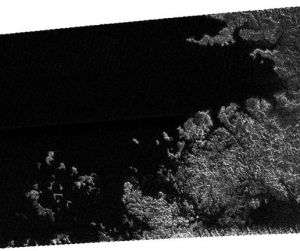
On May 12, 2007, Cassini completed its 31st flyby of Saturn's moon Titan, which the team calls T30. The radar instrument obtained this image showing the coastline and numerous island groups of a portion of a large sea, consistent with the larger sea seen by the Cassini imaging instrument.

Like other bodies of liquid seen on Titan, this feature reveals channels, islands, bays, and other features typical of terrestrial coastlines, and the liquid, most likely a combination of methane and ethane, appears very dark to the radar instrument. What is striking about this portion of the sea compared to other liquid bodies on Titan is the relative absence of brighter regions within it, suggesting that the depth of the liquid here exceeds tens of meters (tens of yards).

Of particular note is the presence of isolated islands, which follow the same direction as the peninsula to their lower right, suggesting that they may be part of a mountain ridgeline that has been flooded. This is analogous to, for example, Catalina Island off the coast of Southern California.

The image as shown is about 160 kilometers (100 miles) by 270 kilometers (170 miles) at 300-meter (980-foot) resolution. The image is centered near 70 degrees north latitude and 310 west longitude.

The Cassini-Huygens mission is a cooperative project of NASA, the European Space Agency and the Italian Space Agency. The Jet Propulsion Laboratory, a division of the California Institute of Technology in Pasadena, manages the mission for NASA's Science Mission Directorate, Washington, D.C. The Cassini orbiter was designed, developed and assembled at JPL. The radar instrument was built by JPL and the Italian Space Agency, working with team members from the United States and several European countries.

Source: NASA

Explore further: Field tests in Mojave Desert pave way for human exploration of small bodies

add to favorites email to friend print save as pdf

Related Stories

Enceladus' jets reach all the way to its sea

Mar 20, 2013

Thanks to the Cassini mission we've known about the jets of icy brine spraying from the south pole of Saturn's moon Enceladus for about 8 years now, but this week it was revealed at the 44th Lunar and Planetary Science Conference outside Houst ...

Titan gets a dune 'makeover'

Jan 17, 2013

(Phys.org)—Titan's siblings must be jealous. While most of Saturn's moons display their ancient faces pockmarked by thousands of craters, Titan - Saturn's largest moon - may look much younger than it really ...

Cassini suggests icing on a Titan lake

Jan 08, 2013

(Phys.org)—It's not exactly icing on a cake, but it could be icing on a lake. A new paper by scientists on NASA's Cassini mission finds that blocks of hydrocarbon ice might decorate the surface of existing ...

Cassini spots mini Nile River on Saturn moon Titan

Dec 12, 2012

(Phys.org)—The international Cassini mission has spotted what appears to be a miniature extraterrestrial version of the Nile River: a river valley on Saturn's moon Titan that stretches more than 400 km ...

What's baking on Saturn's moon Titan?

Oct 16, 2012

(Phys.org)—Radar images from NASA's Cassini spacecraft reveal some new curiosities on the surface of Saturn's mysterious moon Titan, including a nearly circular feature that resembles a giant hot cross ...

Recommended for you

Mars rover Opportunity examines clay clues in rock

17 hours ago

(Phys.org) —NASA's senior Mars rover, Opportunity, is driving to a new study area after a dramatic finish to 20 months on "Cape York" with examination of a rock intensely altered by water.

NASA's STEREO detects a CME from the sun

May 17, 2013

On 5:24 a.m. EDT on May 17, 2013, the sun erupted with an Earth-directed coronal mass ejection or CME, a solar phenomenon that can send billions of tons of solar particles into space that can reach Earth ...

Nine-year-old Mars rover passes 40-year-old record

May 17, 2013

While Apollo 17 astronauts Eugene Cernan and Harrison Schmitt visited Earth's moon for three days in December 1972, they drove their mission's Lunar Roving Vehicle 19.3 nautical miles (22.210 statute miles ...

Bright explosion on the Moon

May 17, 2013

For the past 8 years, NASA astronomers have been monitoring the Moon for signs of explosions caused by meteoroids hitting the lunar surface. "Lunar meteor showers" have turned out to be more common than anyone ...

User comments : 0

More news stories

Galaxy's Ring of Fire

Johnny Cash may have preferred this galaxy's burning ring of fire to the one he sang about falling into in his popular song. The "starburst ring" seen at center in red and yellow hues is not the product of ...

Alaska volcano shoots ash 15,000 feet into the air

(AP)—One of Alaska's most restless volcanoes has shot an ash cloud 15,000 feet into the air in an ongoing eruption that has drawn attention from a nearby community but isn't expected to threaten air traffic.

Chinese, Indian airlines face EU pollution fines

Eight Chinese and two Indian airlines face fines of up to several million euros for not paying for their greenhouse gas emissions during flights within the bloc, the European Commission said on Friday.

US seizes Bitcoin operator accounts

US authorities seized the accounts of a Bitcoin digital currency exchange operator, claiming it was functioning as an "unlicensed money service business," court documents showed Friday.

Morocco to harness the wind in energy hunt

Morocco is ploughing ahead with a programme to boost wind energy production, particularly in the southern Tarfaya region, where Africa's largest wind farm is set to open in 2014.