From ink to optics, study of particle mixtures yields fundamental insights
Since the invention of ink over 3,000 years ago, people have exploited the unique properties of colloids, in which particles of one substance are suspended in another. Now, Princeton University chemical engineers have answered a fundamental question about these mixtures in work that may have wide-ranging practical applications, including the manufacturing of medicines and optical fibers.
Researchers have long tried to use computer simulations to determine the conditions under which colloids will exist in the solid, liquid and gas states -- knowledge that is necessary to capitalize fully on colloidal properties. Charting the freezing, melting and boiling points in "phase diagrams" has been difficult, however, because colloids contain an overwhelmingly large number of charged particles that attract and repel each other in very unusual ways. The problem was particularly difficult when the particles had very high static electric charges, which commonly occurs in practical situations.
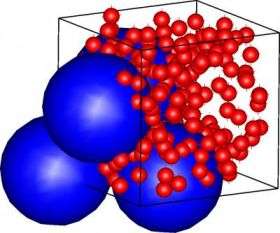
Athanassios Panagiotopoulos, the Susan Dod Brown Professor of Chemical Engineering at Princeton, and postdoctoral research associate Antti-Pekka Hynninen overcame this hurdle by realizing that they could accurately represent the system with just one to four colloidal particles and their oppositely charged counterparts, called counterions. Their result -- a complete phase diagram that is correct even when the particles have very high electric charges -- was published as an "Editors' Selection" in the May 11 issue of the journal Physical Review Letters.
"This is the closure of a long-standing, fundamental problem in statistical mechanics," said Panagiotopoulos, who credits Hynninen with the "elegant and powerful idea" to consider only a very small part of the colloidal system.
With the newfound ability to calculate accurate phase diagrams, researchers may be able to improve the fabrication of artificial opal crystals -- colloids essential for high-speed transmission of data given the way in which they diffract optical signals. In medicine, an enhanced understanding of colloids that contain proteins may enable the design and production of pharmaceutical formulations that are far more stable than those in existence today.
"This is truly pioneering work," said Sanat Kumar, a professor of chemical engineering at Columbia University, who was not affiliated with the research. "Before, the most elementary questions on this difficult, but highly relevant, topic were open. This work has really opened up the field."
Their work also revealed a surprising "love/hate relationship" among highly charged colloidal particles, which causes them to transition directly from a gas to a solid without ever going through a liquid phase. This strange behavior results from the previously observed fact that like-charged particles attract one another at close distances instead of the usual repulsion. At a certain intermediate distance, similarly charged particles switch from being strongly repulsed by one another to incredibly attracted to each other, which causes the phase transition direct from diffuse gas to dense solid.
Panagiotopoulos and Kumar predict that similar simulations of small numbers of particles to calculate the behavior of entire systems will allow researchers to explore a wide variety of fundamental and applied topics in physics, chemistry and biology. For example, the technique could be used in astrophysics to understand phase transitions of dense plasmas or in biology to explore the associations between proteins and DNA, which is key information for understanding the interactions that take place in living cells.
Source: Princeton University


