Mission Could Seek Out Spock's Home Planet
May 10, 2007
Mission Could Seek Out Spock's Home Planet
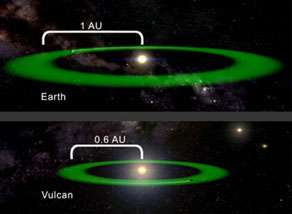
Artist's concept comparing our sun's habitable zone with that of 40 Eridani.

Science fiction may soon become science fact. Astronomers at NASA's Jet Propulsion Laboratory have recently concluded that the upcoming planet-finding mission, SIM PlanetQuest, would be able to detect an Earth-like planet around the star 40 Eridani, a planet familiar to "Star Trek" fans as "Vulcan." 40 Eridani, a triple-star system 16 light-years from Earth, includes a red-orange K dwarf star slightly smaller and cooler than our sun. Vulcan is thought to orbit that dwarf star, called 40 Eridani A.

When pondering the idea that SIM might be able to detect Vulcan, astronomer Dr. Angelle Tanner at Caltech had two questions: Can a planet form around 40 Eridani A? Can SIM detect such a planet?

She consulted a planetary theorist, Dr. Sean Raymond of the University of Colorado, Boulder. "Since the three members of the triple star system are so far away from each other [hundreds of astronomical units - the Earth-Sun distance], I see no reason why an Earth-mass planet would not be able to form around the primary star, 40 Eridani A," he said.

If Vulcan life were to exist on the planet, the orbit of the planet would have to lie in a sweet spot around the star where liquid water could be present on its surface. Water is an essential ingredient for any organism to live long and prosper. For 40 Eridani A, this spot, or "habitable zone," is 0.6 astronomical units from the star. That means Vulcans would get to celebrate a birthday about every six months.

The SIM PlanetQuest instrument will be so accurate, it could measure the thickness of a nickel at a distance from Earth to the moon. Using a set of mathematical models based on Newton's Laws, Tanner was able to conclude that SIM would be able to definitively determine whether there is an Earth-mass planet orbiting in the habitable zone around 40 Eridani A, and could also determine its orbit.

This is quite an exciting prospect, since NASA's Terrestrial Planet Finder mission, planned for launch after SIM, would not only be able to take a rudimentary "picture" of the planet, but also could search for signatures of life such as methane and ozone

When asked what life would be like on Vulcan, Tanner speculated that the inhabitants might be pale. "A K dwarf star emits its light at wavelengths which are a bit redder compared to those from the sun, so I wonder whether it's harder to get a tan there," she said.

The results of Tanner's simulations will be submitted for publication in the Publications of the Astronomical Society of the Pacific.

Source: NASA

Explore further: Unusual supernova is doubly unusual for being perfectly normal

add to favorites email to friend print save as pdf

Related Stories

Is calling E.T. a smart move?

Jan 29, 2010

In 2008, NASA beamed the Beatles song "Across the Universe" into deep space, sending a message of peace to any extraterrestrial who happens to be in the region of Polaris, also called the North Star, in 2439.

Solar System's Young Twin Has Two Asteroid Belts

Oct 27, 2008

(PhysOrg.com) -- Astronomers have discovered that the nearby star Epsilon Eridani has two rocky asteroid belts and an outer icy ring, making it a triple-ring system. The inner asteroid belt is a virtual twin ...

Recommended for you

Three centaurs follow Uranus through the solar system

Jun 18, 2013

Astrophysicists from the Complutense University of Madrid have confirmed that Crantor, a large asteroid with a diameter of 70 km has an orbit similar to that of Uranus and takes the same amount of time to ...

Final curtain for Europe's deep-space telescope

Jun 17, 2013

The deep-space telescope Herschel took its final bow on Monday, climaxing a successful four-year mission to observe the birth of stars and galaxies, the European Space Agency (ESA) said.

Hubble spots a very bright contortionist

Jun 17, 2013

(Phys.org) —The contorted object captured by Hubble in this picture is IRAS 22491-1808, also known as the South America Galaxy. It is an ultra-luminous infrared galaxy (ULIRG) that emits a huge amount of ...

Study explains decades of black hole observations

Jun 14, 2013

(Phys.org) —A new study by astronomers at NASA, Johns Hopkins University and Rochester Institute of Technology confirms long-held suspicions about how stellar-mass black holes produce their highest-energy ...

User comments : 0

More news stories

Philippines financial capital bans plastic bags

The Philippines financial capital banned disposable plastic shopping bags and styrofoam food containers on Thursday, as part of escalating efforts across the nation's capital to curb rubbish that exacerbates ...

Singapore haze at worst yet, Malaysia schools shut

Singapore urged people to remain indoors amid unprecedented levels of air pollution Thursday as a smoky haze wrought by forest fires in neighboring Indonesia worsened dramatically. Nearby Malaysia closed ...

China astronauts float water blob in kids' lecture

Astronauts struck floating martial arts poses, twirled gyroscopes and manipulated wobbling globes of water during a lecture Thursday from China's orbiting space station that's part of efforts to popularize ...

Panic over MERS virus fades in Saudi

People in Saudi Arabia's Eastern Province have again started greeting friends with the traditional kiss on the cheek, and face masks in public are becoming rarer, as panic subsides over the outbreak of a deadly respiratory ...

Sony chief says time needed to study proposal

Sony Corp. needs more time to study a key proposal from a U.S. hedge fund to spin off a part of its entertainment unit as a way to propel its fledgling revival, the chief executive told shareholders Thursday.

French firemen test hypnosis to help victims

"Look me straight in the eye. Your mind is emptying, your body is relaxing," says the fireman, using the calming words of hypnosis to help a trauma victim—a technique being pioneered by fire crews in the eastern French ...

Danish chemists in molecular chip breakthrough

Electronic components built from single molecules using chemical synthesis could pave the way for smaller, faster and more green and sustainable electronic devices. Now for the first time, a transistor made ...