Future Space Telescopes Could Detect Earth Twin
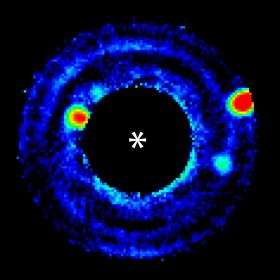
For the first time ever, NASA researchers have successfully demonstrated in the laboratory that a space telescope rigged with special masks and mirrors could snap a photo of an Earth-like planet orbiting a nearby star. This accomplishment marks a dramatic step forward for missions like the proposed Terrestrial Planet Finder, designed to hunt for an Earth twin that might harbor life.
Trying to image an exoplanet - a planet orbiting a star other than the sun - is a daunting task, because its relatively dim glow is easily overpowered by the intense glare of its much bigger, brighter parent star. The challenge has been compared to looking for a firefly next to a searchlight.
Now, two researchers at NASA's Jet Propulsion Laboratory in Pasadena, Calif., have shown that a fairly simple coronagraph - an instrument used to "mask" a star's glare - paired with an adjustable mirror, could enable a space telescope to image a distant planet 10 billion times fainter than its central star.
"Our experiment demonstrates the suppression of glare extremely close to a star, clearing a field dark enough to allow us to see an Earth twin. This is at least a thousand times better than anything demonstrated previously," said John Trauger, lead author of a paper appearing in the April 12 issue of Nature. This paper describes the system, called the High Contrast Imaging Testbed, and how the technique could be used with a telescope in space to see exoplanets. The lab experiment used a laser as a simulated star, with fainter copies of the star serving as "planets."
To date, scientists have used various techniques to detect more than 200 exoplanets. Most of these exoplanets are from five to 4,000 times more massive than Earth, and are either too hot, too cold or too much of a giant gas ball to be considered likely habitats for life. So far, no one has managed to capture an image of an exoplanetary system that resembles our own solar system. Scientists are eager to take a closer look at nearby systems, to hunt for and then characterize any Earth-like planets - those with the right size, orbit and other traits considered friendly for life.
In the lab demonstration, the High Contrast and Imaging Testbed overcame two significant hurdles that all telescopes face when trying to image exoplanets - diffracted and scattered light.
When starlight hits the edge of a telescope's primary mirror, it becomes slightly disturbed, producing a pattern of rings or spikes surrounding the major source of light in the focused image. This diffracted light can completely obscure any planets in the field of view.
To address this problem, Trauger and his colleagues at JPL fashioned a pair of masks for their system. The first, which resembles a blurry barcode, directly blocks most of the starlight, while the second clears away the diffracted rings and spikes. The combination creates enough darkness to allow the light of any planets to shine through.
"Mathematically, and sort of magically, this coronagraph blocks both the central star and its rings," said Wesley Traub of JPL, co-author of the new paper and Terrestrial Planet Finder project scientist.
Scattered light presents the additional hurdle. Minor ripples on a telescope's mirror produce "speckles" - faint copies of a star, shifted to the side, which can also hide planets. In the High Contrast Imaging Testbed, a deformable mirror the size of a large coin limits scattered light. With a surface that can be altered ever so slightly by computer-controlled actuators, this mirror compensates for the effects of minor imperfections in the telescope and instrument.
"This result is important because it points the way to building a space telescope with the ability to detect and characterize Earth-like planets around nearby stars," Traub said.
For their next steps, Trauger and Traub plan to improve the suppression of speckles by a factor of 10, and extend the method to accommodate many wavelengths of light simultaneously.
Source: NASA


