Chandra Sheds Light on Galaxy Collision
Mar 29, 2007
Chandra Sheds Light on Galaxy Collision
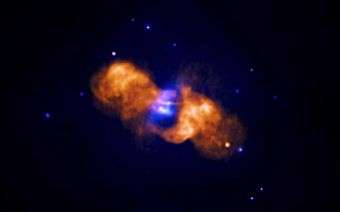
Image credit: X-ray: NASA/CXC/Univ. of Bristol/Worral et al.; Radio: NRAO/AUI/NSF

Astronomers think that there are enormous black holes at the centers of most, if not all, galaxies. These black holes, which can be millions or even billions of times more massive than the Sun, can greatly affect the galaxy and the environments around them.

One way such black holes shape their surroundings is by generating powerful jets of high-energy particles. The jets, which are bright in radio waves, have been seen to push around the hot gas that envelopes the galaxy. When this happens, astronomers can detect huge cavities and powerful shock fronts in the hot, X-ray emitting gas.

However, the opposite scenario is apparently unfolding in the galaxy known as 3C442A. X-ray data from NASA's Chandra X-ray Observatory and radio observations from the NSF's Very Large Array show that the hot gas (blue) in the middle of 3C442A is pushing apart the radio-bright gas (orange). The inner sections of the radio structure are sharp and concave, which is consistent with the idea that the X-ray bright gas is sweeping the radio-emitting gas aside. This is the first convincing evidence for such a role reversal.

A team of scientists, led by Diana Worrall of University of Bristol, UK, has studied this system and determined why the dynamics in 3C442A seem to be topsy-turvy. First, there are two galaxies near the middle of 3C442A which are in the process of merging. These two galaxies are on their second pass toward a collision, having already experienced a close encounter. The energy generated from this impending merger is heating the combined atmospheres from these two galaxies, causing them to shine brightly in X-rays and expand.

The researchers determined that the jets that had produced the lobes of radio-emitting gas are no longer active. The jets may have ceased at the time of, and possibly as a result of, the galaxy collision. Since the radio-emitting gas no longer has a power source, it is then at the mercy of the expanding hot gas and has been pushed aside.

Source: NASA

Explore further: Galaxies fed by funnels of fuel

add to favorites email to friend print save as pdf

Related Stories

Fragile mega-galaxy is missing link in history of cosmos

May 22, 2013

Two hungry young galaxies that collided 11 billion years ago are rapidly forming a massive galaxy about 10 times the size of the Milky Way, according to UC Irvine-led research published Wednesday in the journal ...

4C+29.30: Black hole powered jets plow into galaxy

May 15, 2013

(Phys.org) —This composite image of a galaxy illustrates how the intense gravity of a supermassive black hole can be tapped to generate immense power. The image contains X-ray data from NASA's Chandra X-ray ...

Sifting through the atmospheres of far-off worlds

May 09, 2013

(Phys.org) —Gone are the days of being able to count the number of known planets on your fingers. Today, there are more than 800 confirmed exoplanets—planets that orbit stars beyond our sun—and more ...

Spitzer telescope puts planets in a petri dish

May 06, 2013

(Phys.org) —Our galaxy is teeming with a wild variety of planets. In addition to our solar system's eight near-and-dear planets, there are more than 800 so-called exoplanets known to circle stars beyond ...

Fermi and Swift see 'shockingly bright' burst

May 03, 2013

A record-setting blast of gamma rays from a dying star in a distant galaxy has wowed astronomers around the world. The eruption, which is classified as a gamma-ray burst, or GRB, and designated GRB 130427A, ...

Recommended for you

Galaxies fed by funnels of fuel

May 24, 2013

(Phys.org) —Computer simulations of galaxies growing over billions of years have revealed a likely scenario for how they feed: a cosmic version of swirly straws.

Hubble reveals the ring nebula's true shape

May 23, 2013

(Phys.org) —The Ring Nebula's distinctive shape makes it a popular illustration for astronomy books. But new observations by NASA's Hubble Space Telescope of the glowing gas shroud around an old, dying, ...

User comments : 0

More news stories

Galaxies fed by funnels of fuel

(Phys.org) —Computer simulations of galaxies growing over billions of years have revealed a likely scenario for how they feed: a cosmic version of swirly straws.

Century-old science helps confirm global warming

(Phys.org) —Ocean measurements taken more than 135 years ago during the scientific expedition of HMS Challenger have provided further confirmation of human-produced global warming over the past century.