Space Data Unveils Evidence of Ancient Mega-lake in Northern Darfur
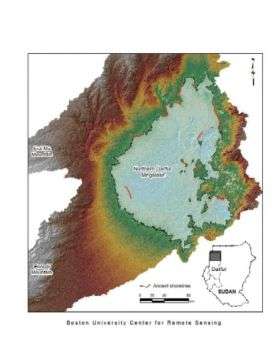
Researchers at the Boston University Center for Remote Sensing used recently acquired topographic data from satellites to reveal a now dry, ancient mega-lake in the Darfur province of northwestern Sudan. Drs. Eman Ghoneim and Farouk El-Baz made the finding while investigating Landsat images and Radarsat data. Radar waves are able to penetrate the fine-grained sand cover in the hot and dry eastern Sahara to reveal buried features.
Segments of the lake’s shoreline were identified at the constant altitude of 573 ± 3 meters above sea level. Ghoneim incorporated these segments with the Shuttle Radar Topography Mission (SRTM) data into a Geographical Information System to reconstruct the lake and the ancient river courses that led to it. At its maximum extent, the lake occupied an area of about 30,750 km2 (larger than the area of Massachusetts) and would have contained approximately 2,530 km3 when full of water in the past.
The researchers made no inferences regarding the age of the lake; however, its vast extent suggests that it existed for a long period of time when rainfall was plentiful in the eastern Sahara.
“Field investigations and samples will determine the exact age of the lake,” said El-Baz, director of the Boston University Center for Remote Sensing. “One thing is certain – much of the lake’s water would have seeped through the sandstone substrate to accumulate as groundwater.”
“This ancient lake, which represents indisputable evidence of the past rainy conditions in the eastern Sahara, will have significant consequences for improving our knowledge of continental climate change and regional palaeohydrology,” said Ghoneim.
According to the researchers, mapping the site of the former lake, named the Northern Darfur Mega-lake, will help with groundwater exploration efforts in the Darfur region, where access to fresh water is essential for refugee survival.
As proven by El-Baz in Egypt, just north of Darfur, former lakes in this part of the Sahara are underlain by vast amounts of groundwater. His earlier detection of the “East Uweinat” basin in southwestern Egypt – where the groundwater rises to 25 meters below the surface – resulted in the drilling of 500 wells to irrigate 100,000 acres of agricultural land.
“Such large sedimentary basins have potential not only in groundwater resources, but also oil and gas resources at depth,” said El-Baz.
A paper detailing the discovery will be published in an upcoming issue of the International Journal of Remote Sensing.
The Boston University Center for Remote Sensing is a research facility that was established in 1986. Researchers at the Center apply techniques of remote sensing and geographic information systems (GIS) to research in the fields of archaeology, geography and geology. In 1997, the Center was recognized by NASA as a “Center of Excellence in Remote Sensing.”
Founded in 1839, Boston University is an internationally recognized institution of higher education and research. With more than 30,000 students, it is the fourth largest independent university in the United States. BU contains 17 colleges and schools along with a number of multi-disciplinary centers and institutes, which are central to the school’s research and teaching mission.
Source: Boston University


