Gold nanorods assemble themselves into rings
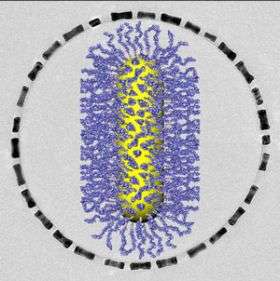
Rice University chemists have discovered that tiny building blocks known as gold nanorods spontaneously assemble themselves into ring-like superstructures.
This finding, which will be published as the inside cover article of the March 19 international edition of the chemistry journal Angewandte Chemie, could potentially lead to the development of novel nanodevices like highly sensitive optical sensors, superlenses, and even invisible objects for use in the military.
"Finding new ways to assemble nano-objects into superstructures is an important task because at the nanoscale, the properties of those objects depend on the arrangement of individual building blocks," said principal investigator Eugene Zubarev, the Norman Hackerman-Welch Young Investigator and assistant professor of chemistry at Rice.
Although ring-like assemblies have been observed in spherical nanoparticles and other symmetrical molecules, until now such structures had not been documented with rod-shaped nanostructures.
Like many nanoscale objects, gold nanorods are several billionths of a meter, or 1,000 times smaller than a human hair. Zubarev used hybrid nanorods for this research because attached to their surface are thousands of polymer molecules, which are flexible chainlike structures. The central core of the nanorods is an inorganic crystal, but the polymers attached to the outside are organic species. The combination of the inorganic and organic features resulted in a hybrid structure that proved to be critical to the study.
Working with Rice graduate student Bishnu Khanal, Zubarev placed the nanorods in a solution of organic solvent called chloroform. As the chloroform evaporated, its surface temperature dropped low enough to cause condensation of water droplets from the air, much like how dew forms. As thousands and thousands of microdroplets of water formed on the surface of the liquid chloroform, the nanorods that had been suspended in the solution started to press up against the round droplets and form rings around them. The polymer coating prevented the rods from being absorbed into the droplets because it is insoluble in water.
After the droplets evaporated, the nanorods remained in their ring formation.
"When nanorods are organized into a ring, significant changes in their optical and electromagnetic properties occur," Zubarev said. "These can have technological applications in the area of metamaterials, which have enormous potential in opto-electronics, communications and military applications." Zubarev said thousands of well-defined rings can be produced in a matter of seconds using the approach from his study. "This method is surprisingly simple and can be used for organizing nanocrystals of various shapes, size and chemical composition into circular arrays."
Source: Rice University


