February 21, 2007 feature
Maglev launch assist technology may enable commercial space travel
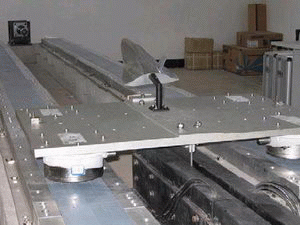
The same technology used in magnetically levitated ("maglev") trains may give spaceships a low-cost, stable boost for the future of space travel—possibly even for joy rides. A research group from two universities in Beijing, China has constructed a maglev test vehicle that works on a model track made of a permanent magnet-high temperature superconductor (PM-HTS).
With a typical launch cost for a spaceship around $20 million, it’s difficult to practically conceive of a space industry beyond federally funded agencies. Nevertheless, many people believe that expanding space travel—whether for research purposes, entertainment, or even colonization—is not impractical. Bridging the economic hurdle may be technologies such as the maglev launch assist. According to an analysis, the cost of launching payloads into the low earth orbit with maglev may be achieved with only hundreds of dollars per pound (John Olds and Peter Bellini).
Most recently, researchers in a group including Wenjiang Yang and his colleagues from the Beijing University of Aeronautics and Astronautics and the Chinese Academy of Sciences have investigated the possibility of the “Maglifter,” a maglev launch assist vehicle originally proposed in the 1980s. In this system, a spaceship would be magnetically levitated over a track and accelerated up an incline, lifting off when it reaches a velocity of 1,000 km/hr (620 miles/hr). The main cost-saving areas would come from reduced fuel consumption and the reduced mass of the spaceship.
“Magnetic levitation is a promising technology for future space transportation,” Yang told PhysOrg.com. “The most expensive part of space missions to low-Earth orbit is the first few seconds—getting off the ground.”
In their model of a test vehicle on a seven-meter-long track, Yang’s group used a suspension system based on bulk high temperature superconductors, which achieve highly stable levitation due to their diamagnetic and flux pinning properties. The researchers used an arrangement of YBCO bulk superconductors, which achieve their remarkable property of zero resistance at 77 K. When the superconductors were cooled to this temperature, the test vehicle levitated freely over the track.
“The maglev launch assist benefits from the large levitation ability for heavy loads and a linear motor’s acceleration technology, as in the maglev train,” Yang explained. “In this investigation on the feasibility of the PM-HTS maglev technology, the test vehicle weighed 40kg and was moved on the 7-meter-long track. A running velocity of 5m/s was achieved with an acceleration of 1.2g (gravity).”
Because the permanent magnets and irons which make up the track create an inhomogeneous magnetic field distribution, superconductors located at different positions created different amounts of levitation. By applying four sensors to their test vehicle, the researchers compared field gradients of different YBCO bulk arrangements and determined the optimal arrangement: one with YBCO bulks located both on top of the center iron rails of the track and in between the center rails.
Yang’s group also found that the lower “field-cooled height” (the height of the cooled magnetic field over the track), the greater stability the vehicle possessed. The researchers explained that this correlation is because a low field-cooled height allows the YBCO superconductors to trap more flux, the main guidance force influencing stability. Although a low field-cooled height also results in lower levitation, the researchers found that an increased amount of YBCO superconductors would provide a safer yet effective alternative for increasing levitation height.
“We think that the largest challenge of the maglev launch assist may be the dynamic stability of the maglev launch vehicle at high speeds, especially the stability affected by the aerodynamics,” said Yang. “That’s why we suggested the PM-HTS maglev system use a low cooled-height for bulk superconductors.
Yang also said that the future goal of maglev launch assist would be to build a space vehicle and maglev sled—together weighing 100 tons—and accelerate them to a velocity of 255 m/s (918 km/hr).
“The energy result would be about 2600 kw•hr, which is a very small energy cost compared with other launch technologies, such as a pneumatic acceleration system,” Yang explained. “Key challenges for this maglev launch assist are the linear motor’s acceleration system and its power supply system, which are required to provide an acceleration of 2g-3g (gravity).”
As Yang explained, the future of maglev launch assist in action may occur within our lifetime.
“Magnetic levitation using superconductors dates from the 1960s,” Yang said. “Since that time, various research and development programs aimed at developing superconducting maglev technology for high-speed urban rail transport have been in progress in the U.S., Japan, and Germany. For example, both the Japanese and Germans have demonstrated maglev systems at speeds of 0.15 km/s (550 km/hr) on open-air tracks, which is about one-half that required for the maglev launcher. Therefore, with steady progress, it’s very possible that this maglev technology could be used in space launches within 20 to 30 years. On the other hand, the achievement of the maglev launch assist also depends largely on the development of the advanced space transportation system, especially a recoverable spaceship which could offer low-cost space travel for more people.”
Citation: Yang, Wenjiang, Qiu, Ming, Liu, Yu, Wen, Zheng, Duan, Yi, and Chen, Xiaodong. “Levitation characteristics in an HTS maglev launch assist test vehicle.” Superconductor Science and Technology, 20 (2007) 281-286.
By Lisa Zyga, Copyright 2007 PhysOrg.com.
All rights reserved. This material may not be published, broadcast, rewritten or redistributed in whole or part without the express written permission of PhysOrg.com.


