Building a Molecular Computer Chip

Feb 13, 2007

For Dr. Jerry Bernholc, a trip to Oak Ridge National Laboratory (ORNL) is like a suburbanite’s trek to Costco. Bulk consumption is the name of the game.

Bernholc, the Drexel Professor of Physics at North Carolina State University, spends more hours conducting research on supercomputers each year than all but a handful of U.S. scientists. Using the powerful computers – like ORNL’s -- to crunch numbers is the only way to get results for the complex calculations he uses to study molecules.
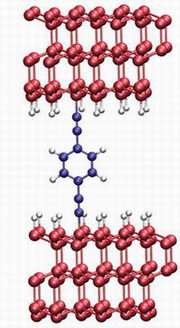
Building a Molecular Computer Chip
Bernholc´s research has shown that a benzine molecule, in blue, can act as a very fast switch in a transistor when conected to silicon leads, in red. Illustration courtesy of Dr. Jerry Bernholc.

Bernholc is trying to keep intact one of technology’s great streaks—Moore’s Law. Gordon Moore, the co-founder of semiconductor giant Intel, predicted in 1965 that the number of transistors the industry would be able to fit onto a computer chip would double every 18 months. The prediction has become a guiding principle for the semiconductor industry, which continually delivers more powerful chips. But upholding Moore’s Law for 40 years has pushed the industry to the brink of running out of space on computer chips.

“The limits of standard silicon technology are coming into play,” Bernholc says. “Beyond 2011 or 2012, the industry has some ideas for future growth, but it has no roadmap to get there.”

So Bernholc is pointing the industry in the direction of molecular technology. His computer simulations have demonstrated that many small molecules exhibit a property known as negative differential resistance. As voltage is increased, the current flowing through molecules drops, Bernholc says, meaning they can be used as switches. Previously, scientists thought negative differential resistance was limited to just a few molecules.

“Designers can focus on processing semiconductors instead of trying to arrange specific molecules, which is difficult at the nanoscale level,” he says. Bernholc also is working with a scientist from his native Poland on “spin electronics”—understanding and devising materials where the spin of electrons is used to control the flow of electricity.

ORNL, where Bernholc holds the title of Visiting Distinguished Scientist, already has one of the fastest supercomputers in the world, but is looking for a system a hundred times more powerful. Bernholc’s research might play a role in developing such a system.

“I’m looking at faster transistors, which could produce faster computers, which would then allow me to do simulations on even faster transistors,” he says with a laugh. “It could be an endless loop, but much more study is needed to understand molecular electronics before we can actually produce these transistors.”

For more information, please visit chips.ncsu.edu/~bernholc/

Source: NC State University

Explore further: Error sought & found: State-of-the-art measurement technique optimised

add to favorites email to friend print save as pdf

Related Stories

How gold nanoparticles can help fight ovarian cancer

17 minutes ago

Positively charged gold nanoparticles are usually toxic to cells, but cancer cells somehow manage to avoid nanoparticle toxicity. Mayo Clinic researchers found out why, and determined how to make the nanoparticles effective ...

Yahoo-Tumblr is among top 10 tech deals in 2013

25 minutes ago

Yahoo has agreed to pay $1.1 billion to buy blogging forum Tumblr, ranking it in among the top 10 tech deals announced this year, according to research firm Dealogic. Here's a list of the top 10 tech mergers and acquisitions ...

Building a better team—on Mars

33 minutes ago

Sometime in the next quarter-century, NASA plans to send the first humans to Mars, a mission that will push the boundaries of teamwork for a handful of astronauts who will spend as long as three years together ...

Recommended for you

Engineers pioneer flat spray-on optical lens

17 hours ago

A University of British Columbia engineer and a team of U.S. researchers have made a breakthrough utilizing spray-on technology that could revolutionize the way optical lenses are made and used.

How do cold ions slide

20 hours ago

Things not always run smoothly. It may happen, actually, that when an object slides on another, the advancement may occur through a 'stop and go' series in the characteristic manner which scientists call ...

User comments : 0

More news stories

A quantum simulator for magnetic materials

Physicists understand perfectly well why a fridge magnet sticks to certain metallic surfaces. But there are more exotic forms of magnetism whose properties remain unclear, despite decades of intense research. ...

Engineers pioneer flat spray-on optical lens

A University of British Columbia engineer and a team of U.S. researchers have made a breakthrough utilizing spray-on technology that could revolutionize the way optical lenses are made and used.

Researchers forward quest for quantum computing

Research teams from UW-Milwaukee and the University of York investigating the properties of ultra-thin films of new materials are helping bring quantum computing one step closer to reality.

How do cold ions slide

Things not always run smoothly. It may happen, actually, that when an object slides on another, the advancement may occur through a 'stop and go' series in the characteristic manner which scientists call ...

Controlling mood through the motions of mitochondria

(Medical Xpress)—Regulating the distribution of power in neurons is done by a system that makes the national electric grid look simple by comparison. Each neuron has several thousand mitochondria confined ...

A hidden population of exotic neutron stars

(Phys.org) —Magnetars – the dense remains of dead stars that erupt sporadically with bursts of high-energy radiation - are some of the most extreme objects known in the Universe. A major campaign using ...