Opposites Attract: Saturn Lures Earthly Admirers
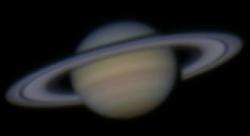
The ringed planet captured by Saturn Observation Campaign members Jeff Barton and Josh Walawender. Credit: Barton and Walawender
The idea that opposites attract may be a romantic cliché. But when Saturn is at opposition, as it will be this month, it is most certainly an attraction for Saturn-watchers around the world.
Opposition is when the Sun and Saturn are lined up directly across from each other with Earth in the center. This year opposition occurs on Saturday, Feb. 10, just a few days before Valentine's Day. It's the time when Saturn comes closest to Earth and is easiest to see from our terrestrial vantage point. It puts Saturn back in the evening sky for viewing until June 2007.
Saturn's admirers are taking advantage of this opportunity. "I'm calling it a Saturn-a-thon," says Jane Houston Jones, of the events planned for observing Saturn during opposition this coming Saturday, a day named, incidentally for the same Roman god as the ringed planet. Jones heads up JPL's Saturn Observation Campaign, an international group of volunteers who share with the public their enthusiasm for viewing the ringed beauty, both through ground-based telescopes and the instruments onboard the Cassini spacecraft. The program includes more than 350 members, many of whom are amateur astronomers, in 45 U.S. states and 52 countries.
There are going to be Saturn-viewing events all around the world," Jones says, "from California, Wisconsin and North Carolina to New Zealand, Peru and Argentina. More than 20 events have been planned for Germany alone."
"The idea for the Saturn Observation Campaign to plan a worldwide observing night came from Bob Larcher of the European Association for Astronomy Education," Jones says. "We tried to get as many members as possible to organize events on the same night, and then we'll share images, photographs, drawings, poems, and notes afterward. This is our first try, and we'll do it again next year."
When Saturn comes in for its close-up with Earth, the period just before and after are good times to see the planet. "This year, January through June are the best months to view Saturn," explains Jones. "In February, it rises at sunset and sets at dawn, so you don't have to get up in the middle of the night to see it. You can start looking for it as soon as the Sun sets. It is easy to see even from the city. Saturn will be a great target for many months to come. Observers in colder climes will appreciate that!"
Since Saturn tilts on its axis, as does Earth, it appears to wear its rings at different angles depending on its relationship to Earth. "We had a nearly edge-on view of the rings in 1995 and 1996," says Jones. "The ring tilt increased year by year to a maximum tilt of 27 degrees in early 2003. Since then, the tilt of the rings has been decreasing and will keep closing slightly each year until 2009, when we'll again see an edge-on, or nearly invisible view of the rings." This year, Jones says, the tilt of the rings will narrow from 15.4 degrees to 6.7 degrees by December.
"Saturn is brighter this year than it will be until 2015," explains Jones, "due to a slight dimming as the ring tilt becomes more narrow and Saturn's distance from Earth increases."
The Cassini, spacecraft of course, now in its third year orbiting in the Saturnian system, doesn't have the same constraints as observers from Earth and continues to provide spectacular images of what has been called the most beautiful planet in our solar system.
"As wonderful as the Cassini images of Saturn are," says Jones, "it is still incredibly exciting to look through a telescope and see this spectacular planet with your own eyes."
For more information on the Saturn Observing Campaign, go to http://soc.jpl.nas … ov/index.cfm
Source: NASA
-
From lemons to lemonade: Reaction uses carbon dioxide to make carbon-based semiconductor,
32 comments
-
Thioridazine kills cancer stem cells in human while avoiding toxic side-effects of conventional cancer treatments,
3 comments
-
SpaceX private rocket blasts off for space station (Update),
42 comments
-
Climate scientists say they have solved riddle of rising sea,
31 comments
-
SpaceX capsule has 'new car' smell, astronauts say (Update),
4 comments
-
Distance of planets from stars and revolution
11 hours ago
-
revamping general concept and cosmological principle
May 25, 2012
-
Transiting Exoplanet Light Curve
May 25, 2012
-
Math behind Theoretical Physics
May 24, 2012
-
Do we know whats at the center of galaxies yet?
May 23, 2012
-
Structure of the Milky Way?
May 20, 2012
- More from Physics Forums - General Astronomy
More news stories
Land and sea species differ in climate change response: study
(Phys.org) -- Marine and terrestrial species will likely differ in their responses to climate warming, new research by Simon Fraser University and Australia’s University of Tasmania has found.
8 hours ago |
4 / 5 (5) |
6
|
Yale study concludes public apathy over climate change unrelated to science literacy
Are members of the public divided about climate change because they don't understand the science behind it? If Americans knew more basic science and were more proficient in technical reasoning, would public consensus match ...
10 hours ago |
4.8 / 5 (6) |
26
|
10 million years needed to recover from mass extinction
It took some 10 million years for Earth to recover from the greatest mass extinction of all time, latest research has revealed.
Space & Earth / Earth Sciences
10 hours ago |
4.2 / 5 (5) |
2
|
Sophisticated simulations predict future warming
The chances of our planet being hit by a global warming of 3 degrees Celsius by 2050 is as likely as it being hit by an increase of 1.4 degrees, new research shows. Presented in the journal Nature Geoscience, the British study ...
Space & Earth / Earth Sciences
May 22, 2012 |
3.8 / 5 (11) |
51
Aliens don't want to eat us, says former SETI director
Alien life probably isnt interested in having us for dinner, enslaving us or laying eggs in our bellies, according to a recent statement by former SETI director Jill Tarter.
Space & Earth / Space Exploration
May 25, 2012 |
4.4 / 5 (15) |
41
'Unzipped' carbon nanotubes could help energize fuel cells, batteries
Multi-walled carbon nanotubes riddled with defects and impurities on the outside could replace some of the expensive platinum catalysts used in fuel cells and metal-air batteries, according to scientists at ...
Change in developmental timing was crucial in the evolutionary shift from dinosaurs to birds: study
At first glance, it's hard to see how a common house sparrow and a Tyrannosaurus Rex might have anything in common. After all, one is a bird that weighs less than an ounce, and the other is a dinosaur that ...
Computer model used to pinpoint prime materials for efficient carbon capture
When power plants begin capturing their carbon emissions to reduce greenhouse gases and to most in the electric power industry, it's a question of when, not if it will be an expensive undertaking.
T cells 'hunt' parasites like animal predators seek prey, study shows
By pairing an intimate knowledge of immune-system function with a deep understanding of statistical physics, a cross-disciplinary team at the University of Pennsylvania has arrived at a surprising finding: T cells use a movement ...
Stunning image of smallest possible five-ringed structure
Scientists have created and imaged the smallest possible five-ringed structure about 100,000 times thinner than a human hair and you'll probably recognise its shape.
Browser wars flare in mobile space
The browser wars are heating up again, but this time the fight is for dominance of the mobile Internet.