3-D model shows big body of water in Earth's mantle
Feb 08, 2007
3-D seismic model of vast water reservoir revealed
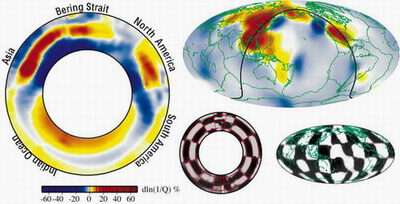
One of the most dramatic features in the Wysession et. al global mantle shear-wave attenuation model is a very high-attenuation anomaly at the top of the lower mantle beneath eastern Asia. This anomaly is believed due to water that has been pumped into the lower mantle via the long history of the subduction of oceanic lithosphere — crust and upper mantle — in this region. The left figure is a slice through the earth, showing the attenuation anomalies within the mantle. The location of the slice — red line in the upper right figure — is a map of the seismic attenuation at a depth of roughly 620 miles. In both images, red shows unusually soft and weak rock, and blue shows unusually stiff rock (yellow and white show near-average values). The two figures in the lower right are resolution tests to see if the data have the resolution to retrieve Earth structure in these parts of the Earth. The sharper the black-white transitions are, the better the resolution is. Credit: Washington University in St. Louis

A seismologist at Washington University in St. Louis has made the first 3-D model of seismic wave damping — diminishing — deep in the Earth's mantle and has revealed the existence of an underground water reservoir at least the volume of the Arctic Ocean. It is the first evidence for water existing in the Earth's deep mantle.

Michael E. Wysession, Ph.D., Washington University professor of earth and planetary sciences in Arts & Sciences, working with former graduate student Jesse Lawrence (now at the University of California, San Diego), analyzed 80,000 shear waves from more than 600,000 seismograms and found a large area in Earth's lower mantle beneath eastern Asia where water is damping out, or attenuating, seismic waves from earthquakes.

The traditional method seismologists use to image the Earth below us is to measure the speed of seismic waves. This will provide a sort of CAT scan of the Earth's core and mantle. Using wave speeds alone is a problem, however, because they cannot distinguish between temperature and composition variations.

The research is described in a forthcoming monograph, Earth's Deep Water Cycle, which is in press to be published by the American Geophysical Union.

Analyzing damped-out waves

An increasingly popular method, which Wysession used, is to analyze the way waves damp out from their source. If you take a hammer and pound it hard on a desk, waves will go from the source to the end of the table with the mass of the table lessening, or attenuating, the power of waves. A picture near the striking point might topple, but a stapler two feet away might not even budge. Attenuation data tell seismologists how stiff a region is, which is a function of how hot it is and how much water it contains. Looking at the seismic wave speeds and attenuation at the same time can tell whether an anomaly is due to temperature or water.

In analyzing the data, Wysession first saw large patterns associated with known areas where the ocean floor is sinking down into the earth. Beneath Asia, the fallen Pacific sea floor piles up at the base of the mantle. Right above that he observed an "incredibly highly attenuating region, that is both very damping and slightly slow," he said. "Water slows the speed of waves a little. Lots of damping and a little slowing match the predictions for water very well."

Previous predictions calculated that a cold ocean slab sinking into the earth at 1,200 to 1,4000 kilometers beneath the surface would release water in the rock that would escape the rock and rise up to a region above it, but this was never previously observed.

Beijing anomaly

"That is exactly what we show here, the exact depth and high attenuation amounts right above it," Wysession said. "I call it the Beijing anomaly. Water inside the rock goes down with the sinking slab and it's quite cold, but it heats up the deeper it goes, and the rock eventually becomes unstable and loses its water. The water then rises up into the overlying region, which becomes saturated with water.

"If you combine the volume of this anomaly with the fact that the rock can hold up to about 0.1 percent of water, that works out to be about an Arctic Ocean's worth of water."

In recent years, seismologists have become excited at the possibility of a feature like the Beijing anomaly. The availability of vast amounts of digital seismograms made possible the discovery by Wysession and Lawrence, who wrote many thousands of lines of computer codes to do the analyses.

Seventy percent of the earth is covered by water, which is very important for the earth's geology, serving as a lubricant that allows efficient convection and plate tectonics and the continental collisions that form mountains.

"Water is like a lubricant, constantly oiling the machine of mantle convection which then drives plate tectonics and causes the continents to move about Earth's surface," Wysession said. "Look at our sister planet, Venus. It is very hot and dry inside Venus, and Venus has no plate tectonics. All the water probably boiled off, and without water, there are no plates. The system is locked up, like a rusty Tin Man with no oil."

Source: Washington University in St. Louis, By Tony Fitzpatrick

Explore further: Alaska volcano shoots ash 15,000 feet into the air

add to favorites email to friend print save as pdf

Related Stories

Developing a clearer understanding of ocean ecosystems

May 08, 2013

The EU-funded HERMIONE project ('Hotspot Ecosystem Research and Man's Impact on European Seas') has contributed much needed data on the complexity of deep-sea ecosystems. This in turn has created a community ...

Weather forecasts on Mars

May 08, 2013

(Phys.org) —In the north of the red planet snowfalls occur with great regularity. Expeditions of Mars rovers into this region could therefore be easily planned.

Sounding rocket mission to study what disrupts radio waves

Apr 25, 2013

(Phys.org) —A NASA-funded sounding rocket mission will launch from an atoll in the Pacific in the next few weeks to help scientists better understand and predict the electrical storms in Earth's upper atmosphere ...

Recommended for you

Alaska volcano shoots ash 15,000 feet into the air

20 hours ago

(AP)—One of Alaska's most restless volcanoes has shot an ash cloud 15,000 feet into the air in an ongoing eruption that has drawn attention from a nearby community but isn't expected to threaten air traffic.

NASA sees Cyclone Mahasen hit Bangladesh

May 17, 2013

NASA's Tropical Rainfall Measuring Mission satellite known as TRMM measured Cyclone Mahasen's rainfall rates from space as it made landfall on May 16. Mahasen has since dissipated over eastern India.

Rapid climate change ruled out ice age trees

May 17, 2013

Short, sharp fluctuations in the Earth's climate throughout the last ice age may have stopped trees from getting a foothold in Europe and northern Asia, scientists say.

Earth's iron core is surprisingly weak, researchers say

May 17, 2013

The massive ball of iron sitting at the center of Earth is not quite as "rock-solid" as has been thought, say two Stanford mineral physicists. By conducting experiments that simulate the immense pressures deep in the planet's ...

User comments : 0

More news stories

Galaxy's Ring of Fire

Johnny Cash may have preferred this galaxy's burning ring of fire to the one he sang about falling into in his popular song. The "starburst ring" seen at center in red and yellow hues is not the product of ...

Alaska volcano shoots ash 15,000 feet into the air

(AP)—One of Alaska's most restless volcanoes has shot an ash cloud 15,000 feet into the air in an ongoing eruption that has drawn attention from a nearby community but isn't expected to threaten air traffic.

Chinese, Indian airlines face EU pollution fines

Eight Chinese and two Indian airlines face fines of up to several million euros for not paying for their greenhouse gas emissions during flights within the bloc, the European Commission said on Friday.

Morocco to harness the wind in energy hunt

Morocco is ploughing ahead with a programme to boost wind energy production, particularly in the southern Tarfaya region, where Africa's largest wind farm is set to open in 2014.

US seizes Bitcoin operator accounts

US authorities seized the accounts of a Bitcoin digital currency exchange operator, claiming it was functioning as an "unlicensed money service business," court documents showed Friday.