February 8, 2007 feature
Scientists discover first fossil of a leaf insect
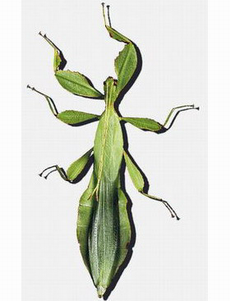
Stick and leaf insects both belong to the insect order “Phamatodea,” or “phasmid” for short, a term which shares the same roots as the word “phantom.” Besides appropriately describing the species’ illusory presence mimicking natural flora, the rare leaf insect was proving to be illusive to scientists in search of the history behind the leaf insects—namely, through a complete absence of fossils.
But recently, scientists Sonja Wedmann and Jes Rust from the Institute for Paleontology in Bonn, Germany, and Sven Bradler from the Institute for Zoology in Goettingen, Germany, have unearthed the first recorded fossil of a 2.4-inch (63-mm) male leaf insect. The nearly complete fossil comes from deposits from a pit that was formerly a deep maar lake in Messel, Germany.
While all leaf insect species today live in southeast Asia, the scientists predict that warmer past climates extended their habitats to places such as Messel. Wedmann and her colleagues named the fossil Eophyllium messelensis, derived from its age (Eocene epic), its genus (Phyllium), and the fossil site.
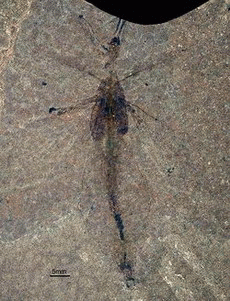
One of the most striking parts of the discovery is that the sediment deposit where the scientists found the fossil was radiometrically dated at 47 million years old (the Eocene epic in the Cenozoic era spans 56-44 mya). This means that the minimum age of the origin of leaf insects is 47 million years.
“Most unexpected was that there existed a leaf imitating insect as early as 47 million years ago,” Wedmann told PhysOrg.com. “This fossil sets a calibration point to the evolution of leaf insects because they were never found as fossils before. Together with two other fossils from Baltic amber, it is the oldest fossil record of determined adult representatives of phasmids.”
Because leafy angiosperm plants mimicked by phasmids arose in the middle of the Cretaceous (125-90 mya, not too long before the final days of the dinosaurs), this date range places a maximum age limit on leaf insects. But scientists still aren’t sure whether leaf insects appeared earlier, in the Cretaceous, and took a while to evolve their unique camouflage morphology and behavior, or whether they appeared later, in the Eocene, and evolved rapidly.
It’s also possible that the stick species evolved earlier than the leaf species, and were the ancestors of the leaf types. Wedmann et al.’s fossil, in fact, has some intermediate features between typical stick insects and extant (current) leaf insects. For example, the curved front femora form a notch for the head when the insect enters catalepsy (extreme stillness)—a feature common to stick insects but absent in extant leaf insects.
“Another hypothesis for the phylogenetic position of leaf insects suggested that they have a very basal placement among phasmids,” said Wedmann. “But Eophyllium shows that the straight fore femora and the absence of tergal thorn pads in extant leaf insects is a secondary condition, because Eophyllium has both curved fore femora and tergal thorn pads. So now it can be assumed that leaf insects descend from stick-insect like ancestors.”
One thing that Wedmann et al.’s discovery does show, however, is that little has changed with leaf insects during the last 47 million years. Though the fossil has a few differences, it bears a considerable resemblance to extant leaf insects in the size and shape of its segments. This specialized cryptic behavior and morphology, the scientists say, exemplifies evolutionary stasis.
“The fossil shows a specialized form of foliaceous appearance that mimics angiosperm leaves,” said Wedmann. “This allows the inference that a correlated behavior was also present; that is, these insects remained practically motionless during daylight and performed slight rocking motions when disturbed. This is what perfects the camouflage of their extant relatives.”
The scientists explain that the evolution of leaf insect mimicry is due to intense selection pressure by visually-oriented predators—especially birds, but also lizards, and early primates. Phasmids are fragile, and wouldn’t have many other defensive strategies besides camouflage.
Part of the challenge—and intrigue—in researching leaf insects is their rarity. While more than 3,000 phasmids are species with elongate bodies, only 37 are leaf-imitating species. However, as the scientists note, the Eocene epic experienced a burst of new insect species, and like E. messelensis, many of them are still waiting to be discovered.
Citation: Wedmann, Sonja, Bradler, Sven, and Rust, Jes. “The first fossil leaf insect: 47 million years of specialized cryptic morphology and behavior.” Proceedings of the National Academy of Sciences. January 9, 2007. Vol. 104. no. 2. 565-569.
By Lisa Zyga, Copyright 2007 PhysOrg.com.
All rights reserved. This material may not be published, broadcast, rewritten or redistributed in whole or part without the express written permission of PhysOrg.com.


